Why Every AI-Native Enterprise Needs a Control Plane

As AI moves from copilots to autonomous agents, enterprises need a new operating layer for visibility, governance, security, and real-time control.
The enterprise AI stack is changing
For the last decade, enterprise technology leaders have been focused on cloud transformation, data modernization, application modernization, and digital workflows.
Now a new transformation is underway: AI-native transformation.
This is not just about adding a chatbot to an existing application. It is not just about giving employees access to a large language model. And it is not just about automating a few tasks with copilots.
AI-native transformation means enterprises are beginning to operate with intelligent systems that can reason, retrieve information, call tools, initiate workflows, write code, analyze data, interact with customers, and make recommendations in real time.
In other words, AI is moving from passive assistance to active participation.
That shift creates a new enterprise requirement:
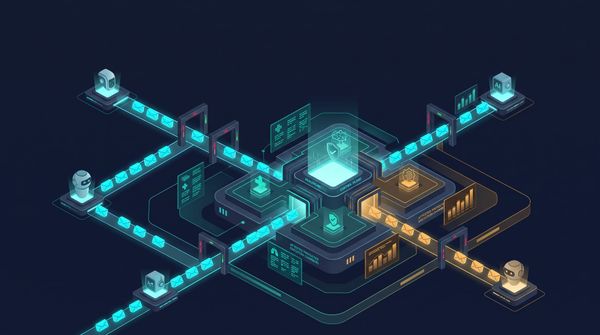
If AI agents can observe, decide, and act across the business, then the enterprise needs a control plane to govern how those agents behave.
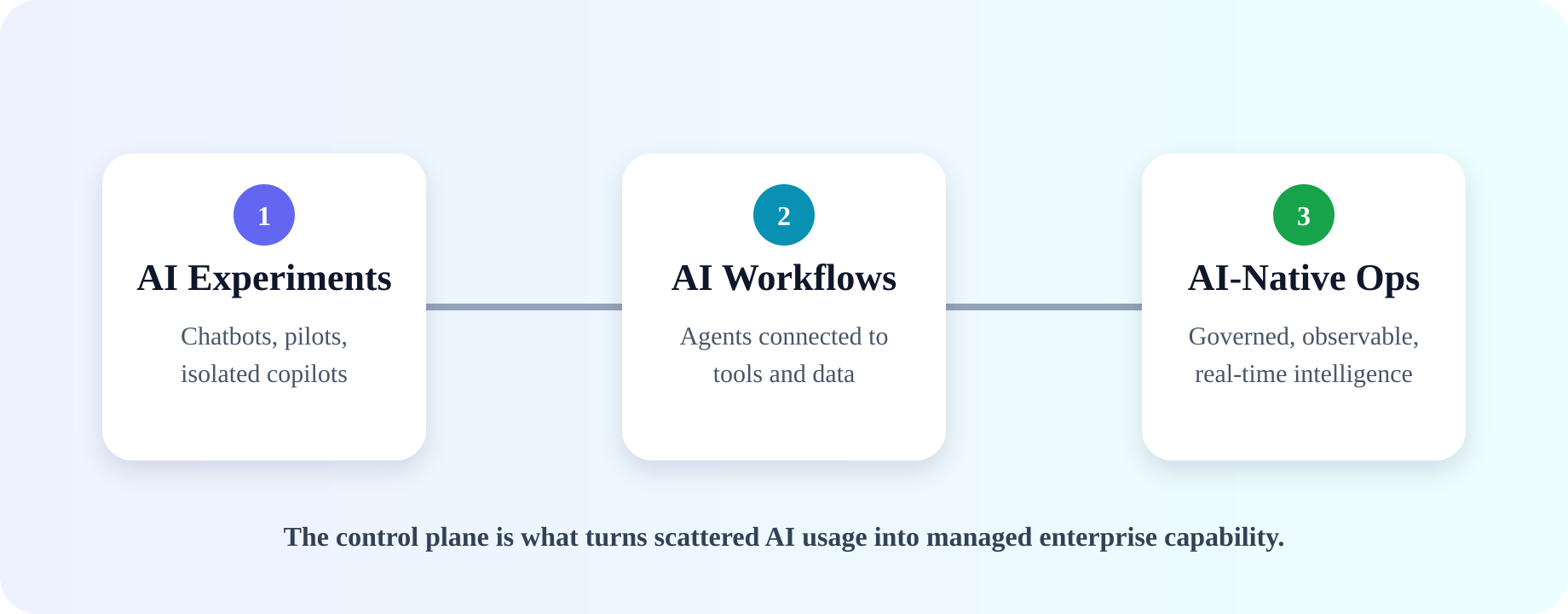
Without it, AI-native transformation becomes a collection of disconnected experiments: powerful, promising, and increasingly difficult to secure.
What is a control plane?
In cloud infrastructure, the control plane is the layer that manages configuration, policy, orchestration, access, and operational state. It does not necessarily do the application work itself, but it governs how the work is coordinated.
The same pattern is now emerging in enterprise AI.
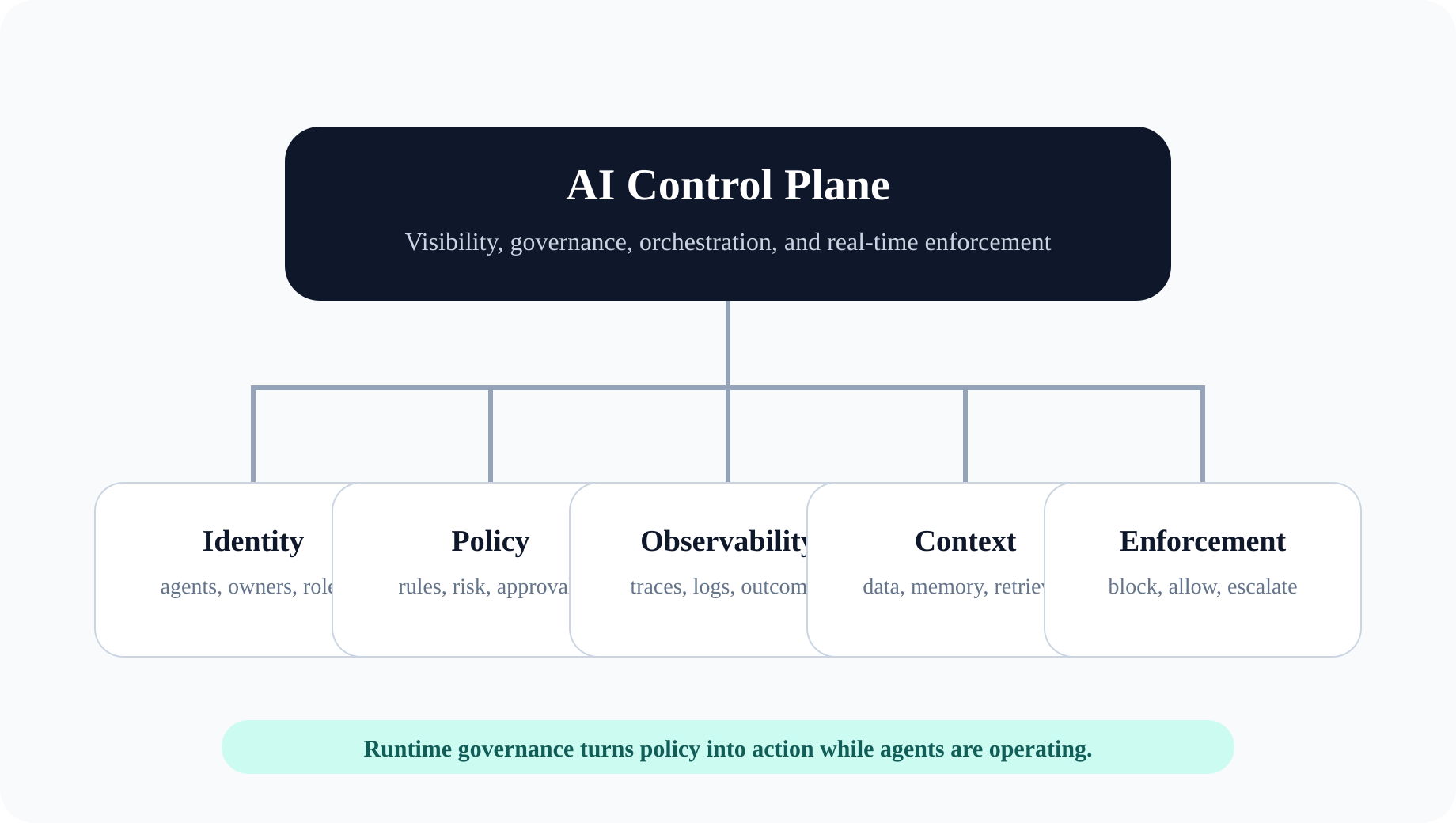
An AI control plane is the intelligence and governance layer that gives an organization visibility and control over AI systems, agents, models, tools, data access, workflows, and decisions.
It answers questions like:
- Which agents are running?
- What tools can they use?
- What data can they access?
- What actions are they allowed to take?
- Which decisions require approval?
- What happened during an AI-driven workflow?
- Was the agent operating within policy?
- Can the organization intervene in real time?
These questions become urgent as AI systems become more autonomous.
A traditional application waits for a user to click a button. An AI agent may interpret intent, select a tool, retrieve sensitive information, execute a workflow, summarize the outcome, and trigger the next step.
That is a fundamentally different operating model.
And it requires a fundamentally different governance model.
The problem with fragmented enterprise AI
Most enterprises are not adopting AI through one clean, centralized system.
They are adopting it everywhere at once.
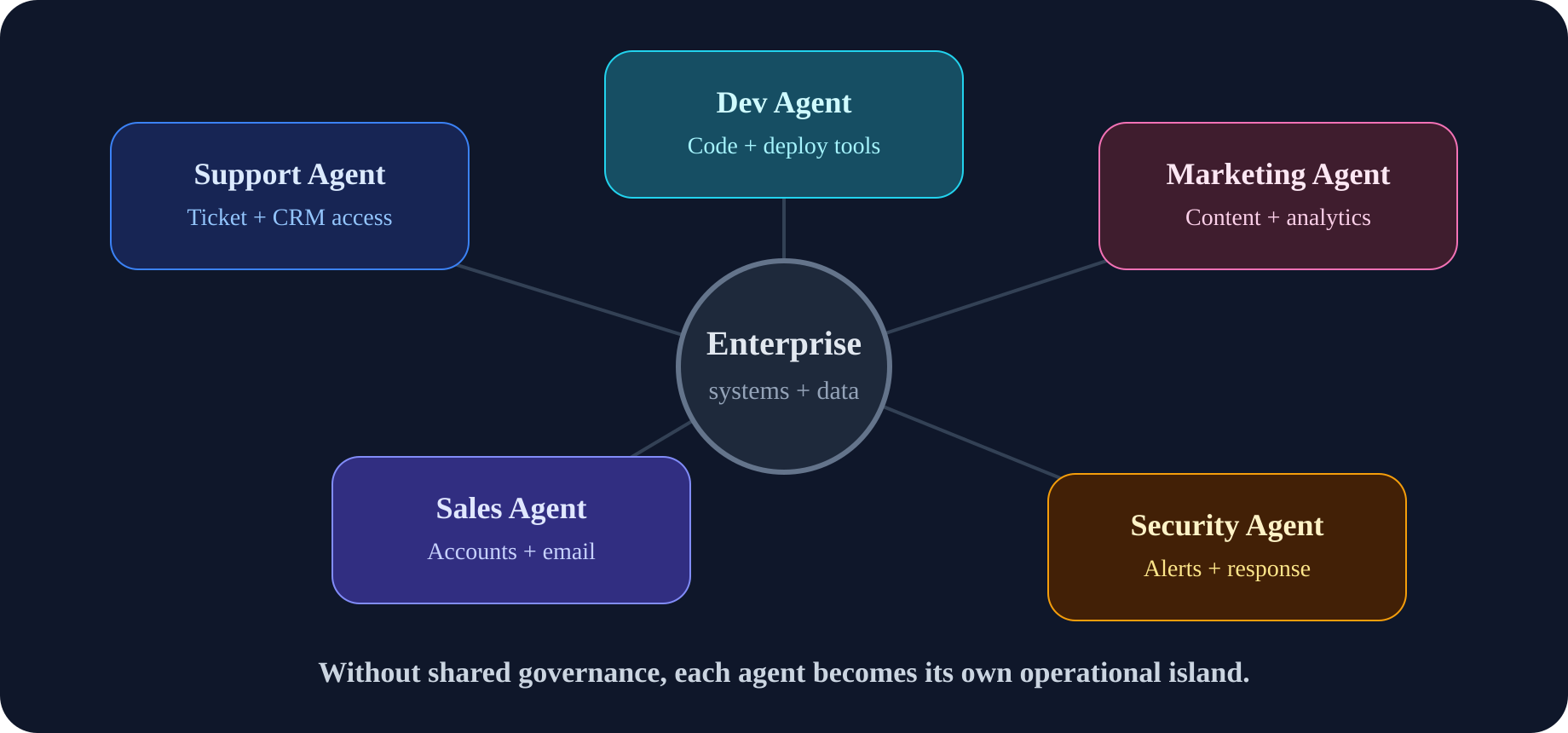
Marketing teams are testing content agents. Sales teams are using AI for account research. Security teams are piloting alert triage. Developers are using coding assistants. Customer support teams are adding AI to ticket workflows. Operations teams are exploring autonomous process automation.
Each of these initiatives may be valuable. But together, they create a growing web of models, prompts, agents, plugins, APIs, SaaS integrations, vector databases, internal tools, and data connections.
The result is often an AI environment with too little shared visibility.
You may know which applications your company has approved. But do you know which AI agents are acting inside them? Do you know what those agents are allowed to do? Do you know when they cross a risk threshold? Do you know whether their actions are being logged in a way that security, compliance, and business leaders can understand?
This is where AI-native transformation can get ahead of enterprise control.
The more useful agents become, the more deeply they connect into business systems. The more deeply they connect, the more risk they introduce if they are not governed.
Why enterprises need a control plane now
The need for an AI control plane is not theoretical. It emerges from five practical realities.
1. Agents need identity
Every agent should have a clear identity.
An enterprise should know which agent is acting, who owns it, what business function it supports, which systems it can access, and what level of autonomy it has.
Without agent identity, it becomes difficult to distinguish between approved automation, shadow AI, user-driven activity, and potentially risky autonomous behavior.
Identity is the foundation of control.
2. Tool use needs policy
The most powerful agents are not limited to generating text. They can call APIs, query databases, update records, create tickets, send emails, deploy code, or initiate transactions.
That makes tool use one of the most important governance surfaces in the AI-native enterprise.
A control plane should define which tools an agent can use, under what conditions, with what permissions, and with what approval requirements.
For example, an agent may be allowed to draft a customer response automatically, but require human approval before sending it. Another agent may be allowed to analyze production logs, but blocked from making infrastructure changes unless a risk score is low and the request comes from an authorized team.
The future of AI governance is not just about what models say. It is about what agents can do.
3. Context needs boundaries
AI systems depend on context. They retrieve documents, inspect records, search knowledge bases, read conversation history, and combine signals from multiple systems.
But more context is not always better.
Enterprises need boundaries around what information an agent can retrieve and how that information can be used. Sensitive data, customer records, regulated information, intellectual property, and privileged operational details require careful control.
A control plane helps enforce context boundaries by connecting identity, permissions, data classification, and workflow intent.
The question is not simply, “Can this user access the data?”
The better question is:
Should this agent, acting on this task, in this context, be allowed to use this data for this purpose right now?
That is a control plane question.
4. Decisions need observability
AI-native systems introduce a new kind of operational trace.
A human may provide an instruction. An agent may interpret it. A model may generate a plan. The agent may retrieve data, call tools, evaluate outputs, make a recommendation, and trigger an action.
If something goes wrong, the enterprise needs to reconstruct what happened.
That requires observability across prompts, model responses, tool calls, retrieved context, policy checks, approvals, exceptions, and final outcomes.
Traditional logs are not enough. Enterprises need AI-aware telemetry that explains both the technical path and the decision path.
A control plane makes agent behavior inspectable.
5. Governance needs to happen in real time
Many governance programs were built for slower systems.
Policies are written. Reviews are scheduled. Reports are generated. Audits happen after the fact.
That model is too slow for agentic AI.
If an agent can take action in seconds, governance must be able to evaluate, approve, block, redirect, or escalate in seconds.
This does not mean every action needs a human in the loop. It means the enterprise needs real-time policy intelligence: the ability to determine which actions are low risk, which require extra checks, and which should be stopped immediately.
The AI-native enterprise needs governance at runtime, not just governance after the fact.
The control plane becomes the enterprise nervous system
The best way to understand an AI control plane is not as a dashboard, but as a nervous system.
A dashboard shows what happened.
A nervous system senses what is happening, interprets signals, coordinates responses, and triggers action.
That is what enterprises will need as AI becomes embedded in day-to-day operations.
The control plane should sense agent activity across the organization. It should interpret risk in context. It should coordinate policy across teams. It should trigger approvals, interventions, escalations, or automated enforcement when necessary.
This is especially important because AI-native transformation cuts across traditional organizational boundaries.
The CIO cares about modernization, integration, architecture, and scale.
The CISO cares about access, threat models, data leakage, abuse, and incident response.
The chief data officer cares about quality, lineage, and responsible use of enterprise data.
Legal and compliance teams care about auditability, regulatory obligations, and defensible controls.
Business leaders care about speed, productivity, customer experience, and competitive advantage.
An AI control plane gives these stakeholders a shared operating model.
It creates a common layer where innovation and governance can coexist.
What happens without one?
Without a control plane, enterprises face a predictable set of problems.
First, AI adoption becomes difficult to inventory. Leaders may know that teams are using AI, but not which agents exist, what they do, or how they are changing over time.
Second, permissions become fragmented. Agents inherit access through users, applications, API keys, or service accounts without a consistent governance model.
Third, security teams struggle to distinguish normal agent behavior from risky behavior. If an agent retrieves unusual data, calls an unexpected tool, or initiates a sensitive workflow, the organization may not have enough context to respond quickly.
Fourth, compliance teams are left with incomplete audit trails. They may see the final action, but not the reasoning path, source context, approval chain, or policy evaluation that led to it.
Finally, business teams lose confidence. If AI systems are perceived as unpredictable or ungoverned, adoption slows.
The irony is that weak governance does not accelerate AI transformation. It eventually blocks it.
Enterprises move faster when they can trust the systems they are scaling.
What good looks like
A strong AI control plane should help the enterprise do five things well.
See the AI environment
The organization should have a living inventory of agents, models, tools, data connections, workflows, and owners.
Govern agent behavior
Policies should define what agents can do based on identity, context, risk, data sensitivity, and business purpose.
Monitor decisions and actions
Every meaningful agent workflow should produce an understandable trace that connects intent, reasoning, tool use, policy checks, approvals, and outcomes.
Enforce in real time
The control plane should be able to allow, block, redact, route for approval, escalate, or terminate actions while workflows are running.
Learn and improve
Governance should become smarter over time by analyzing incidents, exceptions, human feedback, workflow outcomes, and emerging patterns of risk.
This is where control plane intelligence becomes more than infrastructure. It becomes an adaptive enterprise capability.
The strategic takeaway
The enterprises that win with AI will not simply be the ones that adopt the most models.
They will be the ones that build the best operating model around intelligent systems.
That operating model needs a control plane.
Because as AI becomes more agentic, the enterprise must be able to answer four questions at any moment:
- What is acting?
- What is it trying to do?
- Is it allowed?
- What should happen next?
Those questions sit at the heart of AI Control Plane Intelligence.
AI-native transformation will create enormous value, but only if enterprises can govern it at the speed of action.
The future of enterprise AI will not be defined by intelligence alone.
It will be defined by controlled intelligence.
And that is why every AI-native enterprise needs a control plane.