
The Adaptation Advantage
In the age of AI, the durable edge is adaptation.
Husband and Father of 2, who spends his time skateboard surfing with his golden retriever and builds intelligent systems.
In the age of AI, the durable edge is adaptation.

Models can be deployed in weeks. Redesigning authority, workflows, incentives, controls, and capital allocation is the real enterprise challenge. Enterprises can buy access to advanced AI models almost instantly. They can launch copilots in a quarter and build a compelling agent demonstration in weeks. What they cannot change nearly as
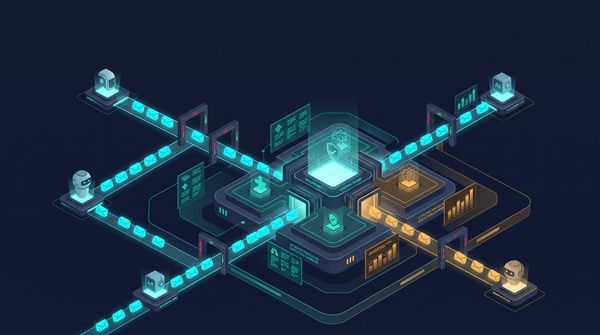
Encrypting an API connection is only the beginning. Sensitive agent workflows must protect data, identity, authority, and evidence across every handoff. AI agents are moving into the most sensitive parts of the enterprise. A healthcare agent may summarize a patient record, coordinate prior authorization, or prepare clinical documentation. A financial

The first great cloud battleground was infrastructure as a service. Who could provide the most reliable compute, storage, networking, and global regions? The next battleground was platforms and managed services. Who could provide the best databases, analytics, developer tools, security services, application platforms, and machine learning infrastructure? Then came AI

The next infrastructure advantage will come from optimizing complete AI pipelines, not isolated model calls. For the first generation of enterprise AI, infrastructure economics were reduced to a familiar question: How cheaply can we run this model? That question is becoming obsolete. A production AI request is rarely a single

AI Agents
How to give AI agents direction without teaching them to game the system Every agent has an architecture you can see: a model, tools, memory, orchestration, identity, and an execution loop. It also has an architecture that is easier to miss. Somewhere in the system is a definition of “better.

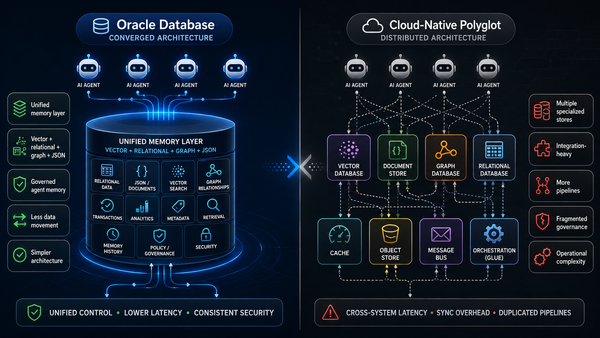
For much of the cloud-native era, Oracle Database was easy for modern developers to dismiss. The dominant architectural story favored small, specialized services: a relational database for transactions, a document store for flexible state, a graph database for relationships, a vector database for semantic search, a cache for speed,

The first pillar of transformation Most organizations will not fail at AI transformation because they picked the wrong model. They will fail because they tried to bolt AI onto an operating model that was designed for a different era. They will buy tools, run pilots, create dashboards, announce initiatives, and

How to choose model-and-compute routes empirically—not by model size, benchmark hype, or GPU-first assumptions. Executive Summary The infrastructure question behind enterprise AI is often framed too narrowly: CPU or GPU? SLM or LLM? Local or cloud? Those are important choices, but they are not the real