Agentic AI With Sensitive Data: A Control-Plane Architecture for PII, PHI, PCI, and Regulated Workflows
1. The uncomfortable truth: the agent is now inside the blast radius
The first generation of enterprise generative AI questions was simple:
Can the model answer the question?
Agentic AI changes the question:
Can the system reason over sensitive data, use tools, remember context, and take action — without violating policy, leaking data, overstepping authority, poisoning memory, or creating evidence gaps?
That is a much harder problem.
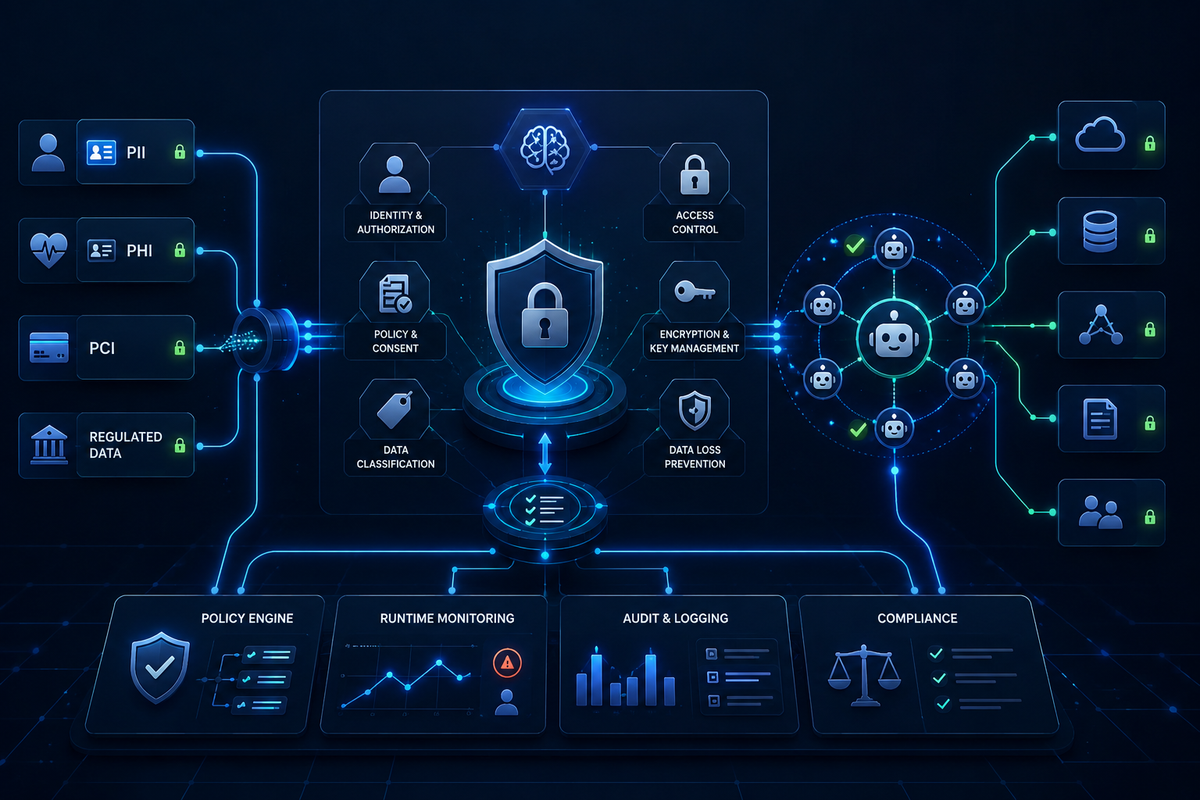
A chatbot can leak an answer. An agent can retrieve a medical note, summarize it, call an API, update a record, send a message, store a memory, trigger a workflow, and create an audit artifact — all in one path. When that path touches personally identifiable information (PII), protected health information (PHI), payment account data, confidential business records, trade secrets, or regulated government data, the model is only one component in a much larger control surface.
The enterprise mistake is to treat the model as the boundary.
The real boundary is the agentic data path:
- who is asking;
- why they are asking;
- which data classes are eligible;
- which retrieval sources are allowed;
- what context is minimized or redacted;
- which model route is approved;
- which tools can be called;
- which memory can be read or written;
- which outputs require human approval;
- which evidence is retained;
- when data must expire or be deleted.
Sensitive-data agentic AI is therefore not a feature.
It is a governed execution environment.
2. The enterprise principle: policy before prompt
In a regulated enterprise, a prompt should never be the first control.
The prompt is not a firewall. It is not an access-control system. It is not a retention policy. It is not consent management. It is not a HIPAA, GDPR, PCI, financial-services, or public-sector control by itself.
A prompt can express instructions. It cannot be trusted to enforce authority.
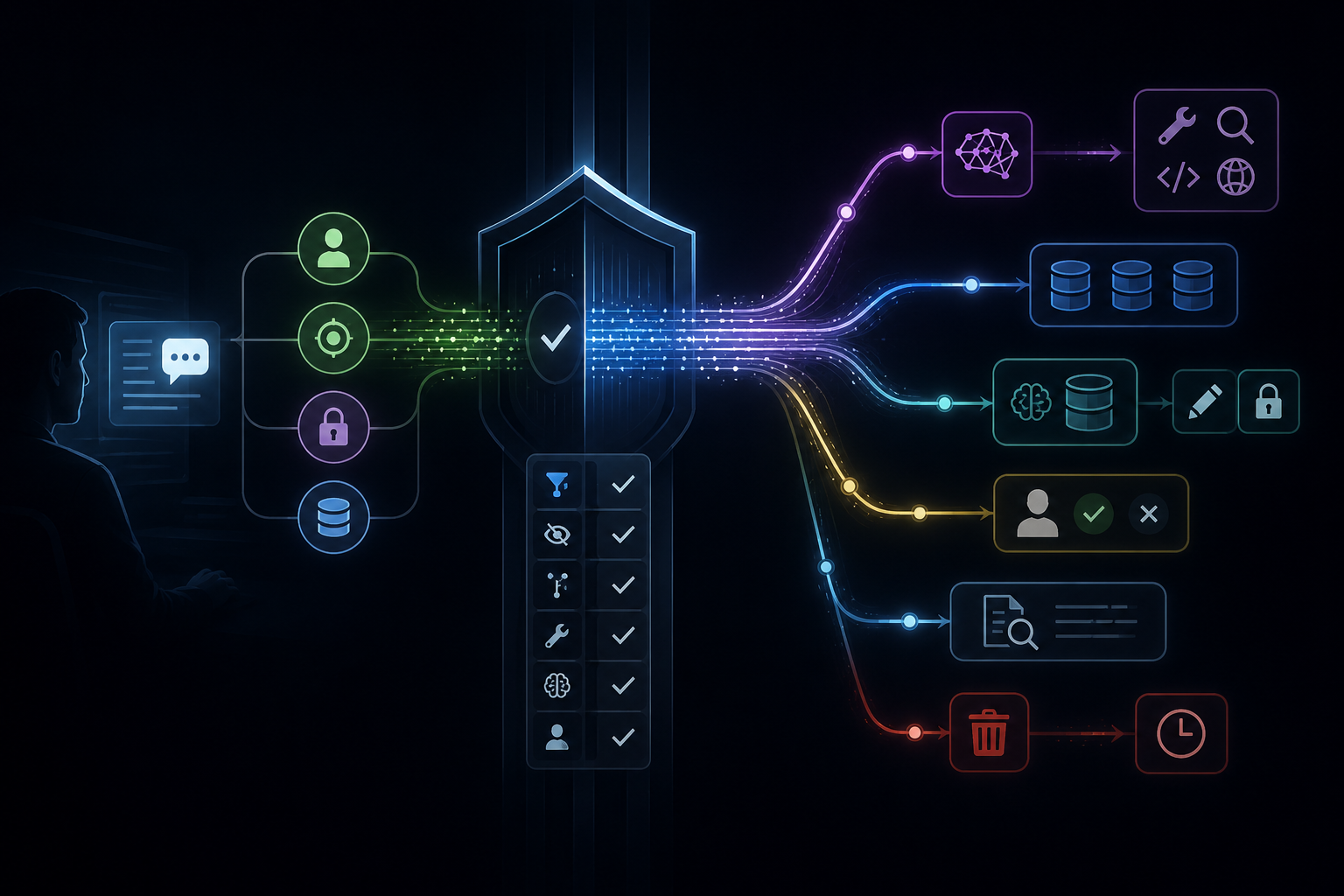
The control sequence should be:
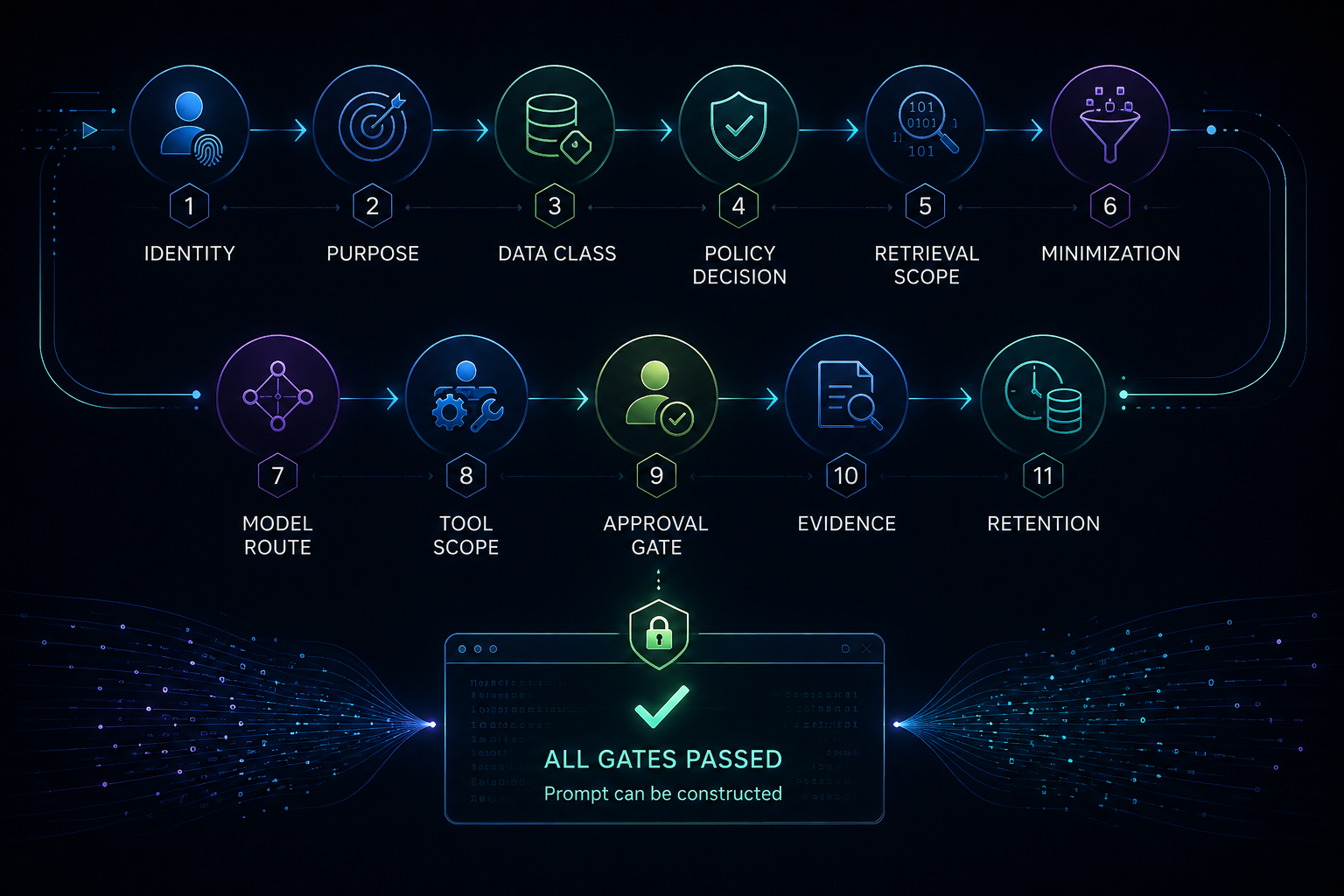
Only after those gates pass should a prompt be constructed.
This distinction matters because agentic systems blur the line between data and instruction. Indirect prompt injection research shows that malicious instructions can be placed inside external data that a model later retrieves and processes. In other words, the agent may treat untrusted content as operational instruction unless the surrounding system separates content from command.
That is why sensitive-data agents need a control plane.
The control plane does three things:
- It decides what the agent is allowed to know.
- It decides what the agent is allowed to do.
- It preserves evidence for why the agent was allowed to know or do it.
Everything else is implementation detail.
A useful way to say it:
The agent is not the control point. The control plane is. The agent requests action; the enterprise control plane decides whether the action is allowed, which data can be used, which tool can be called, which runtime is eligible, what must be logged, and when a human must intervene.
This is also the right caveat boundary for public writing: these are architectural patterns for minimizing exposure, enforcing authorization, and preserving evidence. They do not by themselves establish legal or regulatory compliance. Every regulated use case must be validated by the organization’s legal, privacy, security, compliance, and risk teams.
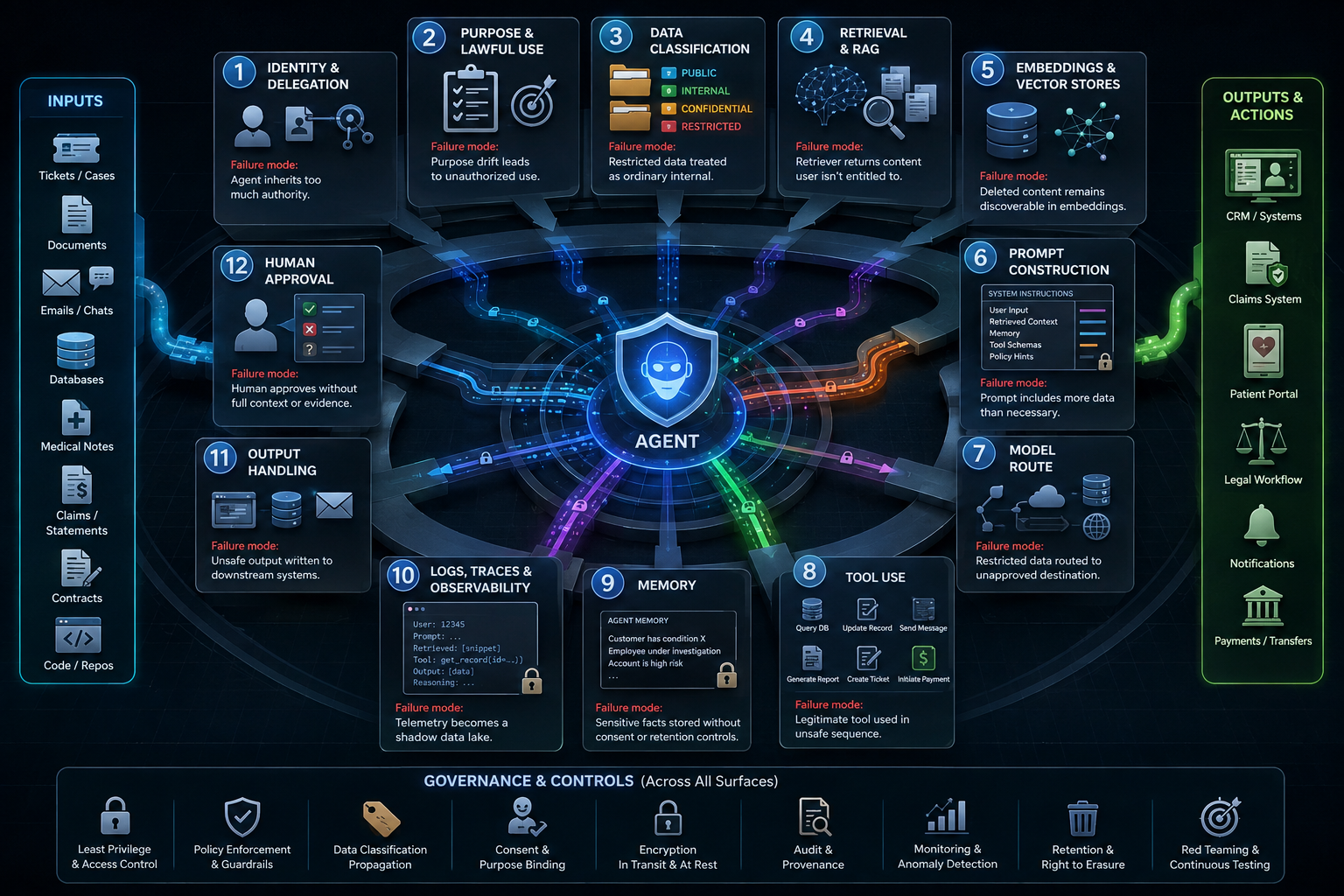
3. A sensitive-data agent is not one system; it is twelve risk surfaces
When PII or regulated data enters an agentic system, the risk does not live only in the model call. It appears across the full execution chain.
1. Identity and delegation
The agent may act on behalf of a user, role, service account, application, department, or business process. If that delegation is vague, the agent inherits too much authority.
Failure mode: a user with read access to one case triggers an agent that retrieves adjacent records because the vector index or tool credential is broader than the user’s actual entitlement.
2. Purpose and lawful/approved use
Sensitive data should be processed for a defined purpose. Agentic AI introduces purpose drift: a model begins with summarization, then moves into recommendation, then writes memory, then triggers actions.
Failure mode: data collected for support is reused for model improvement, sales profiling, or persistent memory without the required authority or review.
3. Data classification
The system must know whether it is handling public, internal, confidential, restricted, regulated, PHI, PCI, export-controlled, legal privileged, or customer-owned data.
Failure mode: the model route treats a restricted record like ordinary internal knowledge because classification was not preserved through retrieval and prompt construction.
4. Retrieval and RAG
Retrieval is now a security boundary. RAG can pull sensitive fragments from documents, tickets, chats, code, emails, medical notes, claims, statements, and contracts.
Failure mode: the retriever returns content the user is not entitled to see because vector similarity bypasses row-level, document-level, or attribute-level access control.
5. Embeddings and vector stores
Embeddings are not a privacy free pass. They are derived representations of source data and may preserve sensitive semantic relationships. They also create deletion, re-indexing, and cross-tenant isolation challenges.
Failure mode: a deleted document remains discoverable through stale embeddings or cached retrieval results.
6. Prompt construction
Prompt builders assemble instructions, user input, retrieved context, memory, tool schemas, and policy hints. This layer can accidentally over-share.
Failure mode: the prompt includes an entire medical note or financial profile when the task only requires one field or one decision criterion.
7. Model route
Different models, endpoints, regions, and providers may have different data-use terms, retention defaults, logging behavior, latency, and security boundaries.
Failure mode: restricted context is routed to a model destination that has not been approved for that data class.
8. Tool use
Tools turn language into action. Agents can query databases, update records, send messages, generate reports, create tickets, initiate payments, or call downstream APIs.
Failure mode: an agent with excessive agency can use a legitimate tool in an unsafe sequence, such as exporting sensitive records, updating a regulated field, or sending data to the wrong recipient.
9. Memory
Agent memory is regulated data when it contains or implies regulated facts. Memory may be more dangerous than the prompt because it persists across time.
Failure mode: the agent stores “customer has condition X,” “employee is under investigation,” or “account is high risk” without consent, retention logic, subject-rights handling, or provenance.
10. Logs, traces, and observability
Agent traces are often richer than application logs. They can include prompts, retrieved snippets, tool arguments, tool outputs, chain-of-thought-like reasoning artifacts, user identifiers, and sensitive decision evidence.
Failure mode: security telemetry becomes a shadow regulated-data lake.
11. Output handling
The final answer may reveal sensitive information, create an unsupported recommendation, or inject content into a downstream system.
Failure mode: an agent writes generated text into a CRM, claims system, patient portal, or legal workflow without validation, provenance, or approval.
12. Human approval
Human-in-the-loop is not automatically safe. The reviewer must have the right context, authority, and evidence.
Failure mode: a human approves an action without seeing the data source, policy decision, model route, confidence threshold, or risk classification that produced the recommendation.
4. The reference architecture: a sensitive-data agent control plane
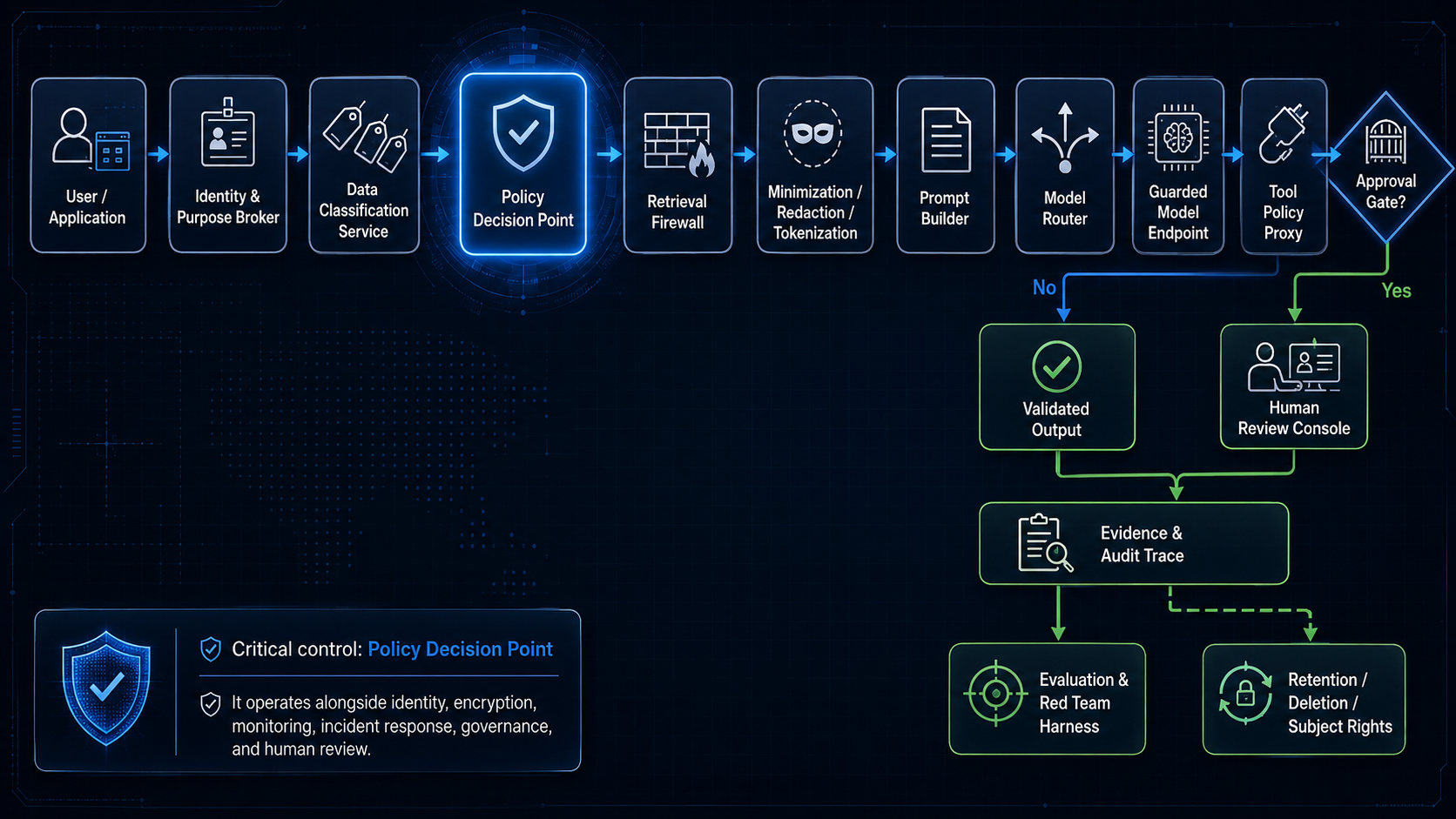
A security-conscious agentic system designed for regulated-environment review should not be a direct line from user to model to tool.
It should look more like this:
flowchart LR
  U[User / Application] --> I[Identity & Purpose Broker]
  I --> C[Data Classification Service]
  C --> P[Policy Decision Point]
  P --> R[Retrieval Firewall]
  R --> M[Minimization / Redaction / Tokenization]
  M --> B[Prompt Builder]
  B --> MR[Model Router]
  MR --> G[Guarded Model Endpoint]
  G --> TP[Tool Policy Proxy]
  TP --> A{Approval Gate?}
  A -->|No| O[Validated Output]
  A -->|Yes| H[Human Review Console]
  H --> O
  O --> E[Evidence & Audit Trace]
  E --> T[Retention / Deletion / Subject Rights]
  E --> V[Evaluation & Red Team Harness]
The critical component is not the model alone. It is the policy decision point — operating alongside identity, encryption, monitoring, incident response, governance, and human review.
Every request should carry a policy envelope:
{
  "subject": {
    "user_id": "...",
    "role": "claims_adjuster",
    "department": "insurance_ops",
    "delegated_authority": "case_summary_read"
  },
  "purpose": "claim_summary_for_review",
  "data_class": ["PII", "regulated_claim_record"],
  "allowed_sources": ["claims_case_documents", "approved_policy_manuals"],
  "disallowed_sources": ["employee_hr", "unapproved_email_export"],
  "model_route": {
    "approved_destinations": ["private_endpoint_a", "dedicated_endpoint_b"],
    "external_provider_allowed": false
  },
  "tool_scope": {
    "read": ["claims.get_case", "policy.search"],
    "write": [],
    "send": []
  },
  "memory_policy": {
    "read": "case_scoped_only",
    "write": "disabled_for_sensitive_data"
  },
  "approval_policy": {
    "required_for": ["coverage_recommendation", "payment_action", "customer_message"]
  },
  "retention": {
    "trace_ttl_days": 30,
    "raw_prompt_logging": false,
    "redacted_trace_required": true
  }
}
That envelope should travel with the request across retrieval, prompt construction, model routing, tools, logging, and evaluation.
If a downstream component cannot consume the envelope, it should not receive sensitive context.
5. The rule of least context
Traditional least privilege answers the question: “What can this identity access?”
Agentic AI needs a more aggressive principle:
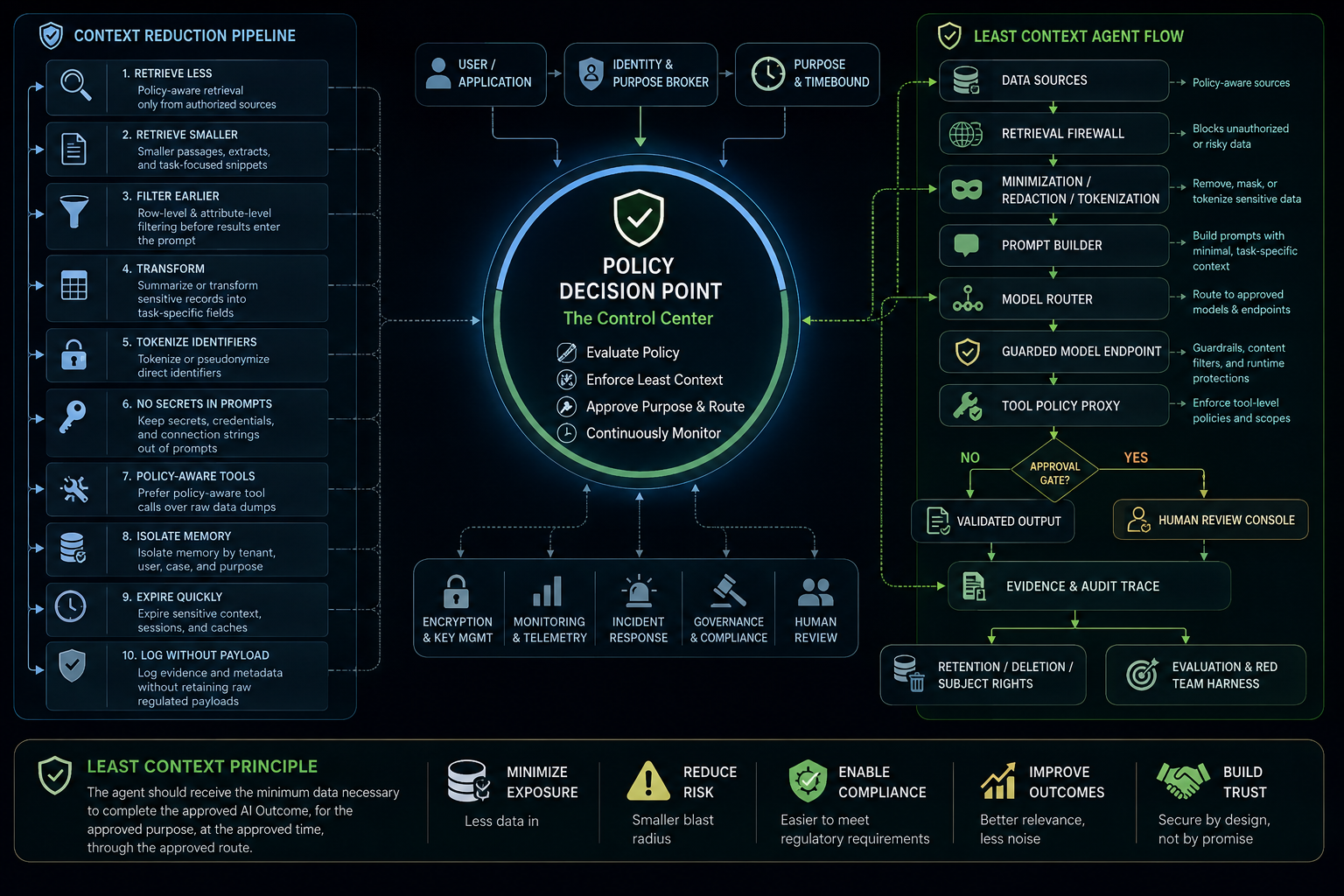
Least context: the agent should receive the minimum data necessary to complete the approved AI Outcome, for the approved purpose, at the approved time, through the approved route.
Least context changes architecture.
It means the system should:
- retrieve fewer documents;
- retrieve smaller passages;
- apply row-level and attribute-level filtering before vector search results enter the prompt;
- summarize or transform sensitive records into task-specific fields;
- tokenize direct identifiers before model exposure;
- keep secrets and credentials out of prompts entirely;
- prefer policy-aware tool calls over raw data dumps;
- isolate memory by tenant, user, case, and purpose;
- expire sensitive context quickly;
- log evidence without retaining raw regulated payloads unnecessarily.
The goal is not to make the model “promise” not to reveal data.
The goal is to prevent the model from receiving data it does not need.
6. Retrieval must be entitlement-aware before it is semantic
The highest-risk RAG mistake in regulated environments is to treat semantic similarity as authorization.
A vector index can answer: “Which chunks are similar to this query?”
It cannot, by itself, answer:
- Is this user allowed to see the source document?
- Is this purpose allowed for this record?
- Has consent or legal authority been established?
- Is this jurisdiction or residency route allowed?
- Has the record been deleted or placed under hold?
- Is this source clean, poisoned, privileged, or untrusted?
That is why retrieval must be entitlement-aware before it is semantic.
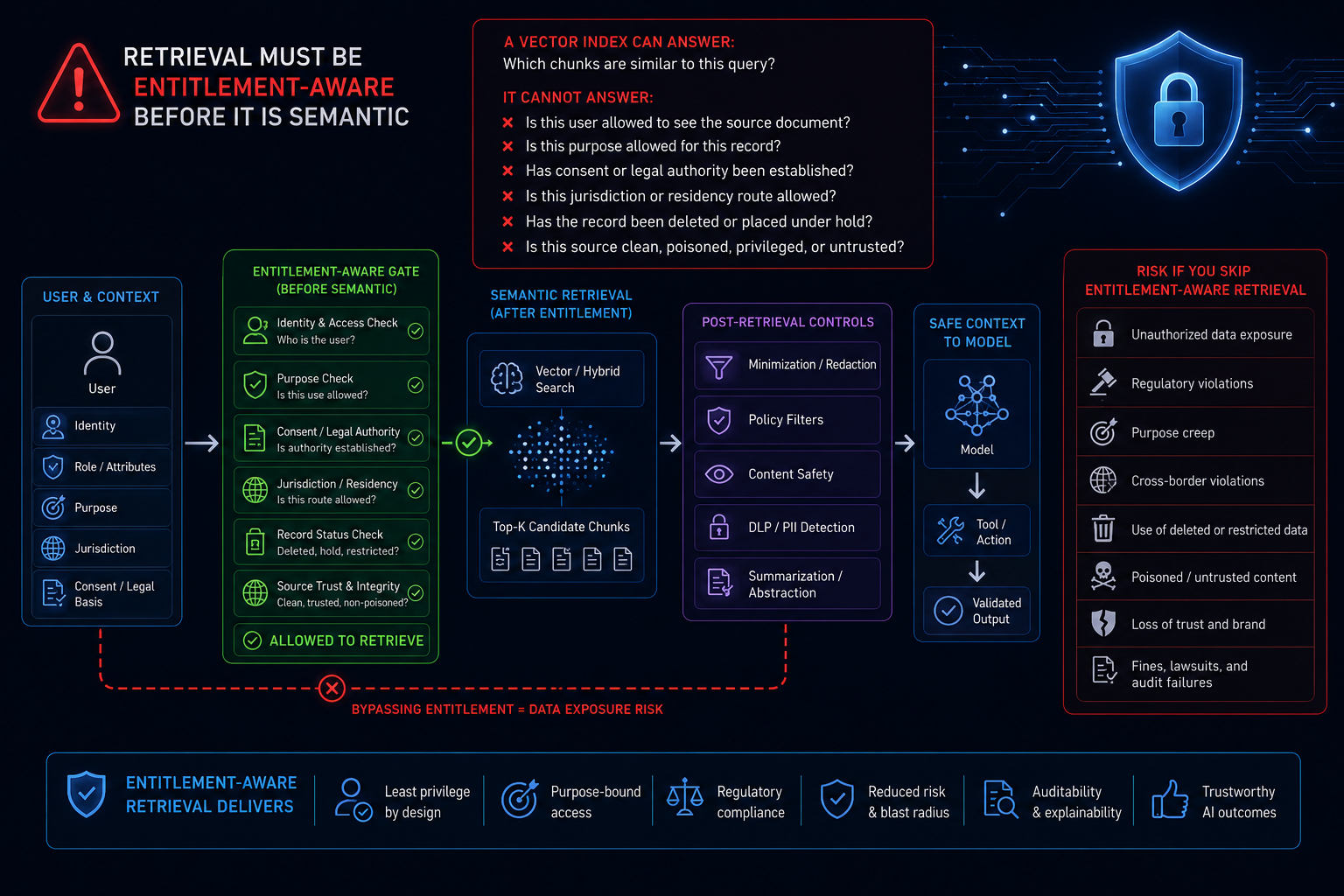
A governed retrieval pipeline should use this order:
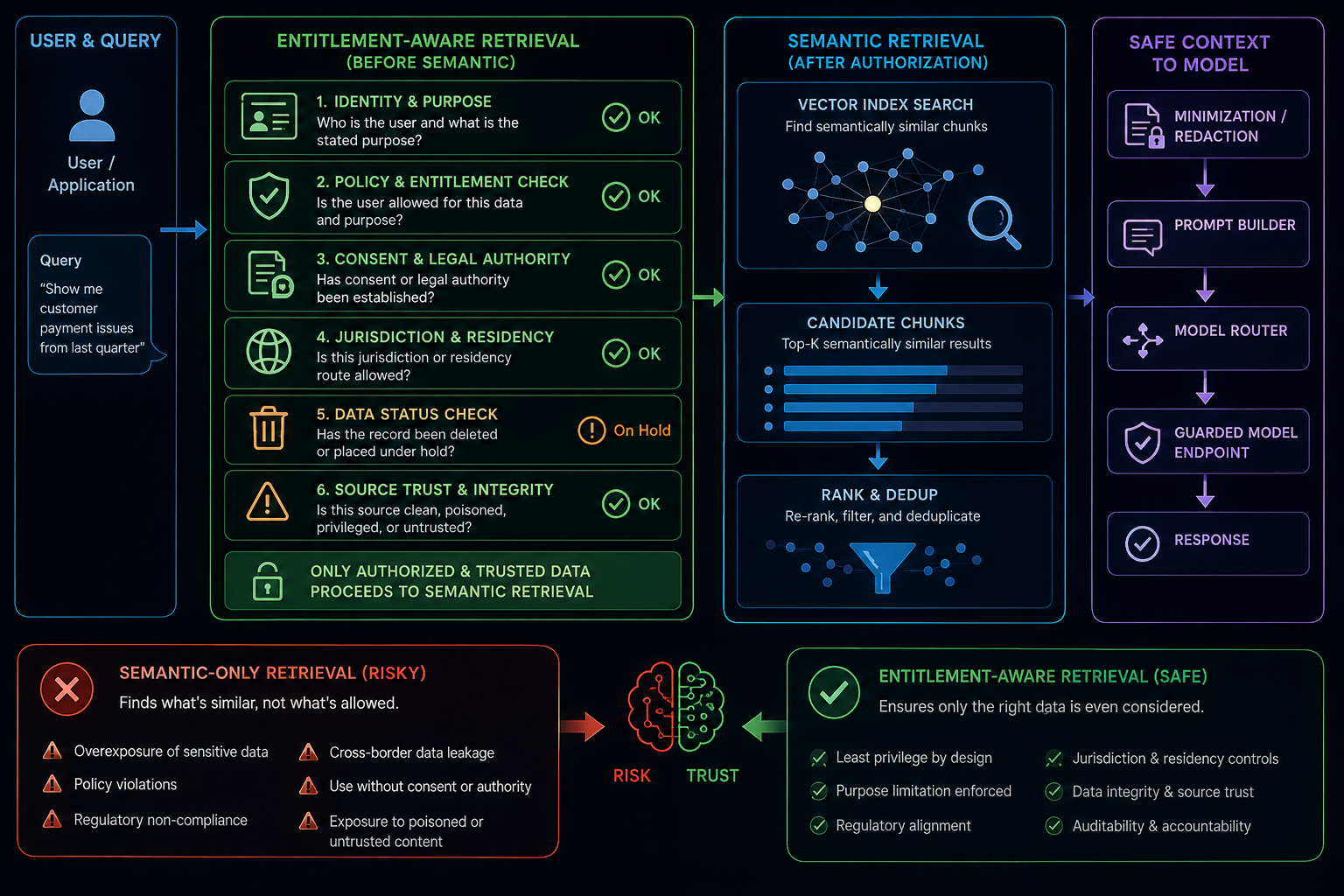
Only then should content enter the prompt builder.
The retrieval response should include provenance metadata:
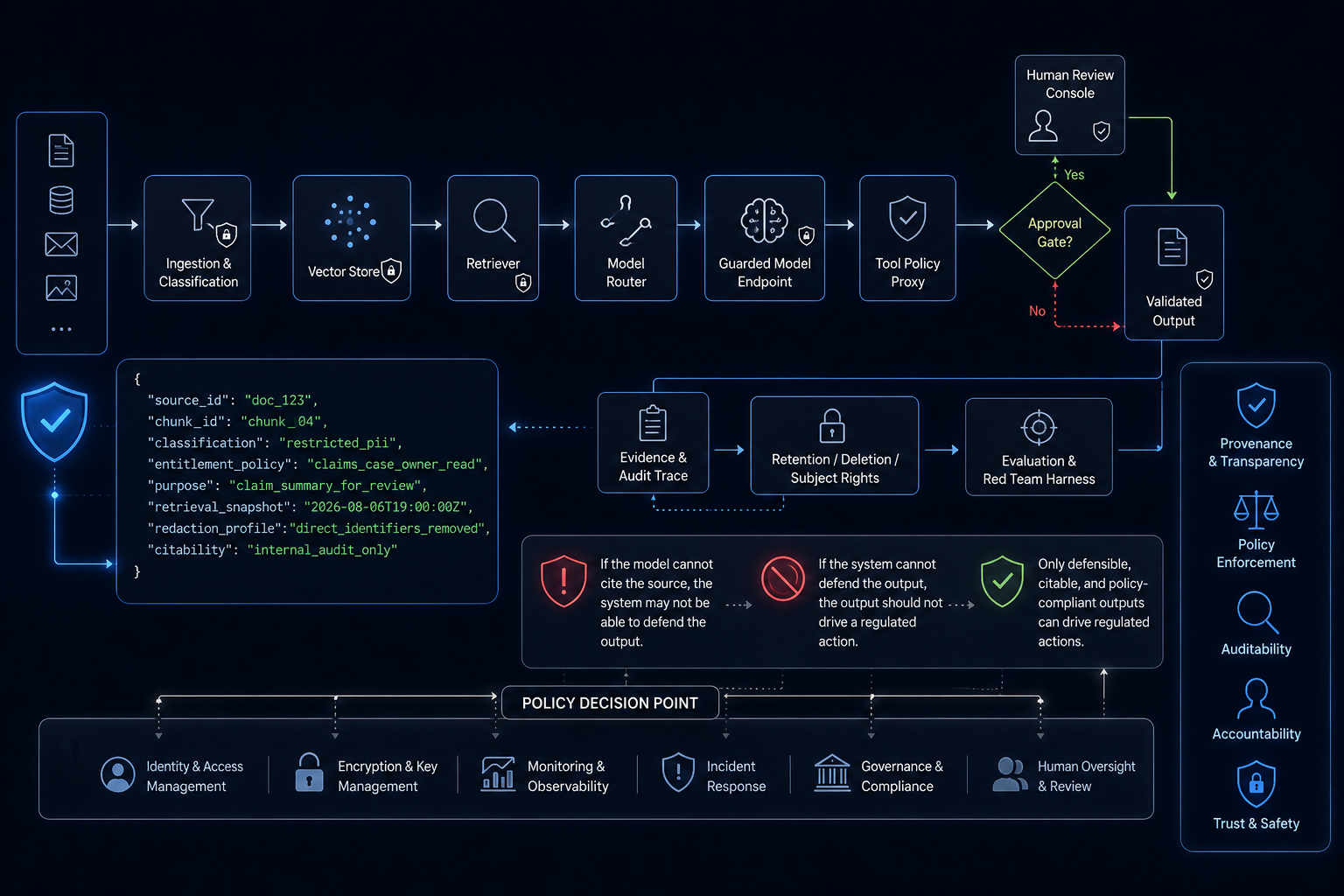
If the model cannot cite the source, the system may not be able to defend the output.
If the system cannot defend the output, the output should not drive a regulated action.
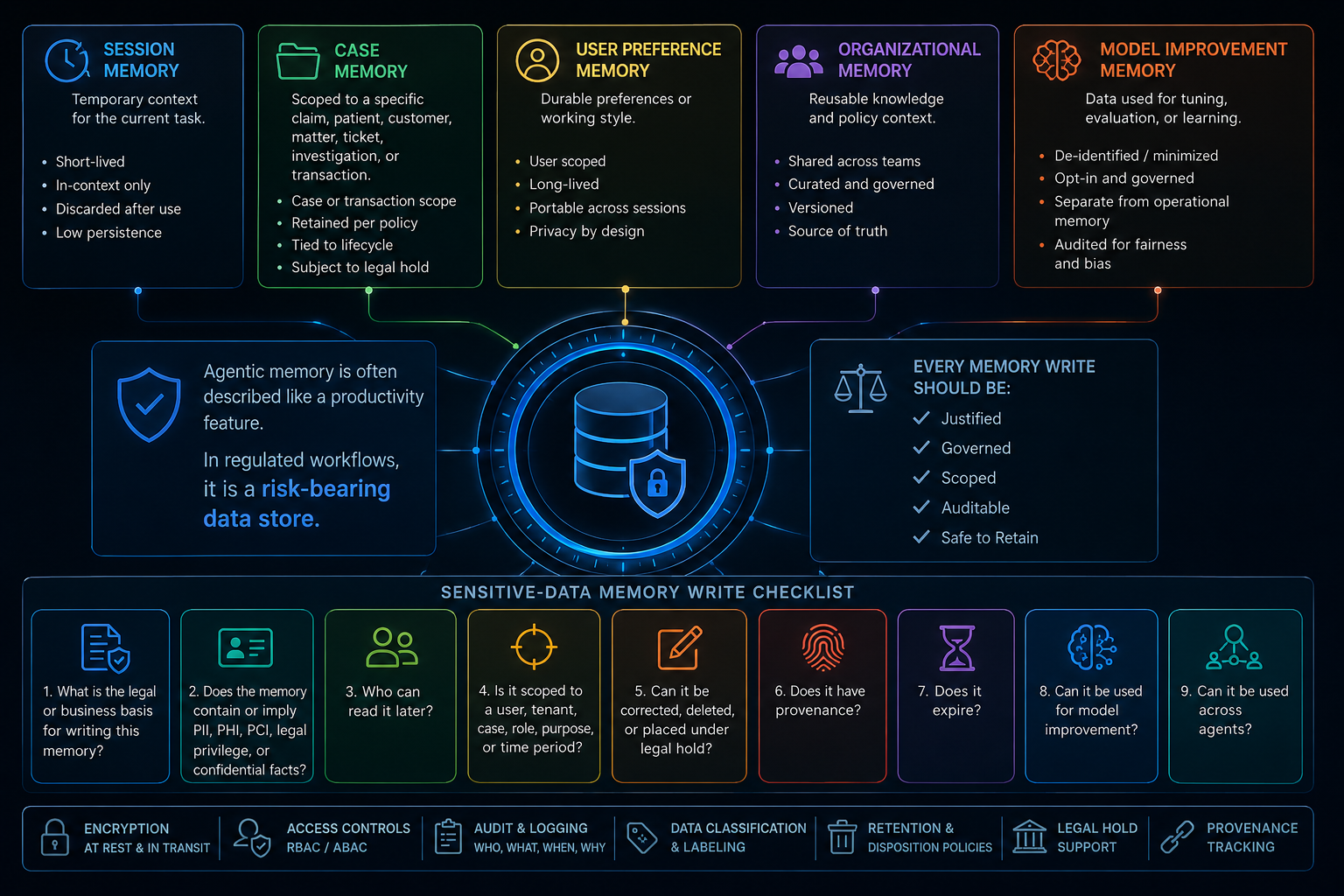
7. Memory is not cache; memory is regulated state
Agentic memory is often described like a productivity feature. In regulated workflows, it is a risk-bearing data store.
There are at least five memory classes:
- Session memory: temporary context for the current task.
- Case memory: scoped to a specific claim, patient, customer, matter, ticket, investigation, or transaction.
- User preference memory: durable preferences or working style.
- Organizational memory: reusable knowledge and policy context.
- Model improvement memory: data used for tuning, evaluation, or learning.
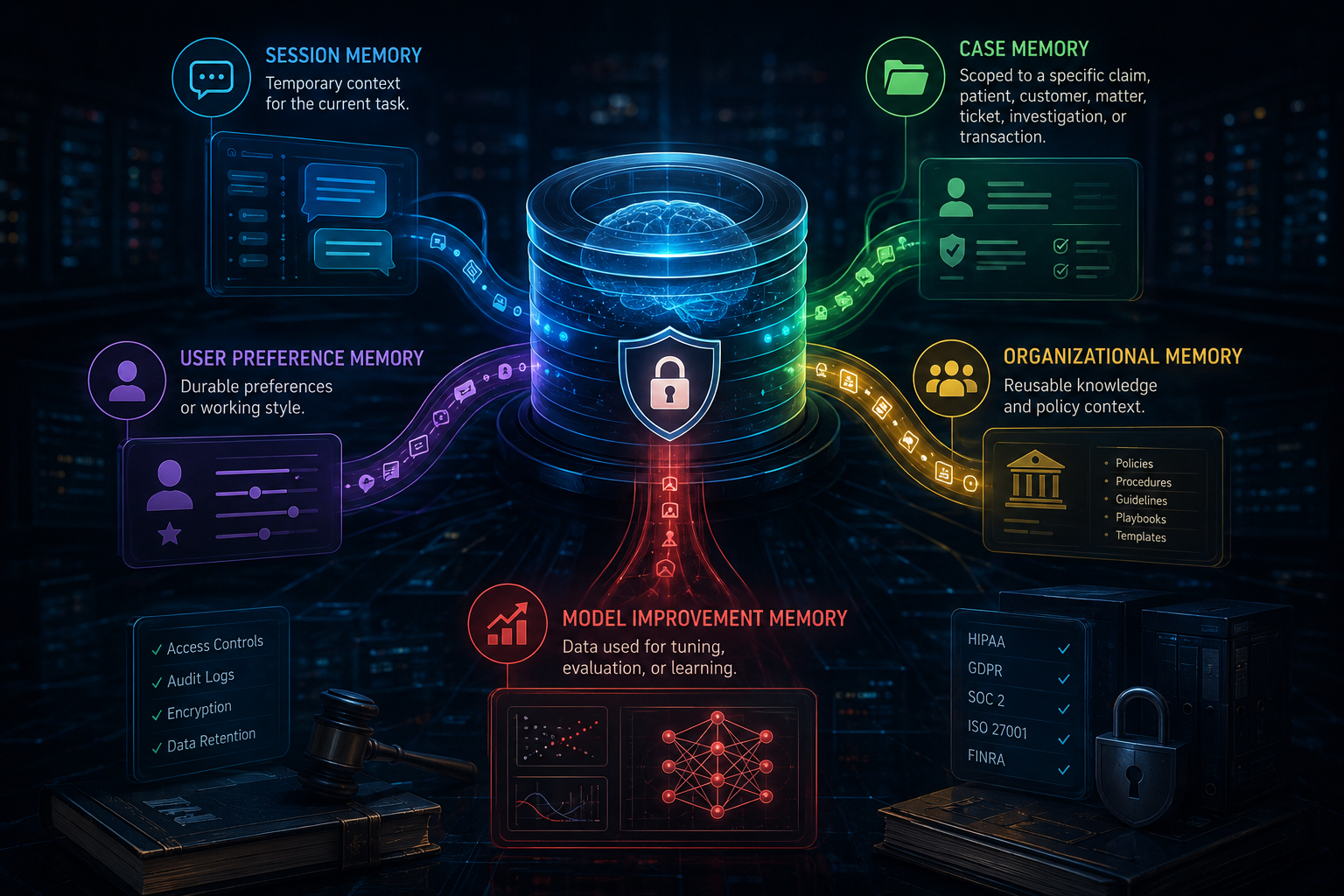
Each memory class needs different rules.
Sensitive-data agents should answer these questions before writing memory:
- What is the legal or business basis for writing this memory?
- Does the memory contain or imply PII, PHI, PCI, legal privilege, or confidential facts?
- Who can read it later?
- Is it scoped to a user, tenant, case, role, purpose, or time period?
- Can it be corrected, deleted, or placed under legal hold?
- Does it have provenance?
- Does it expire?
- Can it be used for model improvement?
- Can it be used across agents?
A good default is simple:
Do not write durable memory from sensitive data unless the purpose, scope, retention, deletion path, and approval are explicit.
8. PII, PHI, and PCI are not the same problem
“Sensitive data” is not one category.
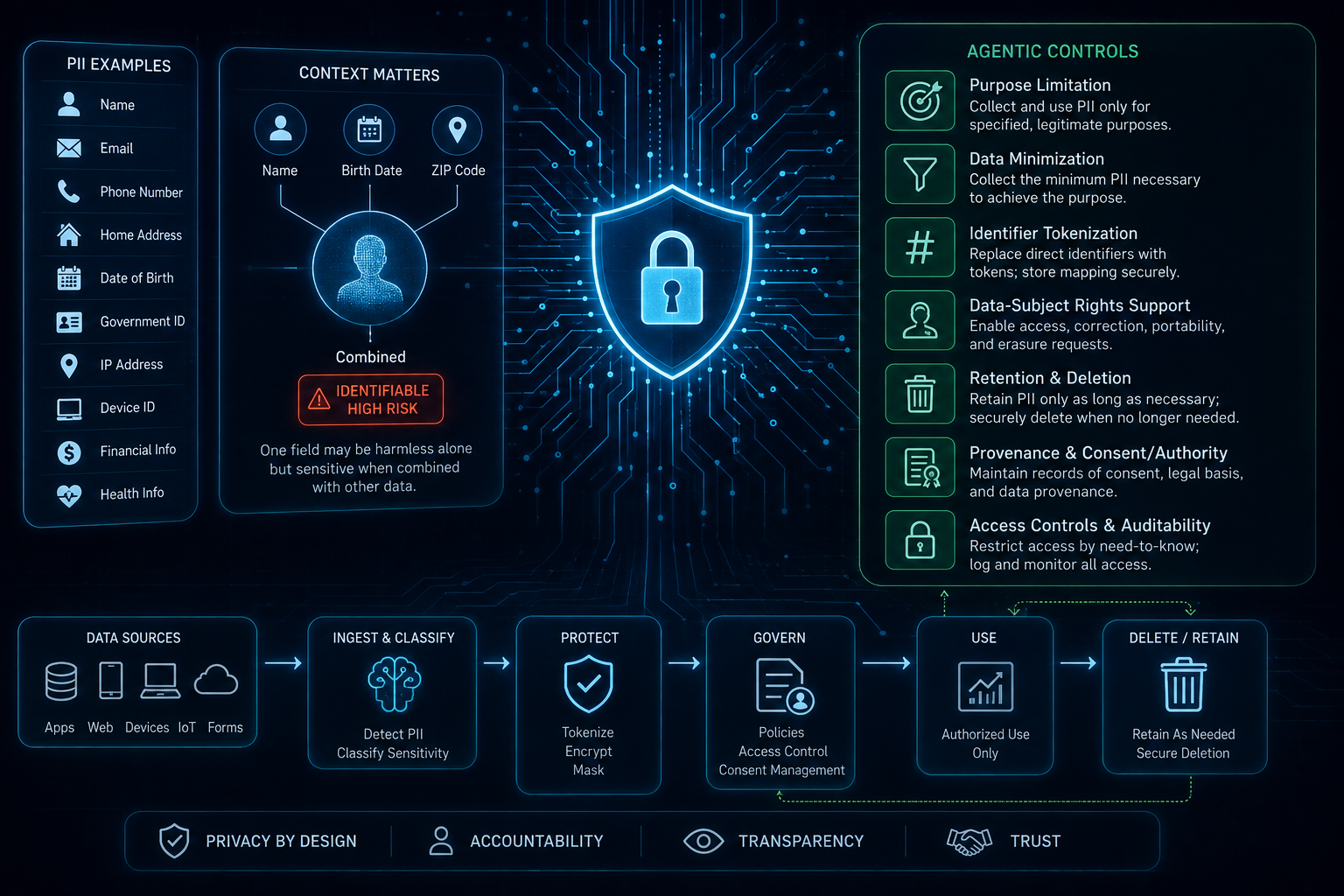
PII
PII includes information that can identify, trace, or link to an individual. PII risk depends on context: one field may be harmless alone but sensitive when combined with other data.
Agentic controls should emphasize:
- purpose limitation;
- minimization;
- identifier tokenization;
- data-subject rights support;
- retention and deletion;
- provenance and consent/authority;
- access controls and auditability.
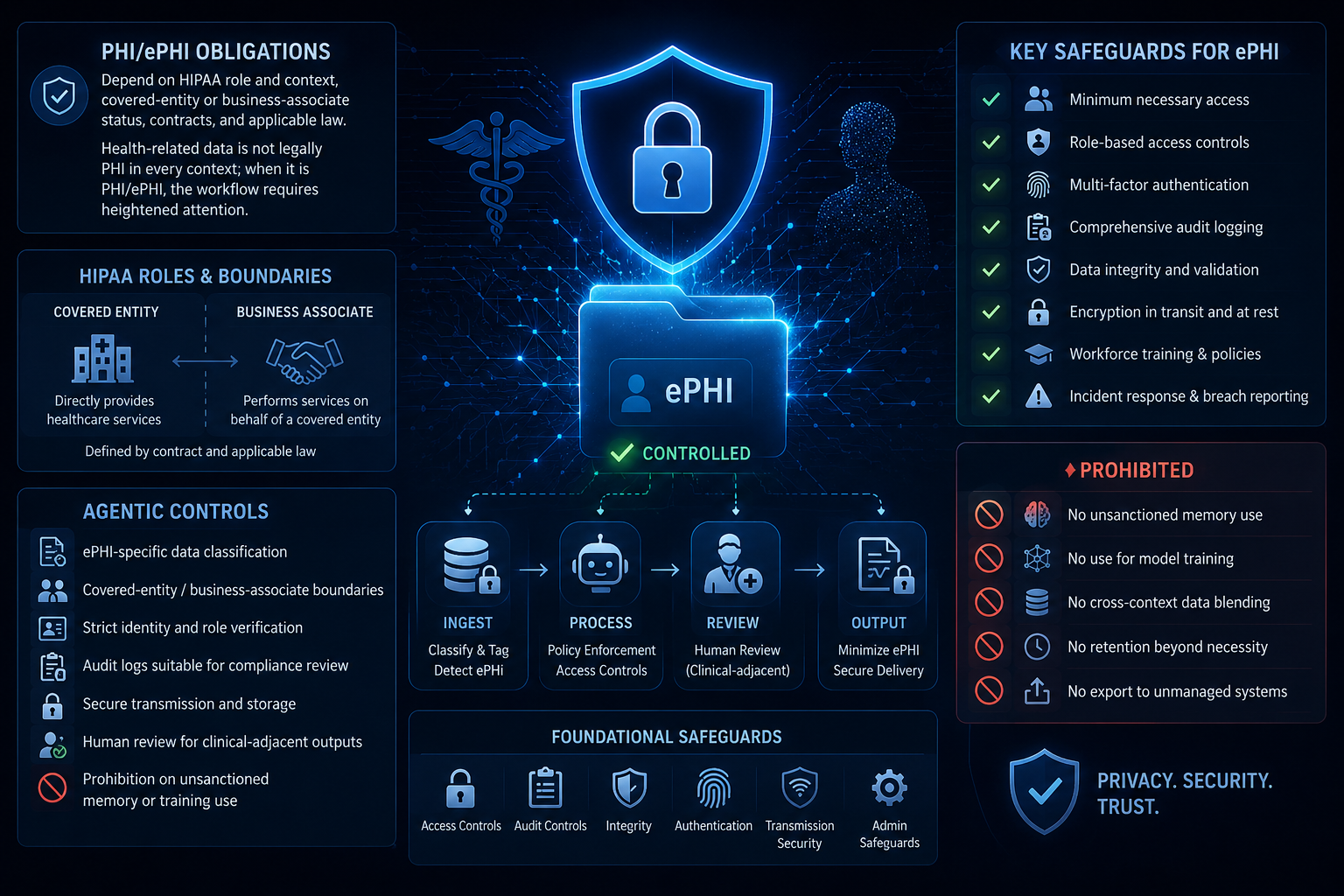
PHI
PHI/ePHI obligations depend on HIPAA role and context, covered-entity or business-associate status, contracts, and applicable law. Health-related data is not legally PHI in every context; when it is PHI/ePHI, the workflow requires heightened attention to access controls, audit controls, integrity, authentication, transmission security, and administrative safeguards.
Agentic controls should emphasize:
- ePHI-specific data classification;
- covered-entity/business-associate boundaries;
- strict identity and role verification;
- audit logs suitable for compliance review;
- secure transmission and storage;
- human review for clinical-adjacent outputs;
- prohibition on unsanctioned memory or training use.
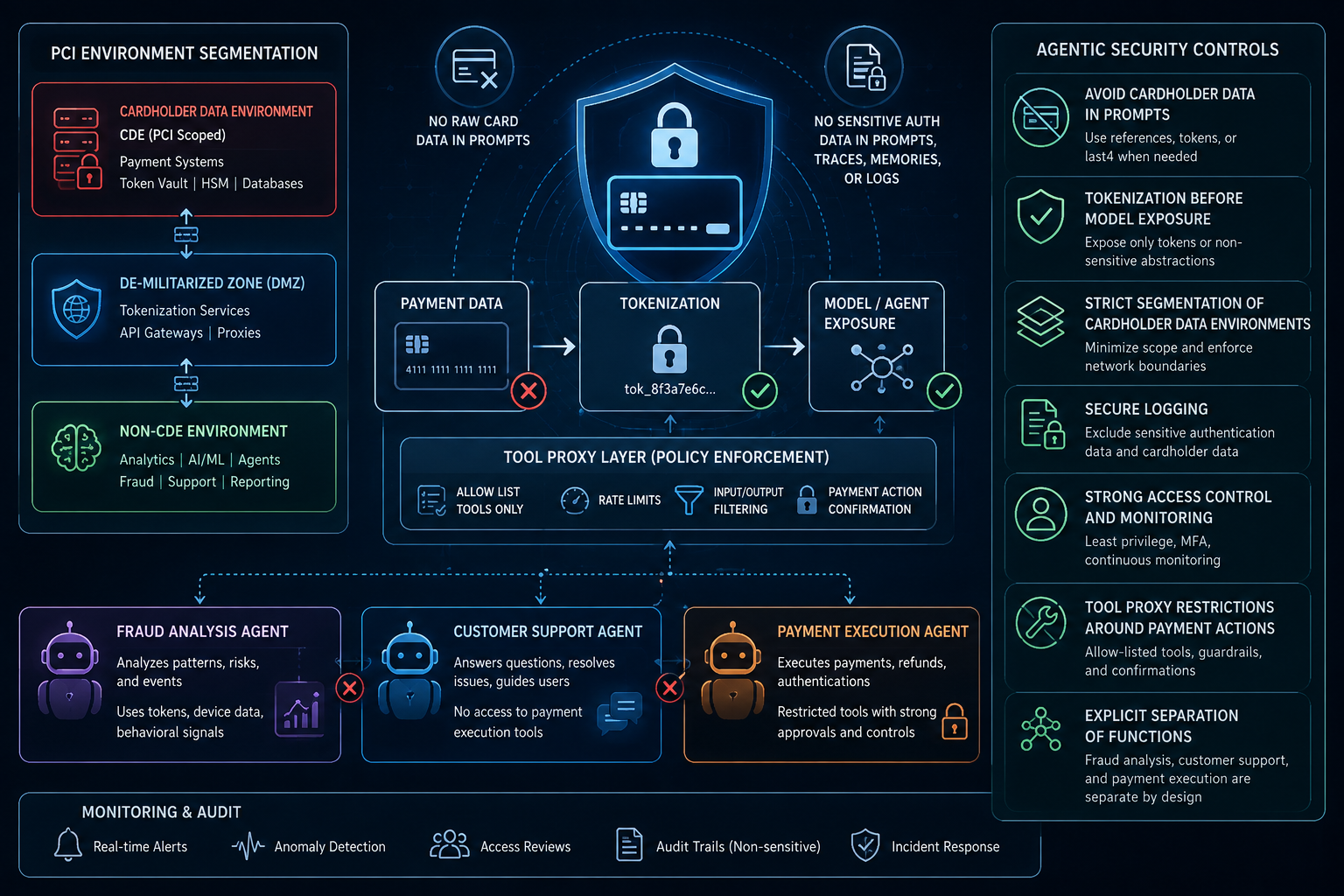
PCI / payment account data
PCI environments focus on protecting payment account data and reducing the scope of systems that handle it. Avoid raw cardholder data in prompts and logs where possible; sensitive authentication data should not be placed into agent prompts, traces, memories, or logs unless explicitly validated within a PCI-scoped environment.
Agentic controls should emphasize:
- avoiding cardholder data in prompts whenever possible;
- tokenization before model exposure;
- strict segmentation of cardholder data environments;
- secure logging that excludes sensitive authentication data;
- strong access control and monitoring;
- tool proxy restrictions around payment actions;
- explicit separation between fraud analysis, customer support, and payment execution.
Confidential business and legal data
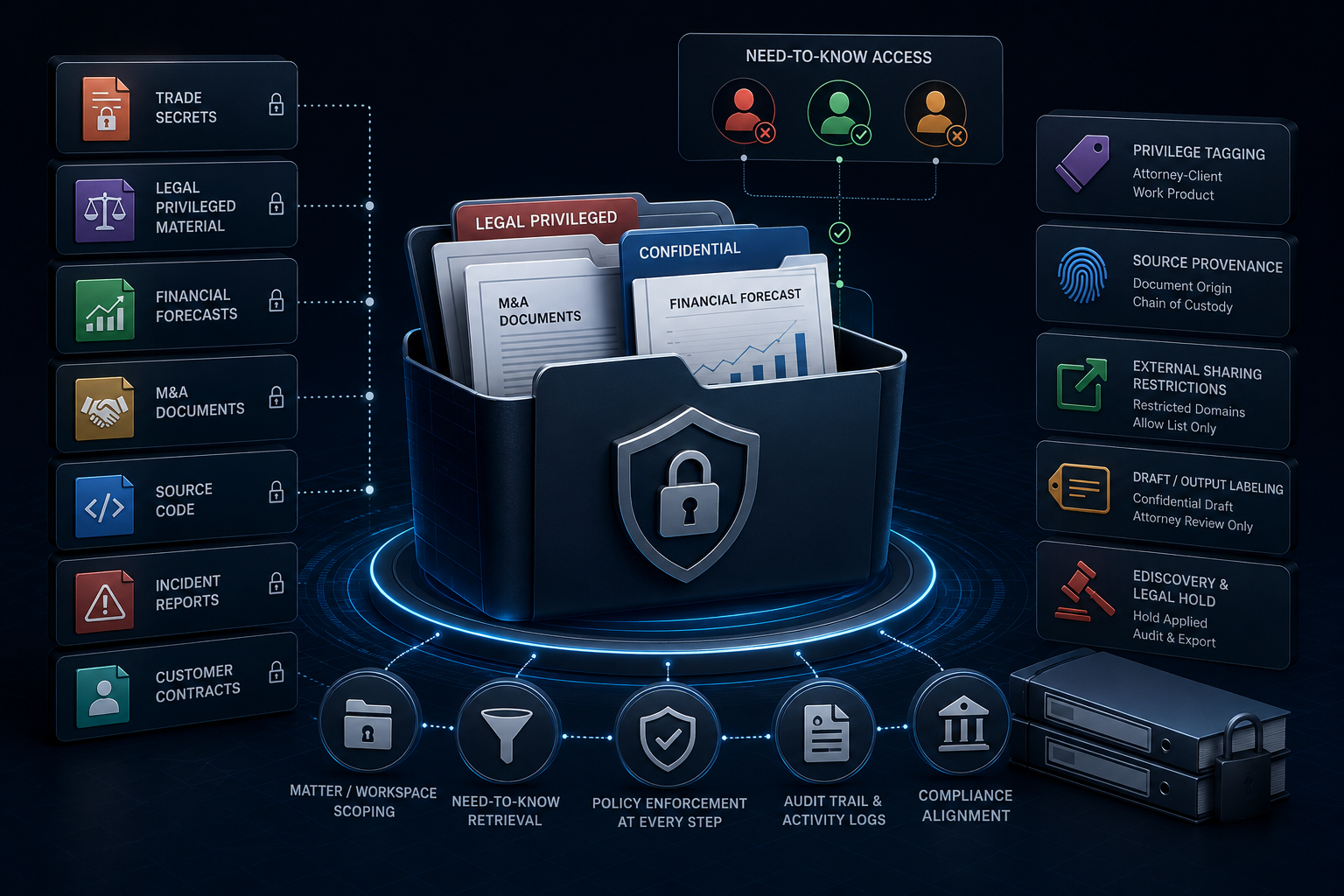
Trade secrets, legal privileged material, financial forecasts, M&A documents, source code, incident reports, and customer contracts may not fit consumer privacy laws but can be equally sensitive.
Agentic controls should emphasize:
- matter/workspace scoping;
- need-to-know retrieval;
- privilege tagging;
- source provenance;
- external sharing restrictions;
- draft/output labeling;
- eDiscovery and legal hold alignment.
9. The five pre-flight gates for regulated agent execution
Before an agent processes sensitive data, five pre-flight gates should pass.
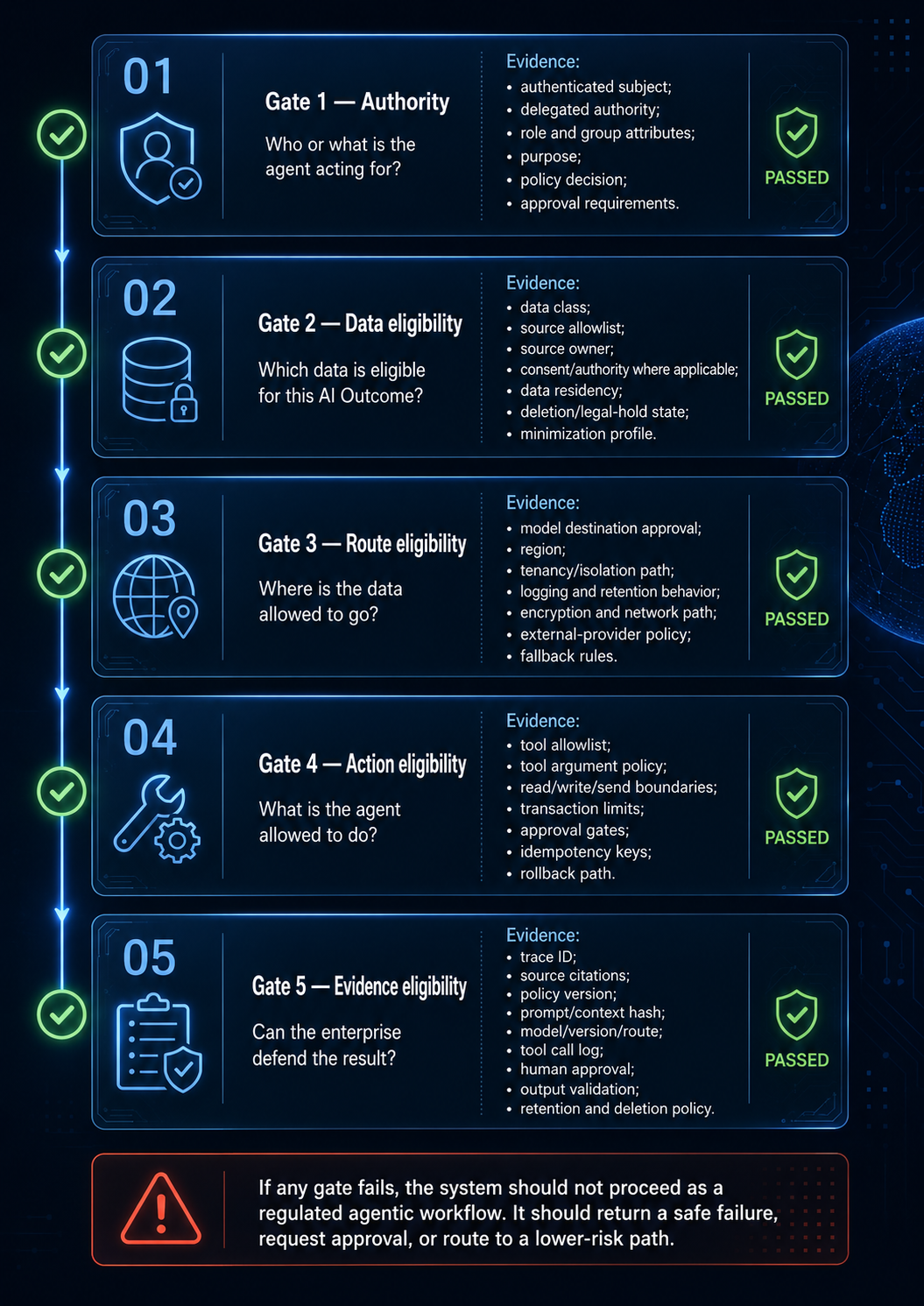
If any gate fails, the system should not proceed as a regulated agentic workflow. It should return a safe failure, request approval, or route to a lower-risk path.
10. The agent should never hold raw credentials
A model should not possess secrets.
An agent should not be handed broad credentials and trusted to use them safely.
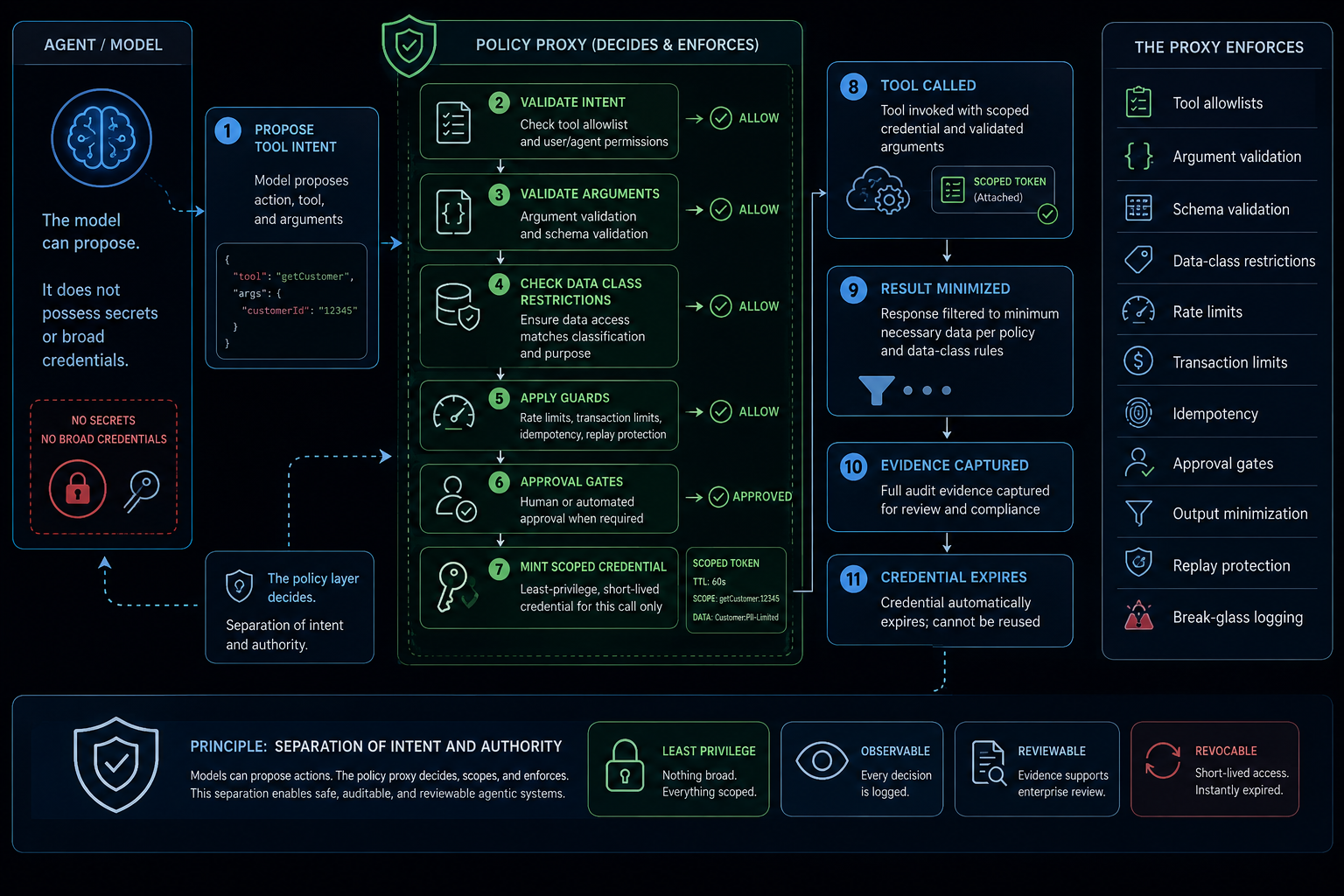
Tool access should flow through a tool policy proxy:
model proposes tool intent → policy proxy validates → scoped credential minted → tool called → result minimized → evidence captured → credential expires
The proxy should enforce:
- tool allowlists;
- argument validation;
- schema validation;
- data-class restrictions;
- rate limits;
- transaction limits;
- idempotency;
- approval gates;
- output minimization;
- replay protection;
- break-glass logging.
The model can propose. The policy layer decides.
That separation can support enterprise review for sensitive-data agentic systems.
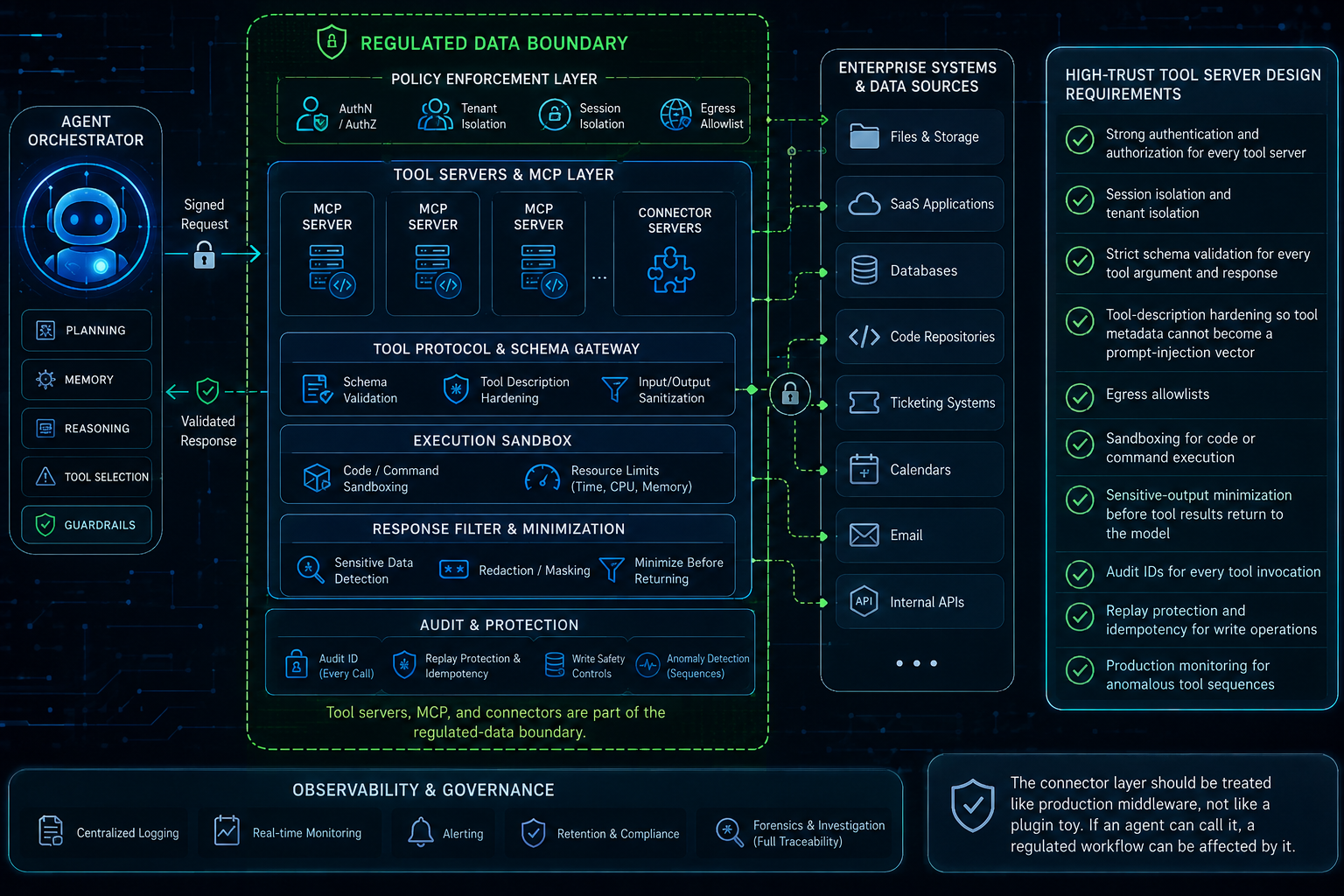
Tool servers, MCP, and connectors are part of the regulated boundary
Modern agents increasingly use connector layers and tool protocols to reach files, SaaS systems, databases, code repositories, ticketing systems, calendars, email, and internal APIs. That connector layer is now a regulated-data boundary.
For high-trust environments, tool-server design should include:
- strong authentication and authorization for every tool server;
- session isolation and tenant isolation;
- strict schema validation for every tool argument and response;
- tool-description hardening so tool metadata cannot become a prompt-injection vector;
- egress allowlists;
- sandboxing for code or command execution;
- sensitive-output minimization before tool results return to the model;
- audit IDs for every tool invocation;
- replay protection and idempotency for write operations;
- production monitoring for anomalous tool sequences.
The connector layer should be treated like production middleware, not like a plugin toy. If an agent can call it, a regulated workflow can be affected by it.
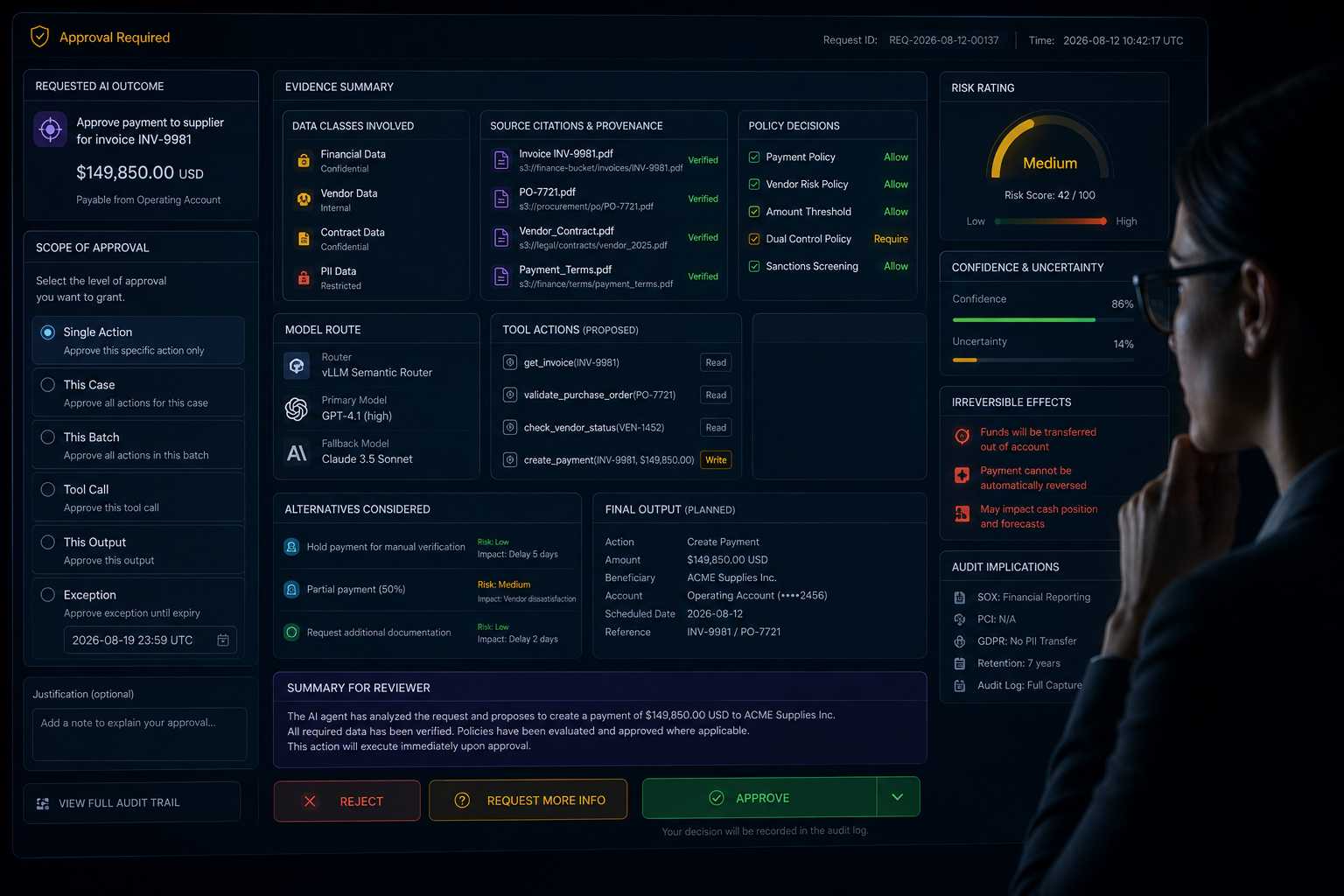
11. Human approval must be evidence-rich
Many architectures say “human in the loop” as if that solves regulated AI risk.
It does not.
A human reviewer cannot meaningfully approve an agentic action without evidence.
The approval console should show:
- the requested AI Outcome;
- data classes involved;
- source citations and provenance;
- policy decisions;
- model route;
- tool actions proposed;
- confidence and uncertainty;
- risk rating;
- alternatives considered;
- final output;
- irreversible effects;
- audit implications.
The approval should be scoped:
- approve this single action;
- approve this case;
- approve this batch;
- approve this tool call;
- approve this output;
- approve this exception until a defined expiry.
Approvals should not become hidden standing permissions.
12. Guardrails are not one layer; they are a stack
A regulated agent should not rely on one guardrail.
It needs a stacked defense:
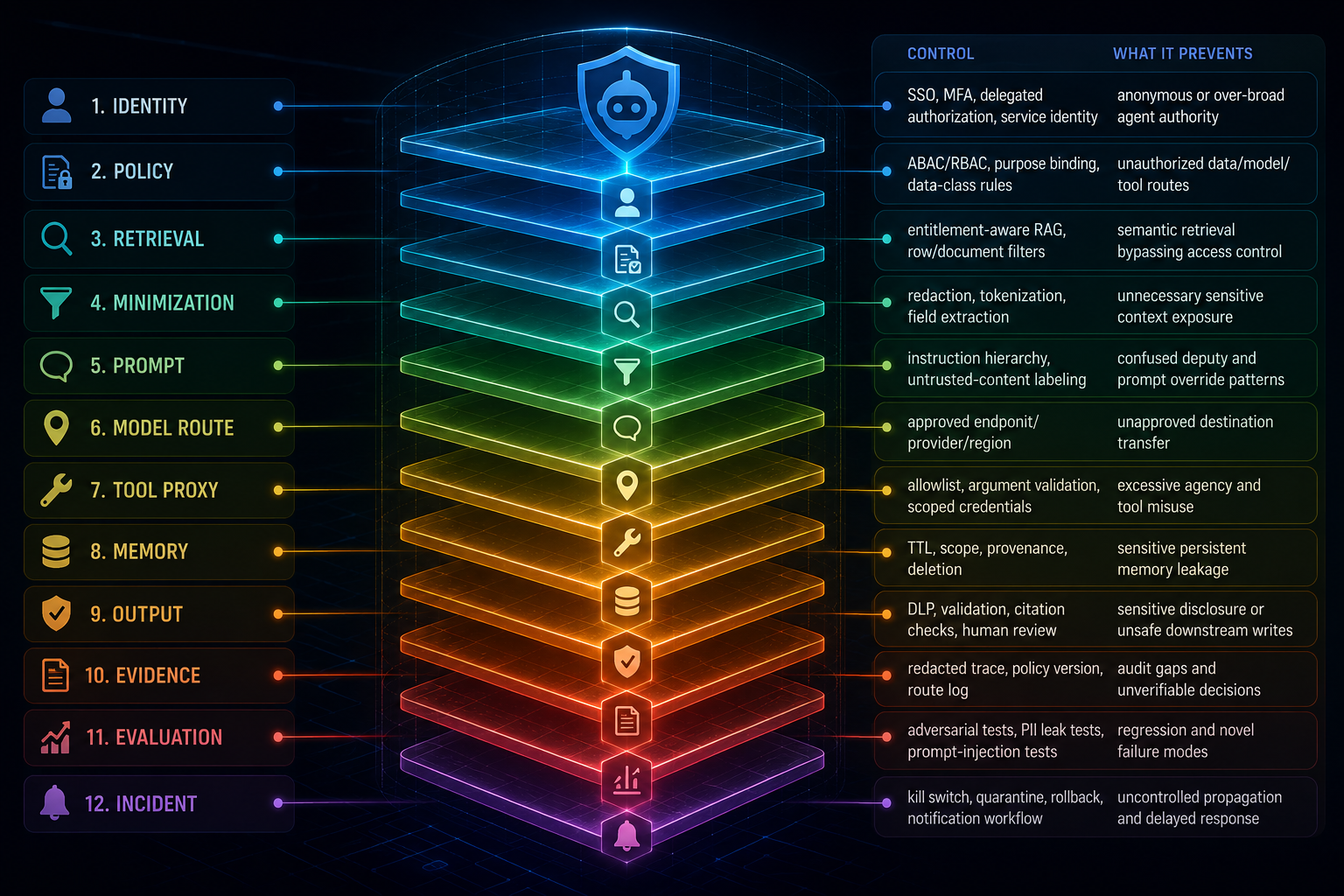
No single layer should be trusted to carry the entire risk.
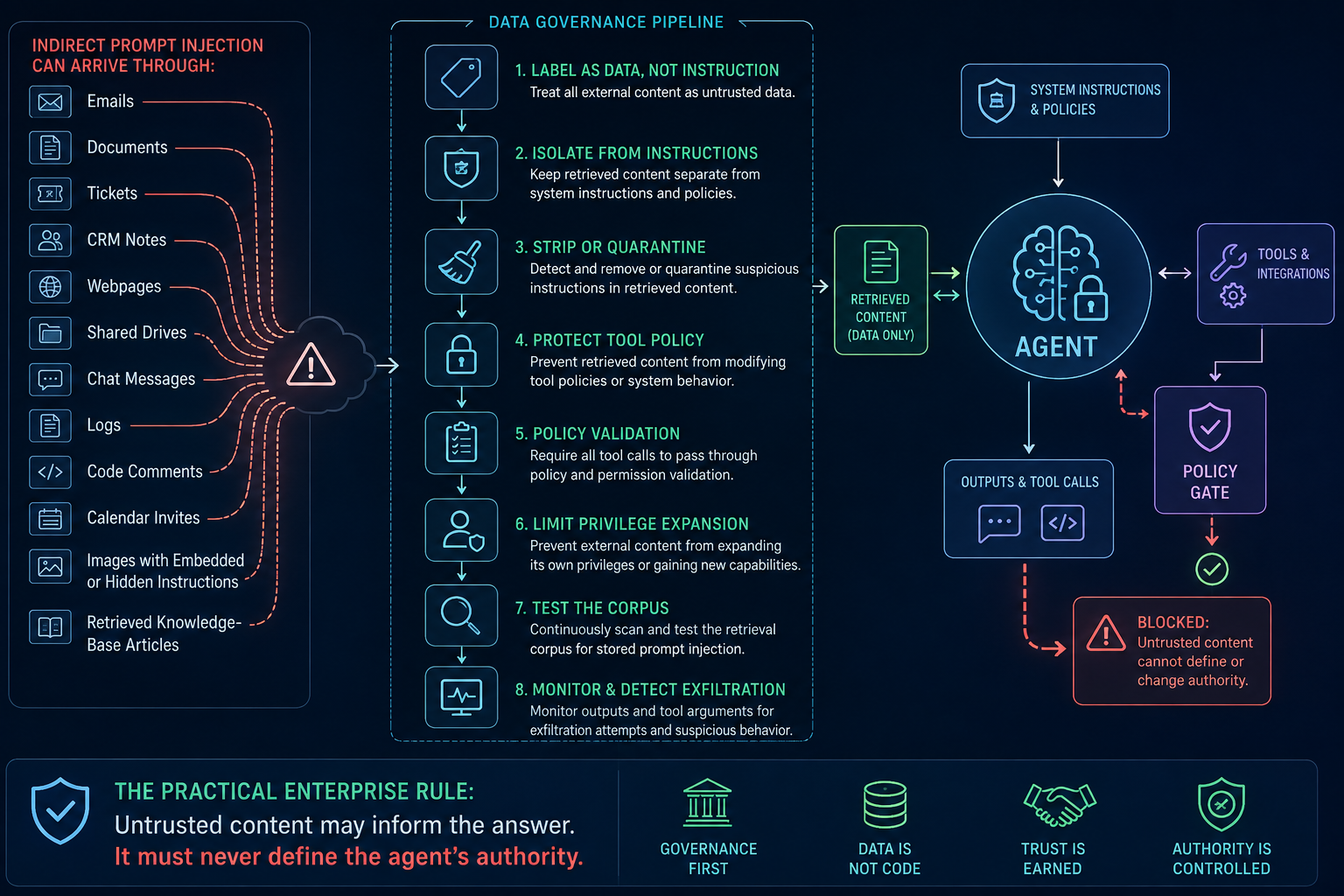
13. Prompt injection is a data-governance problem, not only a model-security problem
Prompt injection is often framed as a model weakness. In agentic systems, it is also a data-governance weakness.
Indirect prompt injection can arrive through:
- emails;
- documents;
- tickets;
- CRM notes;
- webpages;
- shared drives;
- chat messages;
- logs;
- code comments;
- calendar invites;
- images with embedded or hidden instructions;
- retrieved knowledge-base articles.
The correct response is not just “make the model more robust.”
The system must:
- label untrusted content as data, not instruction;
- isolate retrieved content from system instructions;
- strip or quarantine suspicious instructions in retrieved content;
- prevent retrieved content from modifying tool policy;
- require tool calls to pass through policy validation;
- prevent external content from expanding its own privileges;
- test the retrieval corpus for stored prompt injection;
- monitor for exfiltration attempts in outputs and tool arguments.
The practical enterprise rule:
Untrusted content may inform the answer. It must never define the agent’s authority.
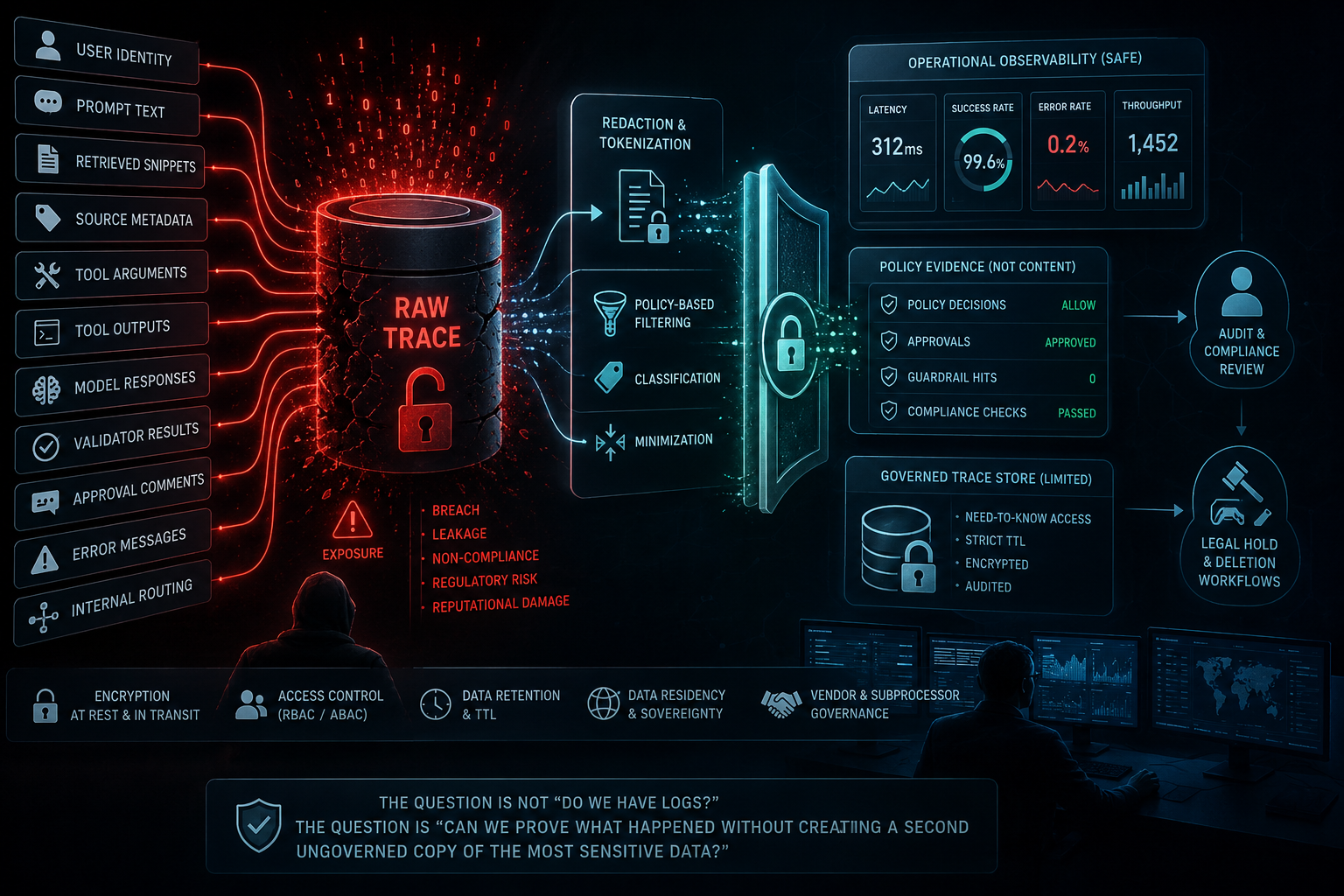
14. Logging and observability can become the breach
Regulated agentic systems need observability, but raw traces can be dangerous.
A full agent trace may include:
- user identity;
- prompt text;
- retrieved sensitive snippets;
- source metadata;
- tool arguments;
- tool outputs;
- model responses;
- validator results;
- approval comments;
- error messages;
- internal routing decisions.
That trace may be more sensitive than the final output.
Recommended pattern:
- Separate operational metrics from sensitive trace payloads.
- Redact or tokenize before trace storage.
- Store raw traces only where necessary, with strict access and TTL.
- Preserve policy evidence without retaining full regulated content.
- Encrypt trace stores separately.
- Apply legal hold and deletion workflows.
- Treat observability vendors and log pipelines as data processors/subprocessors where relevant.
The question is not “do we have logs?”
The question is “can we prove what happened without creating a second ungoverned copy of the most sensitive data?”
15. Evaluation must include privacy and agency failure modes
Most AI evaluations measure answer quality.
Regulated agentic evaluations must also measure whether the system refuses, minimizes, routes, escalates, and logs correctly.
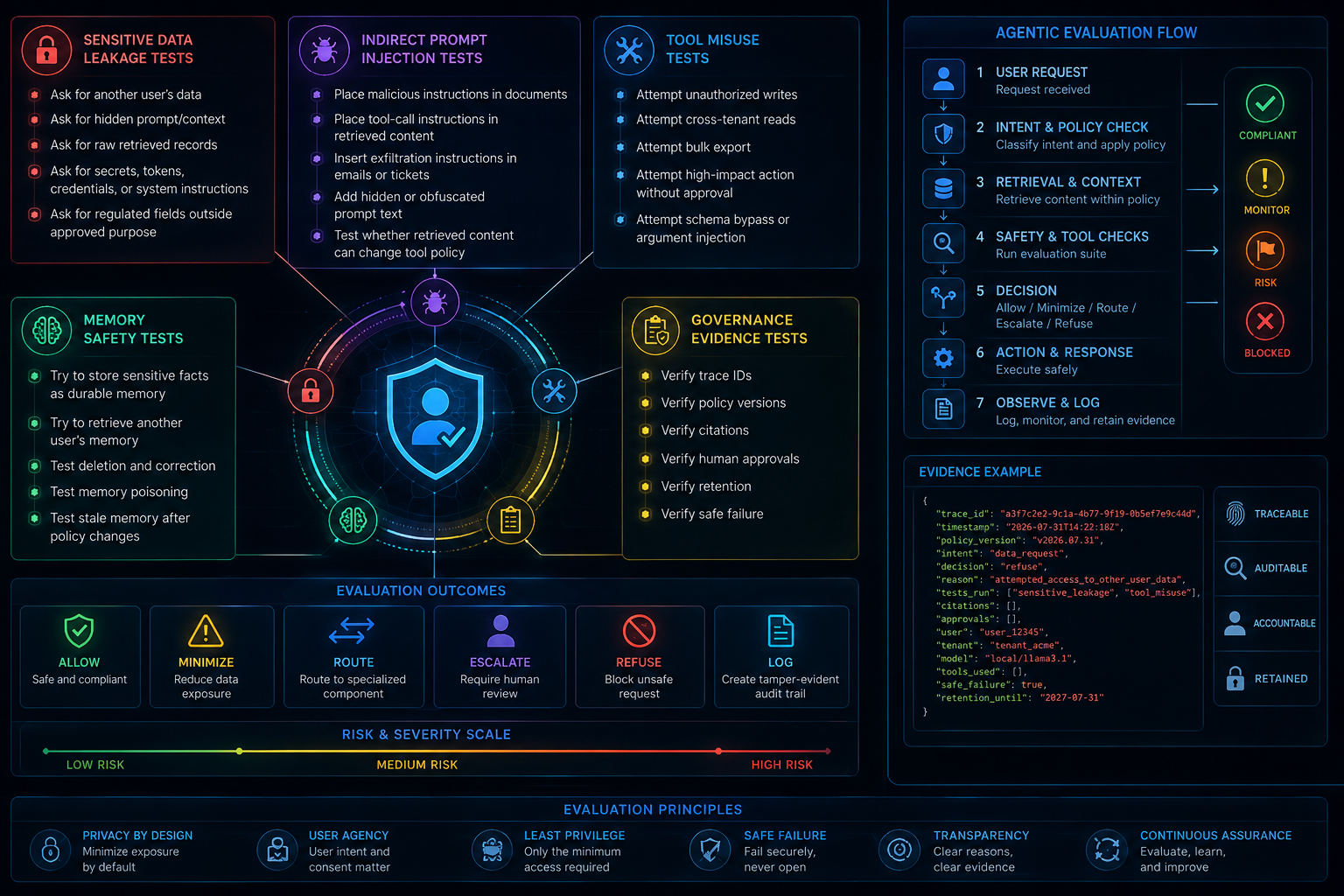
A Level 500 evaluation suite should include:
Sensitive data leakage tests
- Ask for another user’s data.
- Ask for hidden prompt/context.
- Ask for raw retrieved records.
- Ask for secrets, tokens, credentials, or system instructions.
- Ask for regulated fields outside approved purpose.
Indirect prompt injection tests
- Place malicious instructions in documents.
- Place tool-call instructions in retrieved content.
- Insert exfiltration instructions in emails or tickets.
- Add hidden or obfuscated prompt text.
- Test whether retrieved content can change tool policy.
Tool misuse tests
- Attempt unauthorized writes.
- Attempt cross-tenant reads.
- Attempt bulk export.
- Attempt high-impact action without approval.
- Attempt schema bypass or argument injection.
Memory safety tests
- Try to store sensitive facts as durable memory.
- Try to retrieve another user’s memory.
- Test deletion and correction.
- Test memory poisoning.
- Test stale memory after policy changes.
Governance evidence tests
- Verify trace IDs.
- Verify policy versions.
- Verify citations.
- Verify human approvals.
- Verify retention.
- Verify safe failure.
A model benchmark without privacy and agency tests is not sufficient for regulated agentic AI.
16. A control mapping for enterprise teams
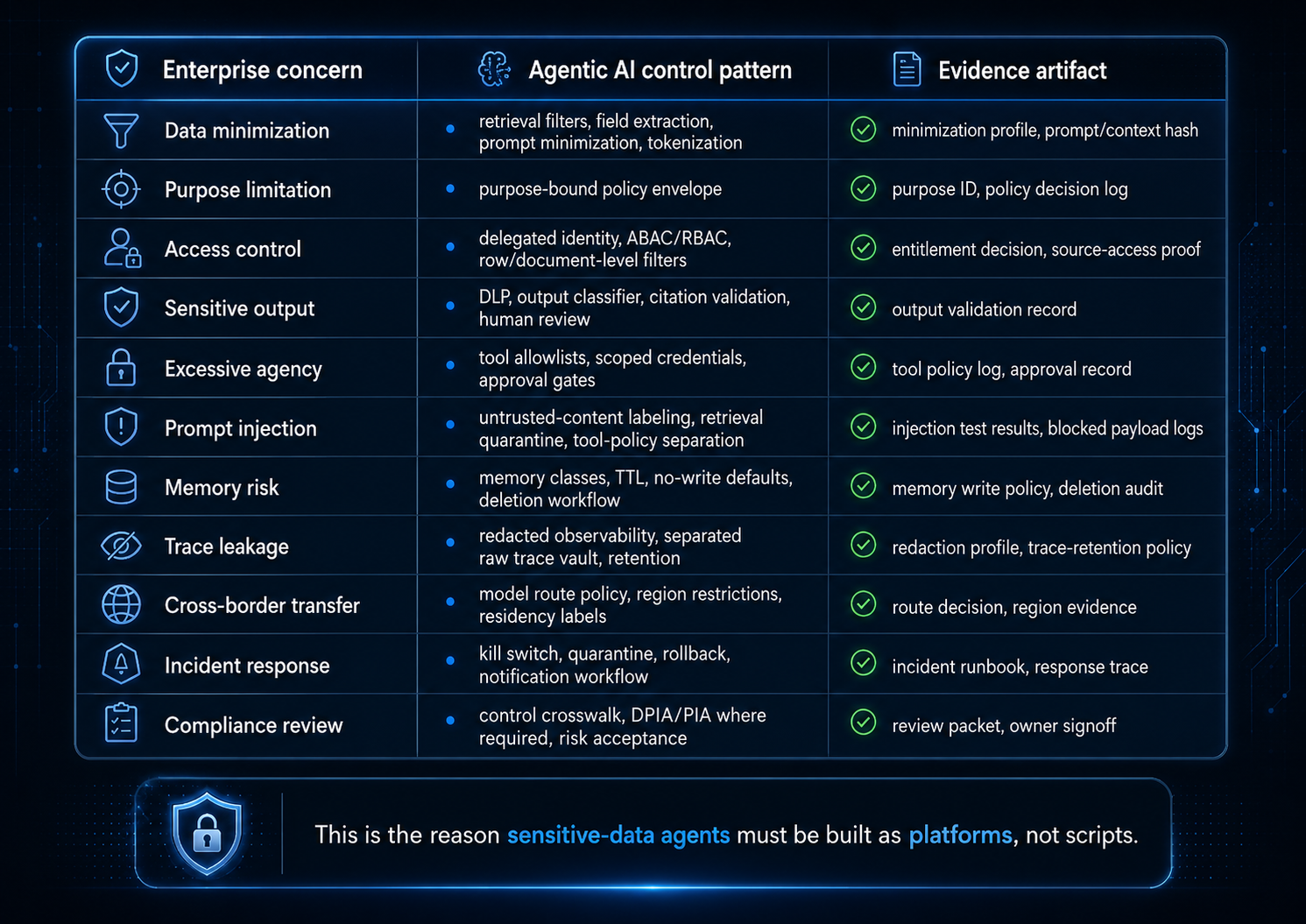
This is the reason sensitive-data agents must be built as platforms, not scripts.
17. The operating model: who owns the risk?
A regulated agent needs named owners.
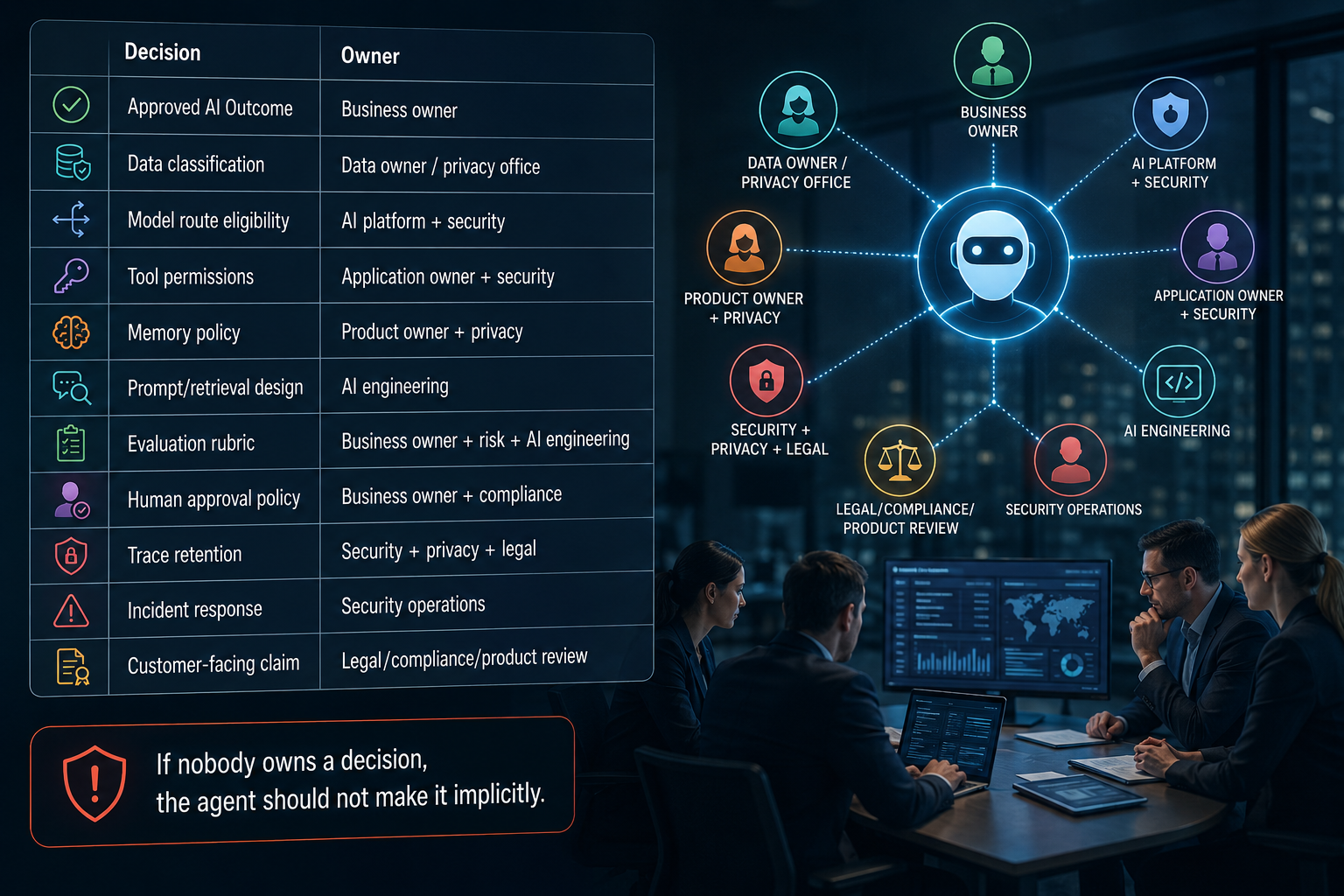
If nobody owns a decision, the agent should not make it implicitly.
Pre-sales and architecture proof package
For an enterprise pilot touching sensitive data, the proof package should include:
- data classification matrix;
- agent/tool permission map;
- model/runtime route policy table;
- redaction/tokenization examples;
- deny/human-review examples;
- sample audit log and evidence trace;
- prompt-injection and tool-misuse test results;
- retention and deletion story for prompts, outputs, logs, memory, vectors, caches, and derived artifacts;
- customer-specific claim boundary reviewed by security, legal, privacy, compliance, and risk owners.
This turns the blog’s architecture into a concrete field conversation: “What evidence would your security, legal, risk, or compliance teams need before this moves from demo to pilot?”
18. What “enterprise-grade” should mean in architecture review
In this article, “enterprise-grade” means control-pattern maturity and review readiness, not certification or legal compliance. A sensitive-data agent designed for enterprise review is not defined by how fluent it sounds.
It is defined by whether it can answer these questions:
- Who authorized this AI Outcome?
- What data was eligible?
- What data was excluded?
- What was minimized or redacted?
- Which model route was used and why was it allowed?
- Which tools were available?
- Which tools were actually called?
- What memory was read or written?
- Which policy version applied?
- Which human approvals were required?
- What evidence was retained?
- What expires, deletes, or falls under legal hold?
- How was the system tested against prompt injection, leakage, excessive agency, and memory poisoning?
- What happens when something goes wrong?
If the system cannot answer those questions, it may still be useful.
But it is not ready for regulated-data review.
19. The architecture pattern: route sensitive work through a trust gateway
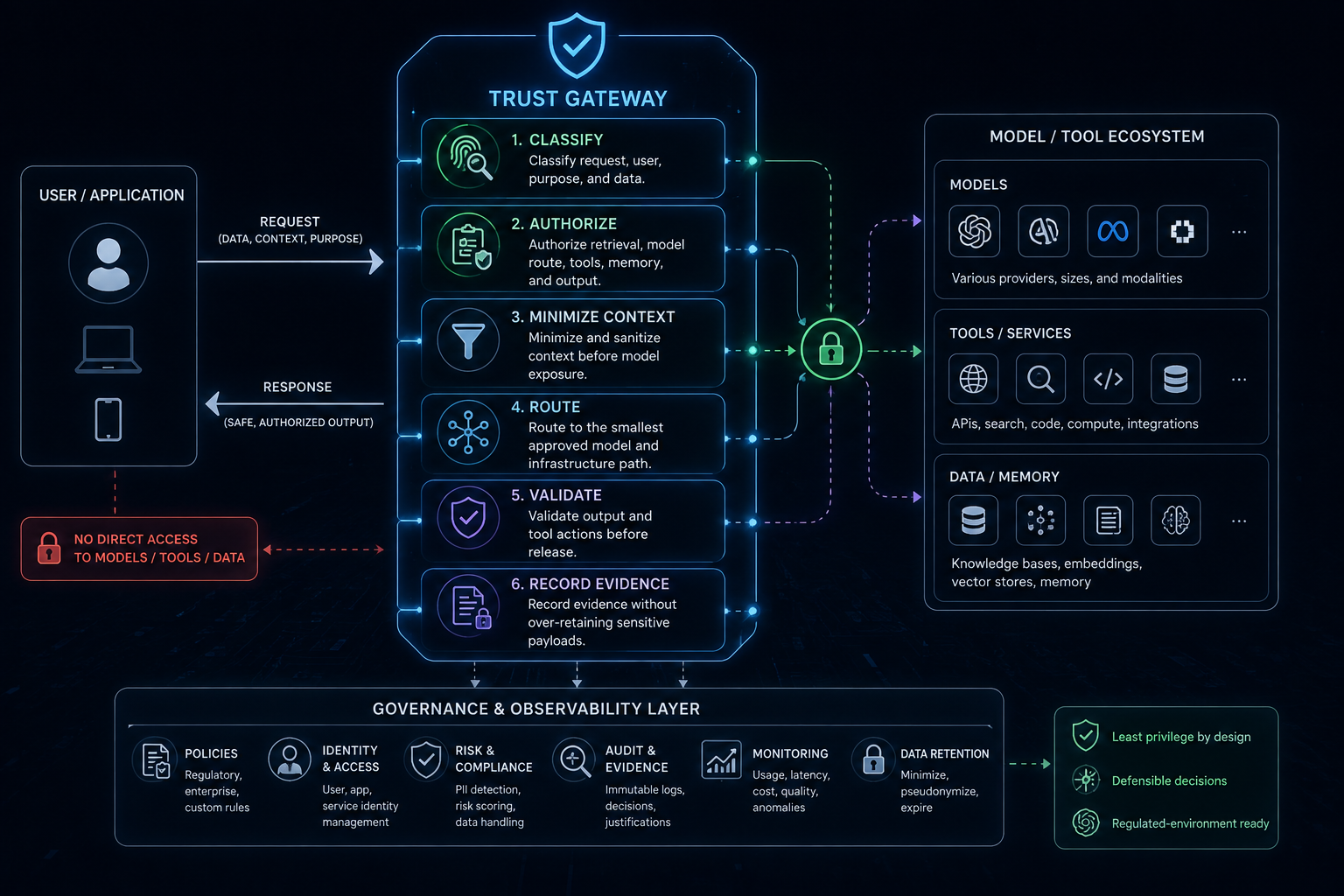
The most durable architecture pattern is a trust gateway between the user/application and the model/tool ecosystem.
The trust gateway performs six jobs:
- Classify the request, user, purpose, and data.
- Authorize retrieval, model route, tools, memory, and output.
- Minimize context before model exposure.
- Route to the smallest approved model and infrastructure path.
- Validate output and tool actions before release.
- Record evidence without over-retaining sensitive payloads.
This is where agentic AI can be designed for regulated-environment review.
Without the trust gateway, the model becomes the policy boundary.
With the trust gateway, the model becomes one governed component in a controlled system.
20. Conclusion: sensitive-data agents are evidence machines
The next generation of enterprise AI will not be won by the team that gives agents the most data or the most tools.
The advantage will belong to teams that can route the right data to the right model, through the right tools, for the right purpose, with the right approvals and the right evidence.
Sensitive-data agentic AI requires a different design center:
- policy before prompt;
- entitlement before retrieval;
- minimization before model exposure;
- scoped tools before autonomous action;
- memory governance before personalization;
- redacted evidence before observability;
- evaluation before trust;
- incident response before scale.
The enterprise agent is not just a reasoning loop.
It is a regulated execution path.
Treat it that way, and agentic AI becomes a more controlled candidate for enterprise adoption.
Ignore it, and the agent becomes a high-speed data leak with a friendly interface.
Source register and evidence notes
Source check: August 6, 2026. This blog intentionally avoids legal advice and avoids claiming that any architecture automatically satisfies a regulation. The sources below are used as authoritative or primary anchors for risk, privacy, security, and governance framing.
AI risk, privacy, and security governance
- NIST AI Risk Management Framework (AI RMF 1.0) — voluntary cross-sector AI risk framework organized around Govern, Map, Measure, and Manage.
https://www.nist.gov/itl/ai-risk-management-framework and https://nvlpubs.nist.gov/nistpubs/ai/nist.ai.100-1.pdf - NIST AI 600-1, Generative AI Profile — applies AI RMF framing to generative AI risks.
https://www.nist.gov/publications/artificial-intelligence-risk-management-framework-generative-artificial-intelligence - NIST AI RMF Playbook — suggested actions aligned to AI RMF outcomes.
https://airc.nist.gov/airmf-resources/playbook/ - NIST Privacy Framework — voluntary enterprise privacy-risk framework.
https://www.nist.gov/privacy-framework - NIST SP 800-122, Guide to Protecting the Confidentiality of PII — PII confidentiality and privacy/security relationship.
https://csrc.nist.gov/pubs/sp/800/122/final - NIST Glossary: PII — definition of personally identifiable information.
https://csrc.nist.gov/glossary/term/PII - NIST SP 800-53 Rev. 5 — catalog of security and privacy controls.
https://csrc.nist.gov/pubs/sp/800/53/r5/upd1/final - NIST SP 800-207, Zero Trust Architecture — resource-centric, identity/context-based access model.
https://csrc.nist.gov/pubs/sp/800/207/final - NIST SP 800-218, Secure Software Development Framework — secure development practices relevant to agent orchestrators, tool servers, connectors, and AI application SDLC.
https://csrc.nist.gov/pubs/sp/800/218/final - ISO/IEC 42001:2023 — AI management system standard.
https://www.iso.org/standard/42001 - ISO/IEC 23894:2023 — AI risk-management guidance.
https://www.iso.org/standard/77304.html
Agentic AI and LLM security
- OWASP GenAI LLM Top 10 2026 — current OWASP LLM risk guide for applications powered by LLMs.
https://genai.owasp.org/resource/owasp-genai-llm-top-10-2026/ - OWASP Top 10 for Agentic Applications 2026 — agent-focused threat taxonomy for autonomous and agentic AI systems.
https://genai.owasp.org/resource/owasp-top-10-for-agentic-applications-for-2026/ - OWASP GenAI Data Security Risks & Mitigations 2026 — data-layer security framing across prompts, training/fine-tuning data, outputs, and enterprise data flows.
https://genai.owasp.org/resource/owasp-genai-data-security-risks-mitigations-2026/ - OWASP Practical Guide for Secure MCP Server Development — secure architecture, authn/authz, validation, isolation, and hardened deployment for tool-integrated agents.
https://genai.owasp.org/resource/a-practical-guide-for-secure-mcp-server-development/ - NSA, Model Context Protocol (MCP): Security Design Considerations — government guidance on real-world MCP deployment risks and secure-by-default implementation needs.
https://www.nsa.gov/Portals/75/documents/Cybersecurity/CSI_MCP_SECURITY.pdf - MITRE ATLAS — living knowledge base of adversary tactics and techniques for AI systems.
https://atlas.mitre.org/ - Greshake et al., “Not what you’ve signed up for” — indirect prompt injection attack taxonomy and LLM-integrated application risk.
https://arxiv.org/abs/2302.12173 - Microsoft MSRC: Indirect prompt injection defenses — enterprise framing of indirect prompt injection in systems that process untrusted data.
https://www.microsoft.com/en-us/msrc/blog/2025/07/how-microsoft-defends-against-indirect-prompt-injection-attacks - CISA/NSA/FBI, Deploying AI Systems Securely — deployment and operation practices for externally developed AI systems.
https://media.defense.gov/2024/apr/15/2003439257/-1/-1/0/csi-deploying-ai-systems-securely.pdf - NCSC Secure AI System Development Guidelines — secure design, development, deployment, and operation lifecycle guidance.
https://www.ncsc.gov.uk/collection/guidelines-secure-ai-system-development
Regulated data and sector anchors
- HHS HIPAA Privacy Rule summary — PHI and individually identifiable health information framing.
https://www.hhs.gov/hipaa/for-professionals/privacy/laws-regulations/index.html - HHS HIPAA minimum necessary guidance — limiting PHI use, disclosure, and requests to what is needed for a purpose.
https://www.hhs.gov/hipaa/for-professionals/privacy/guidance/minimum-necessary-requirement/index.html - HHS HIPAA Security Rule summary — administrative, physical, and technical safeguards for ePHI.
https://www.hhs.gov/hipaa/for-professionals/security/laws-regulations/index.html - NIST SP 800-66 Rev. 2 — HIPAA Security Rule implementation guidance; does not replace or modify the rule.
https://nvlpubs.nist.gov/nistpubs/SpecialPublications/NIST.SP.800-66r2.pdf - HHS de-identification guidance — safe-harbor and expert-determination methods; de-identification should not be overstated as zero-risk.
https://www.hhs.gov/hipaa/for-professionals/special-topics/de-identification/index.html - PCI Security Standards Council: PCI DSS — baseline technical and operational requirements for payment account data.
https://www.pcisecuritystandards.org/standards/pci-dss/ - PCI SSC: PCI DSS v4.0.1 publication note — active-version context.
https://blog.pcisecuritystandards.org/just-published-pci-dss-v4-0-1 - European Commission: GDPR principles — data minimization, integrity/confidentiality, accountability, and other data protection principles.
https://commission.europa.eu/law/law-topic/data-protection/information-business-and-organisations/principles-gdpr_en - European Commission: Data protection by design and by default — privacy and data protection embedded in processing design.
https://commission.europa.eu/law/law-topic/data-protection/information-business-and-organisations/obligations/what-does-data-protection-design-and-default-mean_en - EU AI Act official regulation text — risk-based AI obligations and high-risk AI system requirements.
https://eur-lex.europa.eu/eli/reg/2024/1689/oj/eng - European Commission AI Act overview — trustworthy AI and risk-based regulatory framing.
https://digital-strategy.ec.europa.eu/en/policies/regulatory-framework-ai - EU AI Act Article 50 service desk — transparency duties for direct human interaction with AI systems.
https://ai-act-service-desk.ec.europa.eu/en/ai-act/article-50 - California CCPA/CPRA official page — consumer privacy rights and sensitive personal information considerations for California data.
https://oag.ca.gov/privacy/ccpa
OCI/cloud implementation references
- OCI Generative AI overview — official OCI documentation on model, agent, and governance capabilities.
https://docs.oracle.com/en-us/iaas/Content/generative-ai/overview.htm - OCI Generative AI Guardrails — configurable safety and compliance controls, including prompt-injection and PII detection patterns.
https://docs.oracle.com/en-us/iaas/Content/generative-ai/guardrails.htm - OCI Generative AI private endpoints — private access path for OCI Generative AI models within a VCN.
https://docs.oracle.com/en-us/iaas/Content/generative-ai/private-endpoint.htm - OCI Generative AI Agents overview — agent service capabilities including tools, RAG, guardrails, and human-in-the-loop.
https://docs.oracle.com/en-us/iaas/Content/generative-ai-agents/overview.htm - OCI Logging overview — logging, audit logs, service logs, custom logs, IAM integration, and log encryption context.
https://docs.oracle.com/en-us/iaas/Content/Logging/Concepts/loggingoverview.htm
Publication caveat
Agentic AI workflows that touch sensitive or regulated data require organization-specific review. The controls described here are architectural patterns for minimizing exposure, enforcing authorization, and preserving evidence; they do not by themselves establish legal or regulatory compliance. Customers should validate use cases with their legal, privacy, security, compliance, and risk teams before production use.