The Operating Model Has to Change Before AI Can Transform the Business
AI-native transformation is not about adding more tools. It is about redesigning work for a world where people may direct portfolios of AI agents.
According to McKinsey Global Institute research, the majority of companies are still treating AI like software: deploy the tool, train the users, measure productivity, and move on. That mental model is too small.
For decades, the operating model was built around a familiar assumption: humans do the work, software helps, managers coordinate, and systems of record capture what happened after the fact. Technology improved the speed of the process, but the basic relationship stayed intact. People operated the machine.
AI-native transformation changes that relationship. As agents become more capable, the enterprise is moving from a model where employees use applications to one where employees direct, supervise, and improve networks of machine capabilities.
In this post, "digital worker" is a metaphor for AI agents that can draft, research, reconcile, classify, test, monitor, summarize, route, or execute parts of a workflow. The metaphor is useful because these systems can perform work-like activity. It is also dangerous if taken literally: AI agents are not employees, do not carry human accountability, and should not be treated as moral or legal actors. A May 2026 Harvard Business Review article makes the same caution explicit in its warning against treating AI agents like employees.
The operating question is therefore not "How do we give people better software?" It is "How do we design a system in which humans remain accountable while machines expand the capacity to produce reliable outcomes?"
That is a much deeper transformation than automation.
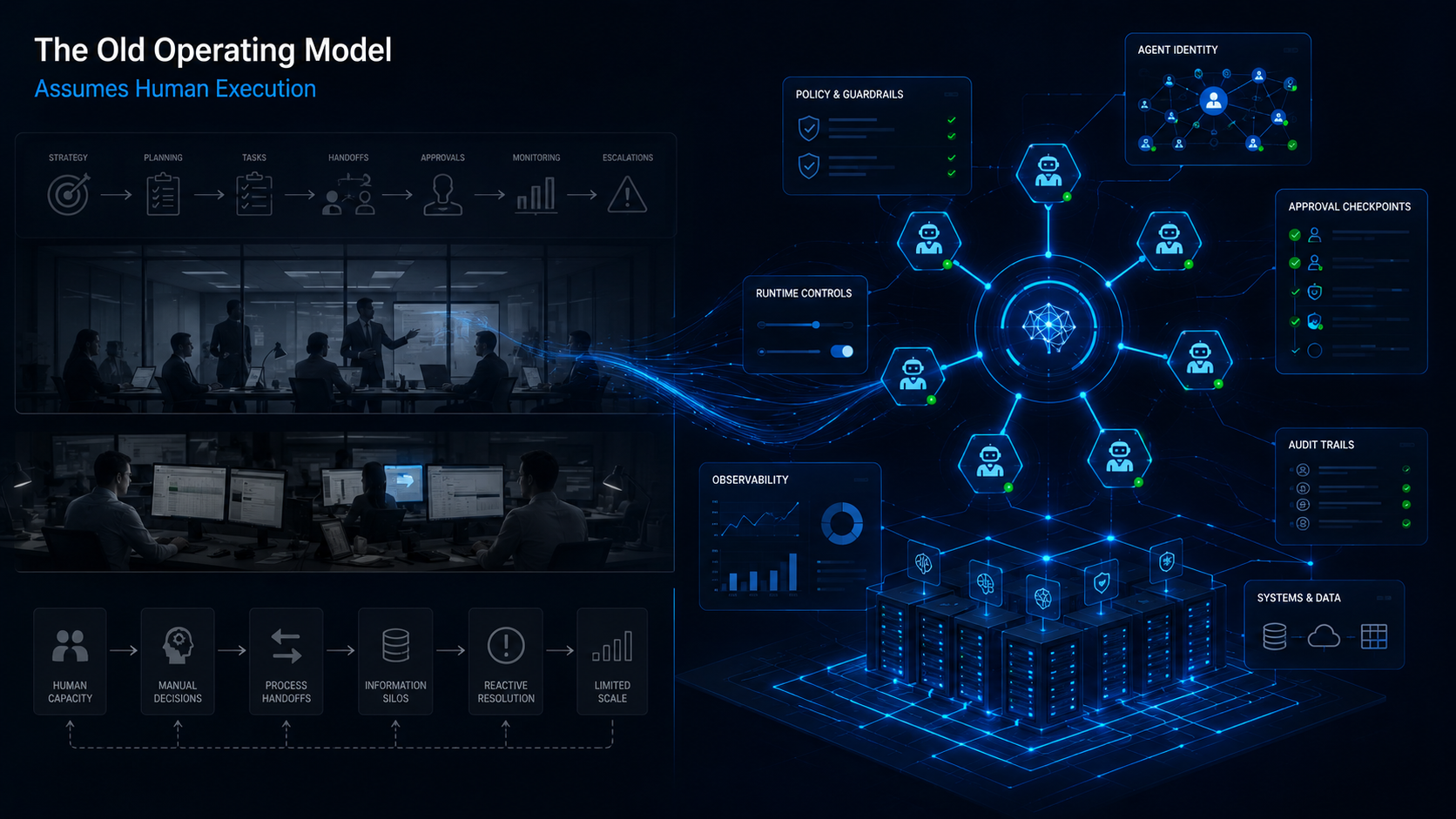
The old operating model assumes human execution
The traditional operating model was designed around human capacity. Work was decomposed into functions, roles, handoffs, meetings, approvals, dashboards, and escalation paths. Managers translated strategy into tasks, monitored performance, resolved exceptions, and made judgment calls when the process did not fit the situation.
Software supported that model, but it rarely challenged it. A CRM did not decide the sales strategy. An ERP did not decide how to resolve a supplier dispute. A project management tool did not decide which trade-offs mattered. The application stored information, accelerated steps, and enforced workflow rules, but people remained the primary unit of execution.
AI agents introduce a different pattern. Gartner defines AI agents as autonomous or semi-autonomous software entities that use AI techniques to perceive, decide, act, and pursue goals in digital or physical environments. That does not make them employees. It does mean they are no longer passive tools in the old sense.
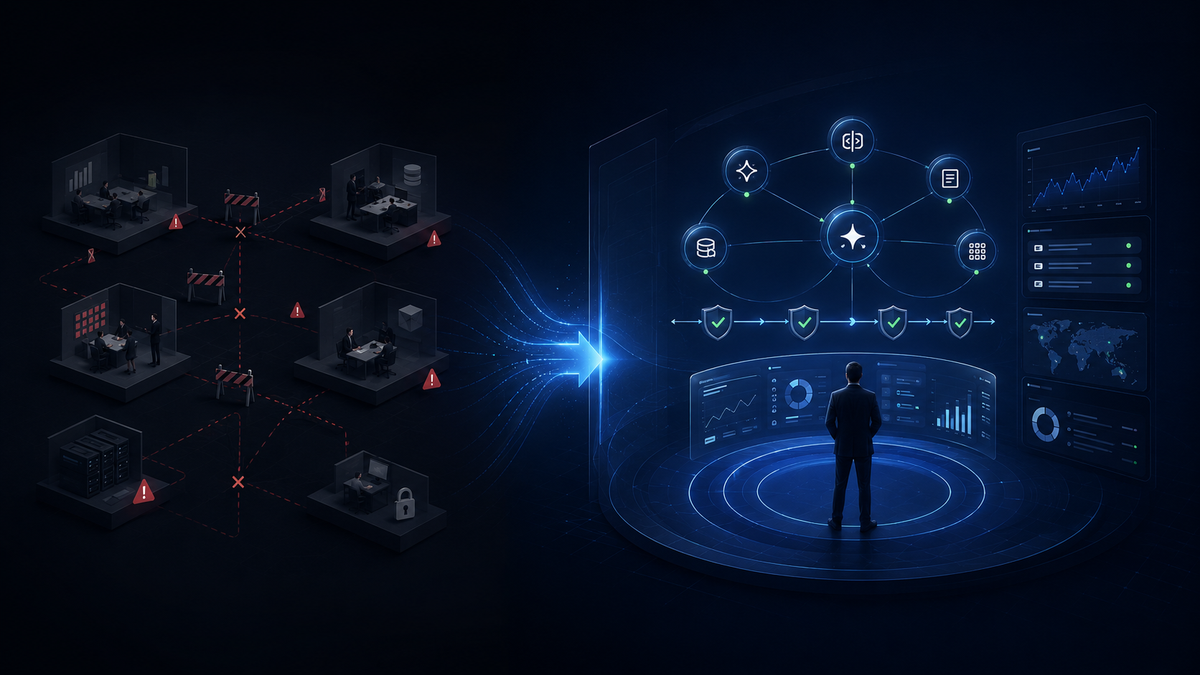
This is where many AI programs stall. Companies deploy copilots and agents into operating models that were never designed to absorb machine execution. The result is a familiar pattern: impressive demos, scattered productivity gains, governance anxiety, and limited enterprise-level transformation.
The constraint is no longer only model capability. It is organizational design.
The new unit of work is the outcome, not the task
AI-native transformation requires leaders to stop asking only, "Which tasks can AI automate?" and start asking, "Which outcomes can be redesigned around human-machine teams?"
That distinction matters.
Task automation improves an existing step. Outcome redesign changes the shape of the work. A task view says: "Can AI write the first draft of this report?" An outcome view asks: "What would it take to continuously sense market signals, generate evidence-backed options, test assumptions, route exceptions, and produce a decision-ready brief with clear accountability?"
The first question adds AI to a workflow. The second question redesigns the workflow around AI.
McKinsey's 2025 report on people, agents, and robots estimates that today's technology could, in theory, automate about 57% of current U.S. work hours. McKinsey explicitly frames this as technical potential, not a prediction that half of jobs will disappear. The practical implication is not "replace the workforce." It is "re-architect the work."
In an AI-native operating model, a workflow is not a linear chain of human handoffs. It is a managed system of intent, context, machine execution, human judgment, policy, feedback, and learning.
Redefining the human-machine relationship
With that definition in place, the human-machine relationship needs to be explicit. If organizations treat AI agents exactly like employees, they risk anthropomorphizing systems that do not possess accountability, values, lived context, or moral judgment. A better framing is this:
Humans remain accountable for intent, judgment, values, and outcomes. Machines expand the organization's capacity to sense, generate, analyze, coordinate, and execute.
That means the human role does not disappear. It moves up the value chain.
Employees will increasingly be asked to:
- Define goals and constraints clearly enough for agents to act.
- Decide which work should be automated, augmented, or kept human-led.
- Provide context that is not obvious from data alone.
- Review exceptions, edge cases, and high-consequence decisions.
- Teach agents how the organization makes decisions.
- Monitor quality, drift, risk, and unintended consequences.
- Improve the system over time.
This is not a small skill shift. The World Economic Forum's Future of Jobs Report 2025 estimates that 39% of workers' existing skill sets may be transformed or become outdated over the 2025-2030 period. The same report says skill gaps are the biggest barrier to business transformation for surveyed employers. The exact impact will vary by industry, geography, and adoption path, but the direction is clear enough: work is being re-bundled.
The employee of the AI-native enterprise is not merely a tool user. They are becoming a designer, orchestrator, coach, auditor, and accountable owner of human-machine performance.
A scenario to design for: one employee, many digital workers
The managerial model also has to change.
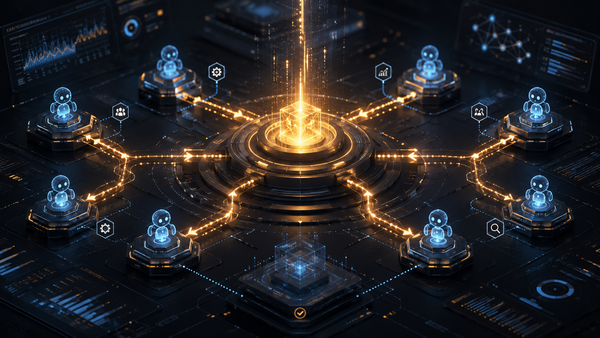
This should be treated as a forward-looking operating scenario, not as a current enterprise norm. Strong public evidence that employees routinely manage dozens or hundreds of AI agents in production is still limited. But the scenario is plausible enough to design for now: as agent adoption grows, some employees may eventually oversee portfolios of specialized digital workers rather than a single application or assistant.
Dozens of digital workers -- and, in some future operating environments, hundreds -- should therefore be framed as a planning case. It is a way to test the operating model before scale exposes its weaknesses.
That is different from people management. A human manager can supervise a team of people because the system relies on shared norms, professional judgment, communication, and mutual accountability. A large digital-worker portfolio is closer to a complex control system. Gartner notes that AI agents can operate with different levels of human involvement and that multi-agent systems can address complex tasks. That makes orchestration, monitoring, and escalation design central to the operating model.
At small scale, a person can prompt an agent, check its output, and move on. At larger scale, manual inspection of every action will not be enough. The operating model needs orchestration, observability, policy, and exception design.
That creates new management questions:
- Which agents are authorized to act, and within what boundaries?
- Who owns the outcome when multiple agents contribute to it?
- Which decisions require human approval?
- What evidence must an agent preserve when it makes a recommendation?
- How are errors detected, corrected, and learned from?
- When should an agent escalate, pause, or refuse to act?
- How do we prevent agent sprawl from becoming the next form of shadow IT?
In other words, the "manager of digital workers" is not simply assigning tasks. They are designing a governed production system.
This is why AI-native transformation belongs in the operating model, not just the technology roadmap.
Seven operating-model shifts for AI-native transformation
1. From org charts to work architecture
The org chart tells you who reports to whom. It does not tell you how work actually moves through the enterprise. AI transformation needs a map of workflows, decisions, data, controls, and accountability.
Leaders should identify the work that matters most, then redesign it around the best combination of human judgment, agent execution, and system controls. The question is not whether AI can fit into the current process. The question is whether the current process still makes sense.
2. From roles to human-machine responsibilities
Job descriptions need to evolve from lists of tasks to responsibility maps. Some responsibilities will remain human-led. Some will be AI-augmented. Some will be agent-executed with human oversight. Some should not be automated because the risk, ambiguity, or trust requirement is too high.
This requires explicit design. If the organization does not define the boundary, the boundary will be improvised by teams under pressure.
3. From supervision to orchestration
Managers will spend less time tracking whether people completed routine steps and more time shaping systems that produce reliable outcomes. That includes setting standards, selecting agent patterns, monitoring performance, coaching employees, and handling exceptions.
The best managers will not be those who simply "use AI." They will be those who can translate business intent into a working human-machine system.
4. From process compliance to decision architecture
AI agents need more than procedures. They need decision rules, escalation thresholds, evidence requirements, and operating constraints.
In June 2026, HBR argued that as agents take on more complex work, the key constraint becomes an organization's ability to make decision-making processes explicit. That is exactly the point: if the company cannot explain how good decisions are made, it cannot reliably delegate parts of those decisions to machines.
Decision architecture becomes a core operating capability.
5. From after-the-fact governance to embedded controls
AI governance cannot live only in a review board or policy document. It has to be embedded into the flow of work.
NIST's AI Risk Management Framework is designed to help organizations manage AI risks to individuals, organizations, and society, while improving how trustworthiness considerations are incorporated into AI design, development, use, and evaluation. The OECD AI Principles, adopted in 2019 and updated in 2024, emphasize trustworthy AI that respects human rights and democratic values. For business leaders, the operating lesson is practical: governance has to be designed into agent permissions, audit trails, data access, testing, monitoring, and escalation.
If governance arrives only after deployment, it will either slow the business down or fail to control the risk.
6. From productivity metrics to system performance metrics
AI programs often over-focus on time saved. Time saved matters, but it is not enough.
An AI-native operating model should measure system performance: cycle time, quality, rework, decision latency, risk reduction, customer impact, employee capacity, exception rates, auditability, and learning velocity. A bad agent that produces fast work creates hidden cost. A good agent that reduces ambiguity, preserves evidence, and improves decisions may create value even when the time savings are modest.
The metric should match the outcome, not the hype.
7. From training events to continuous capability building
AI fluency cannot be solved with a one-time training program. The technology changes too quickly, and the work changes with it.
Organizations need continuous capability building: prompt literacy, agent design, workflow redesign, data judgment, risk awareness, critical thinking, and exception management. Microsoft's 2026 Work Trend Index highlights the continued importance of human judgment, critical thinking, and quality control among professionals working with AI. That is a useful reminder: the more capable the machine becomes, the more important it is for humans to know when to trust it, when to challenge it, and when to take over.
The new operating model in one sentence
The AI-native operating model is a governed system for combining human judgment and machine execution to produce better outcomes than either could produce alone.
That sentence has four important parts.
It is governed because autonomy without accountability does not scale.
It is a system because value comes from redesigning workflows, not sprinkling AI into isolated tasks.
It combines human judgment and machine execution because the future of work is not purely human or purely automated.
It focuses on better outcomes because productivity gains only matter when they translate into performance, trust, resilience, and strategic advantage.
What leaders should do next
For executives beginning this transition, the practical starting point is not to launch another AI pilot. It is to select one high-value workflow and redesign it as a human-machine operating system.
Start with five moves:
- Choose a workflow that matters. Pick one with real business value, measurable outcomes, and enough complexity to justify redesign.
- Map the decisions, not just the tasks. Identify where judgment, policy, data, and exceptions shape the outcome.
- Define the human-machine boundary. Decide what agents may do, what humans must approve, and what should remain human-led.
- Instrument the system. Build in evidence capture, audit trails, quality checks, escalation paths, and performance metrics.
- Train the humans as orchestrators. Teach employees how to direct, evaluate, and improve digital workers -- not just how to prompt a chatbot.
Then repeat.
The companies that win with AI will not be the ones with the largest number of agents. They will be the ones with the clearest operating model for putting agents to work responsibly.
The paradox of AI-native transformation
The more active machines become in the enterprise, the more explicit organizations must be about human responsibility.
When execution becomes abundant, judgment becomes scarce. When content becomes cheap, trust becomes valuable. When agents can move faster than people can manually supervise, governance has to become design, not bureaucracy. And if employees eventually manage large portfolios of digital workers, leadership will be less about directing every action and more about shaping the conditions under which people and machines produce accountable outcomes together.
The future operating model will not be human-only or machine-led. It will be human-accountable, machine-amplified, and designed for a new kind of work.
Source notes and additional reading
- McKinsey Global Institute, Agents, Robots, and Us: Skill Partnerships in the Age of AI — work redesign, technical automation potential, and human-machine collaboration. https://www.mckinsey.com/mgi/our-research/agents-robots-and-us-skill-partnerships-in-the-age-of-ai
- Microsoft WorkLab, 2026 Work Trend Index: Agents, Human Agency, and the Opportunity for Every Organization — human judgment, critical thinking, and quality control in AI-enabled work. https://www.microsoft.com/en-us/worklab/work-trend-index/agents-human-agency-and-the-opportunity-for-every-organization
- World Economic Forum, The Future of Jobs Report 2025 — workforce and skills-change context through 2030. https://www.weforum.org/publications/the-future-of-jobs-report-2025/
- NIST, AI Risk Management Framework — AI risk management and trustworthiness. https://www.nist.gov/itl/ai-risk-management-framework
- OECD, AI Principles — trustworthy AI, human rights, democratic values, and human-centered safeguards. https://www.oecd.org/en/topics/ai-principles.html
- Harvard Business Review, Teach Your AI How You Make Decisions — June 25, 2026 article on making decision processes explicit for AI agents. https://hbr.org/2026/06/teach-your-ai-how-you-make-decisions
- Harvard Business Review, Research: Why You Shouldn't Treat AI Agents Like Employees — May 6, 2026 caution on anthropomorphizing AI agents as employees. https://hbr.org/2026/05/research-why-you-shouldnt-treat-ai-agents-like-employees
- Gartner, How to Implement AI Agents to Transform Business Models — AI-agent definition, human-in-the-loop distinctions, and multi-agent systems. https://www.gartner.com/en/articles/2025/ai-agents