The Hidden Risk of Autonomous Agents: Action Without Oversight

The biggest risk in agentic AI is not that agents generate bad answers. It is that they can take real action before the enterprise has enough visibility, policy, and control.
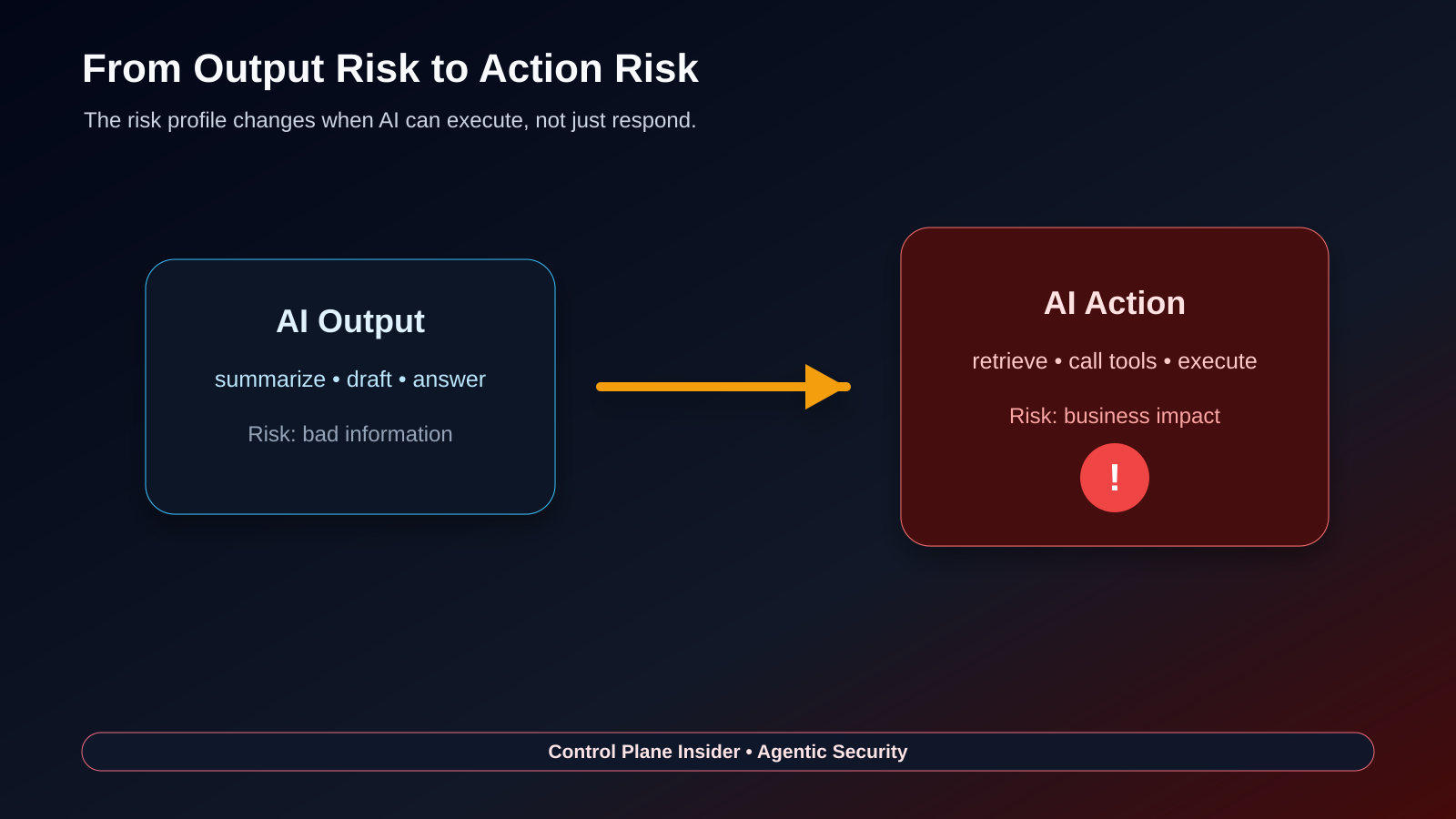
The risk is moving from output to action
For years, enterprise AI risk conversations focused on outputs.
Did the model hallucinate? Was the answer biased? Did the chatbot give the wrong information? Could the system leak sensitive data in a response?
Those risks still matter. But autonomous agents introduce a larger shift.
The central risk is no longer only what AI says. It is what AI does.
An agent can retrieve a record, call an API, update a ticket, send a message, modify a workflow, analyze a security alert, recommend an exception, or trigger a downstream process. The moment AI moves from generating content to taking action, the enterprise security and governance model changes.
That is the hidden risk of autonomous agents: action without oversight.
A bad answer can create confusion. A bad action can create operational, financial, legal, reputational, or security impact.
Autonomy changes the control problem
Traditional software follows defined paths. A user clicks a button. A workflow runs. A system executes logic that engineers designed in advance.
Autonomous agents behave differently.
They interpret goals. They choose steps. They decide which information to retrieve. They select tools. They adapt when conditions change. They may operate across systems that were never designed as one unified workflow.
That flexibility is what makes agents valuable.
It is also what makes them difficult to govern.
A deterministic application can be reviewed by inspecting code paths and permissions. An agentic workflow requires visibility into intent, context, reasoning, retrieval, tool calls, policy checks, approvals, and final outcomes.
If the enterprise cannot see that chain, it cannot reliably control it.
Where oversight breaks down
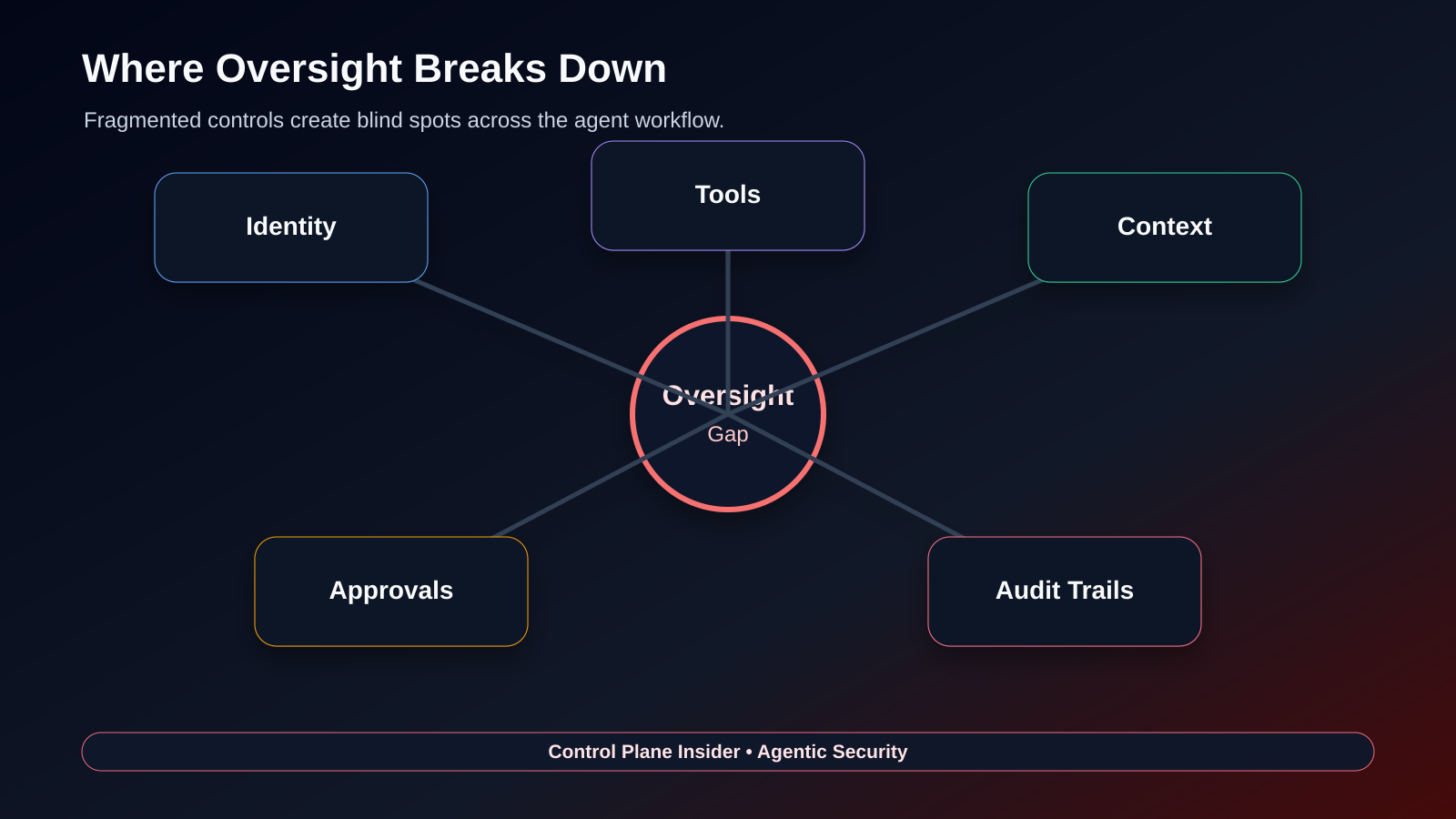
Oversight usually breaks down in five places.
1. Unclear agent identity
If an organization cannot identify which agent acted, who owns it, and what business purpose it serves, accountability becomes weak. Agents need identity just like users, applications, workloads, and service accounts.
2. Excessive tool permissions
Agents become risky when they can use powerful tools without clear boundaries. A support agent that can draft a response is different from one that can issue refunds, update customer records, or send external communications automatically.
3. Unbounded context
Agents often retrieve more data than a task requires. Without context boundaries, sensitive information can enter workflows unnecessarily, creating privacy, compliance, and data leakage risk.
4. Missing approval gates
Some actions should be automatic. Others should require human approval. Without defined autonomy levels, enterprises either over-restrict useful agents or allow risky actions to proceed unchecked.
5. Incomplete audit trails
If an incident occurs, teams need to reconstruct what happened. They need the instruction, retrieved context, model output, tool calls, policy evaluations, approvals, and final action. Without that trace, oversight becomes guesswork.
The false comfort of human-in-the-loop
Many enterprises respond to agentic risk by saying, “We will keep a human in the loop.”
That is useful, but incomplete.
Human review only works when the reviewer has the right context, the right timing, and the right authority.
If a human sees only the final recommendation, they may not know which data the agent used, which tool it called, what policy applied, or what risks were detected along the way.
If approval requests arrive too often, reviewers become fatigued and rubber-stamp decisions. If they arrive too late, the action may already have created risk. If they lack business or security context, they may approve the wrong thing.
The future is not simply human-in-the-loop.
The future is control-plane-in-the-loop.
The AI control plane should determine when human review is necessary, what context the reviewer needs, what decision options are available, and how the approval is recorded.
Why real-time governance matters
Autonomous agents operate at machine speed. Governance cannot rely only on after-the-fact review.
If an agent is about to send sensitive information outside the company, governance has to evaluate that action before it happens.
If an agent is about to modify production infrastructure, the system needs to check authorization, risk, change windows, approval requirements, and rollback controls in real time.
If an agent is attempting unusual data access, the enterprise needs a way to challenge, redact, block, or escalate that behavior immediately.
Real-time governance is the difference between observing risk and controlling risk.
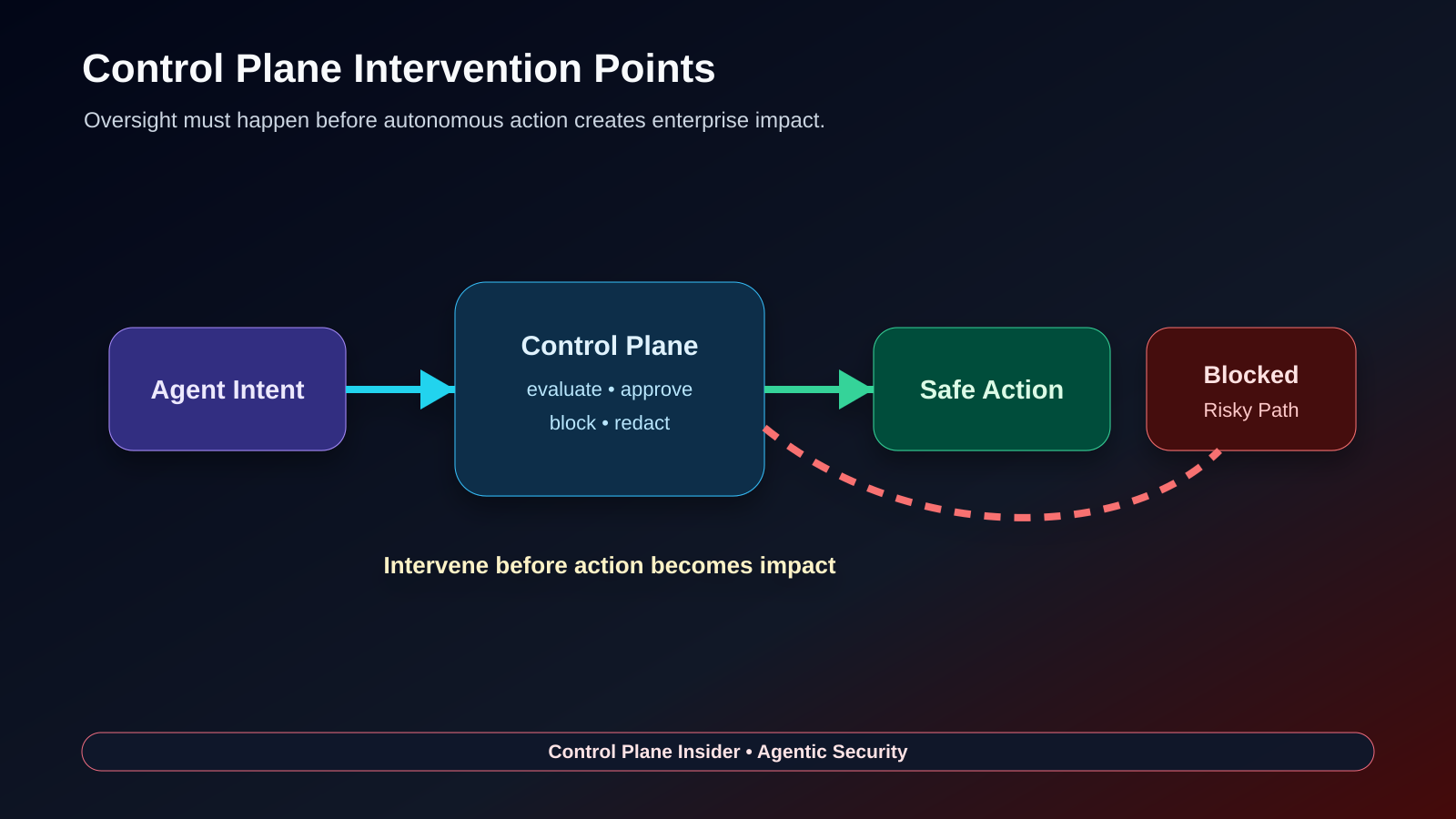
The control plane model for oversight
Oversight for autonomous agents requires a control plane that can coordinate five capabilities.
Visibility
The enterprise needs a live view of agents, owners, workflows, tools, data connections, and autonomy levels.
Policy
Rules must define what agents can do based on identity, task, data sensitivity, tool risk, business purpose, and regulatory requirements.
Decisioning
The system must evaluate actions at runtime and decide whether to allow, block, redact, route for approval, or escalate.
Auditability
Every important workflow should produce a trace that explains the path from intent to outcome.
Learning
The control plane should improve over time by analyzing exceptions, approvals, incidents, and behavioral patterns.
This is how oversight becomes operational instead of aspirational.
What enterprises should do now
To reduce the risk of action without oversight, enterprises should start with practical controls:
- Inventory agents — know what exists and who owns it.
- Classify autonomy — distinguish suggest, draft, execute-with-approval, and execute-autonomously.
- Limit tools — apply least privilege to every agent tool.
- Define approval gates — route high-risk actions to the right reviewers.
- Bound context — restrict data use by task, purpose, and sensitivity.
- Capture traces — log intent, retrieval, model outputs, tools, policy checks, approvals, and outcomes.
- Create kill switches — ensure risky agents or workflows can be paused quickly.
- Review drift — reassess agents as their tools, memory, permissions, and use cases expand.
The goal is not to eliminate autonomy. The goal is to make autonomy governable.
The strategic takeaway
Autonomous agents will create real enterprise value because they can do more than answer questions. They can act.
That is exactly why they require stronger oversight.
The hidden risk is not only a bad response. It is an unobserved action, using the wrong data, through the wrong tool, without the right approval, at the wrong moment.
Enterprises that want to scale agentic AI need more than model monitoring. They need control over the full chain of autonomous behavior.
That means identity, permissions, context, policy, observability, enforcement, and real-time governance.
In the agentic era, oversight cannot be an afterthought.
It has to be built into the control plane.