Policy-as-Intelligence: The Future of AI Governance
Static rules cannot govern autonomous systems. Enterprises need policies that understand context, risk, intent, identity, and business impact in real time.
Executive Summary
AI governance is entering a new phase.
The first phase was policy-as-document: acceptable-use standards, model risk frameworks, review boards, and compliance binders. The second phase was policy-as-rule: hardcoded controls, access restrictions, approval workflows, and static guardrails. Both still matter. But neither is enough for agentic AI.
Agents do not simply generate answers. They interpret goals, retrieve data, select tools, chain actions, trigger workflows, and adapt their plans. That changes the governance problem from “Did we approve this system?” to “Should this action be allowed right now, in this context, by this actor, against this data, with this tool, for this business purpose?”
That is the shift toward policy-as-intelligence: governance that evaluates context, risk, identity, intent, data sensitivity, tool permissions, workflow state, and business impact at runtime.
A policy that cannot act when an agent acts is not governance. It is documentation.
Static Policy Was Built for Slower Systems
Traditional governance assumes a world of relatively stable applications, predictable workflows, known users, and periodic audits. A team proposes a system. A review process evaluates it. Policies are documented. Controls are mapped. Exceptions are tracked. Audits happen later.
That rhythm made sense when software mostly waited for human instruction.
Agentic AI compresses that timeline. An agent may receive a goal, decompose the work, call multiple tools, retrieve records, draft content, update a ticket, send a message, query a system, or invoke an API. Each individual step may look reasonable in isolation. The risk emerges from the chain: who is acting, what they are trying to do, what data is touched, which systems are invoked, what can be reversed, and what happens if the agent is wrong.
This is why security agencies now emphasize careful, incremental adoption of agentic AI, continuous assessment against evolving threat models, strong governance, explicit accountability, monitoring, and human oversight. It is also why frameworks such as the NIST AI Risk Management Framework and ISO/IEC 42001 matter: they push AI risk management into lifecycle practice rather than one-time approval.
But the enterprise still needs a missing layer: the ability to execute policy while AI work is happening.
Hardcoded Rules Break Under Context
The instinctive answer is to create more rules.
Block sensitive data. Require approval above a threshold. Prevent external sharing. Limit tool access. Log everything.
Those are useful starting points, but they are too blunt on their own. In agentic systems, the right policy decision often depends on context:
- Who is requesting the action?
- Which agent is acting on their behalf?
- What business process is involved?
- What data class is being accessed?
- What tool will be invoked?
- Is the action reversible?
- Is there customer, financial, legal, security, or reputational impact?
- Has this workflow produced exceptions before?
- Is the agent operating inside its normal scope?
- Does the action require a human decision, or only better evidence?
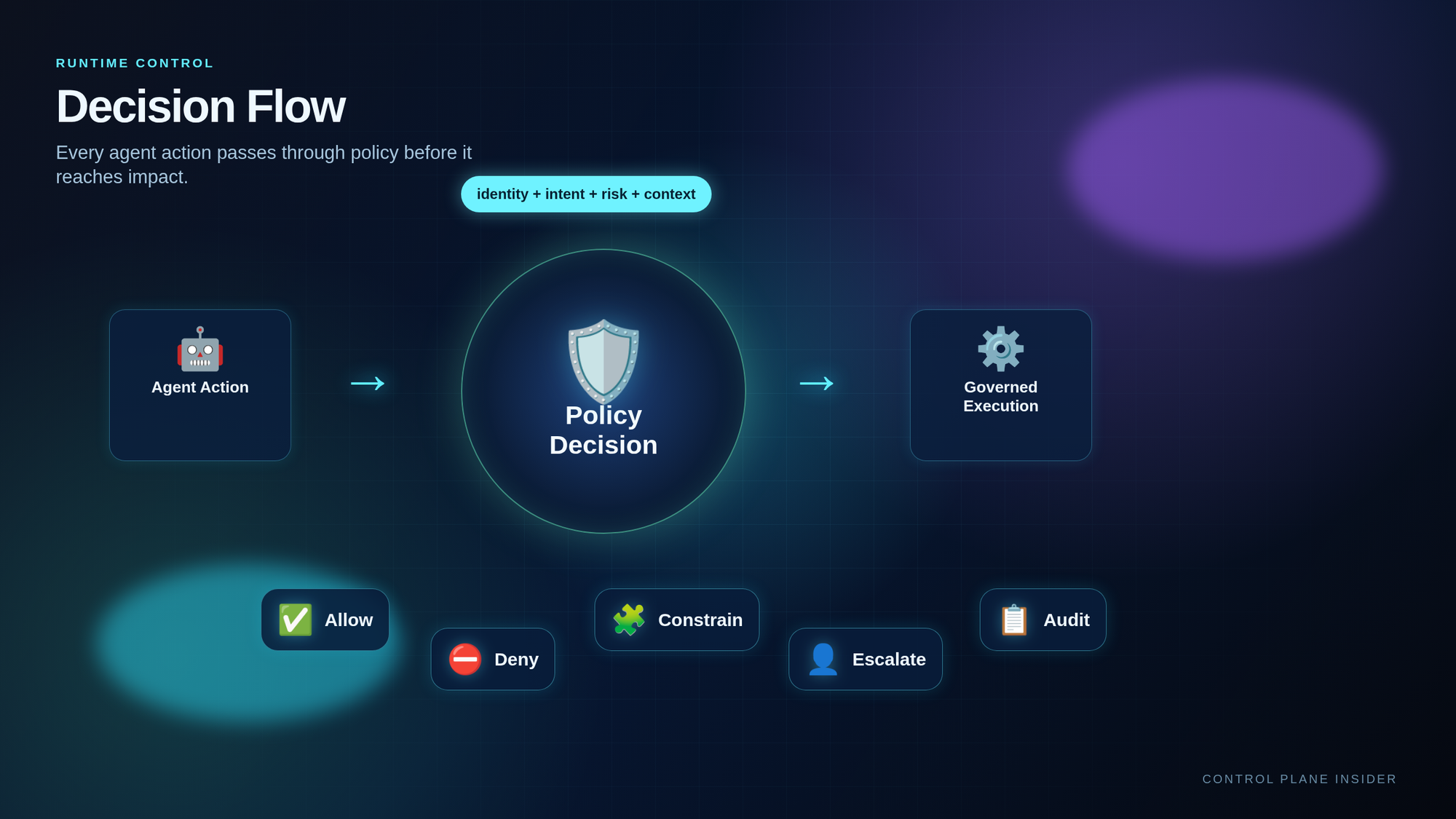
A static rule can say “deny.” A better governance system can say: allow, deny, redact, constrain, require human approval, route to a higher-trust model, request more evidence, log for monitoring, quarantine the output, or roll back the action.
That is not just policy enforcement. That is policy reasoning.
What Policy-as-Intelligence Means
Policy-as-intelligence does not mean handing governance to a black box. It means turning policy into an executable, observable, and continuously improving decision layer.
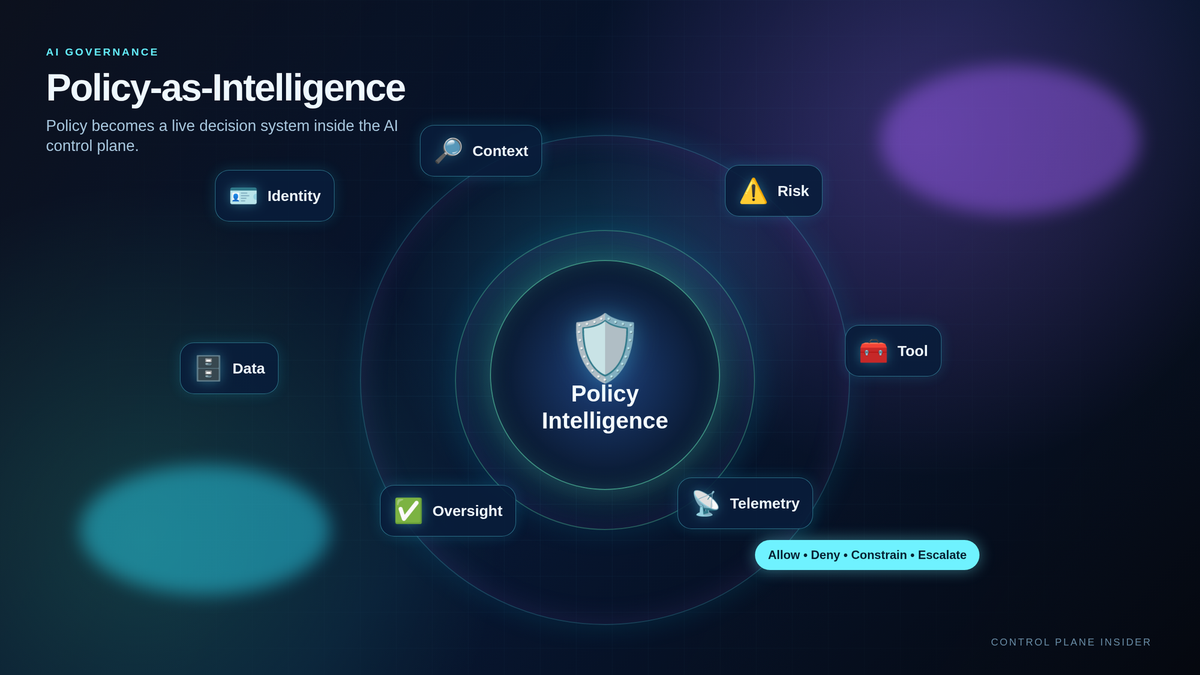
At a minimum, that layer needs five inputs.
1. Identity
Who is the human, agent, service, model, or system involved? What permissions, roles, obligations, and history apply?
2. Context
What workflow is underway? What is the stated goal? What step is this in the process? What system boundary is being crossed?
3. Risk signals
What data is involved? How sensitive is it? Is the tool high-impact? Is the action reversible? Is the request unusual compared with normal behavior?
4. Policy logic
Which rules, obligations, escalation paths, and control requirements apply to this specific action?
5. Telemetry and outcomes
What happened last time? Were there overrides, incidents, false positives, delays, or successful completions that should improve the next decision?
When those inputs come together, governance becomes adaptive without becoming arbitrary. The enterprise can create decision paths that are fast for low-risk work, strict for high-impact work, and precise for everything in between.
The Control Plane Becomes the Policy Execution Layer
Policy-as-intelligence cannot live only in a PDF, GRC workflow, or quarterly dashboard. It has to sit where agents, models, tools, data, workflows, humans, and approvals interact.
That place is the AI control plane.
The control plane is where the enterprise can see what agents are doing, coordinate workflows, observe tool calls, enforce access boundaries, route approvals, capture audit trails, and improve system behavior. If the control plane only reports after the fact, it is a dashboard. If it can intervene at runtime, it becomes governance infrastructure.
This is the architectural shift leaders should pay attention to:
- Governance moves from review to runtime.
- Oversight moves from generic approval to risk-based escalation.
- Audit moves from sampled evidence to traceable execution.
- Policy moves from static documents to executable intelligence.
Human Oversight Gets More Precise
Policy-as-intelligence is not an argument for removing humans from governance. It is an argument for using human attention better.
Putting a human in every loop will not scale. It will slow down low-risk work, create approval fatigue, and train teams to route around the system. The better model is to put the right human in the right loop at the right risk threshold.
A low-risk summarization task may only need logging. A reversible internal workflow may need constraints. A customer-impacting action may need approval. A legal, financial, security, or reputationally sensitive action may need escalation to a specific accountable owner.
The goal is not more approvals. The goal is better judgment embedded in the flow of work.
Governance Becomes a Learning System
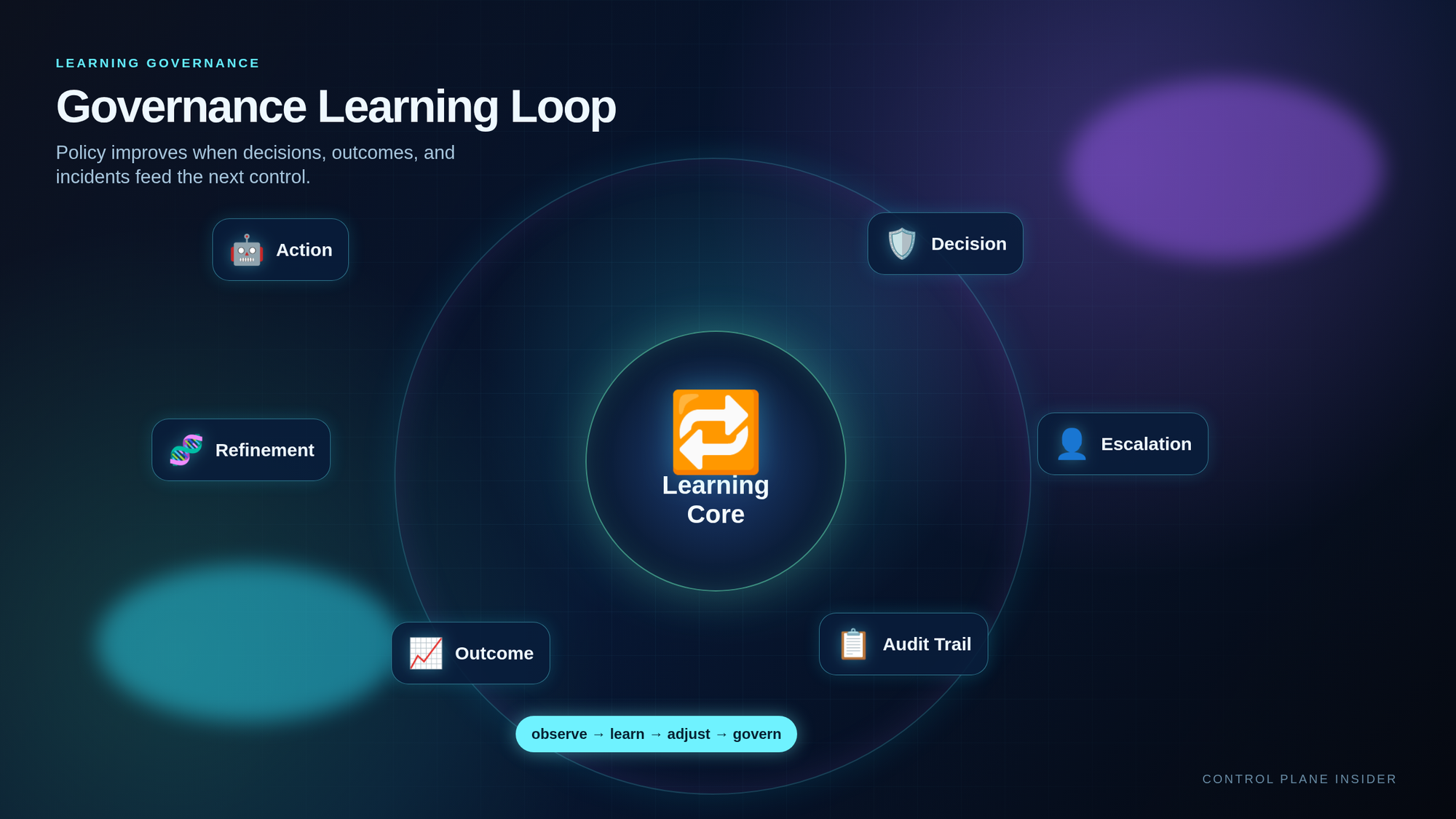
The most important part of policy-as-intelligence is the learning loop.
Every approval, denial, exception, override, incident, false positive, false negative, rollback, and successful completion is a governance signal. Those signals should improve the system.
If a control blocks too much legitimate work, it should be refined. If a certain agent repeatedly triggers exceptions, its scope should be adjusted. If a tool creates disproportionate risk, its access should be constrained. If a particular workflow always requires approval, the policy may need a clearer threshold or a better pre-check.
This is how governance moves from compliance theater to operational intelligence.
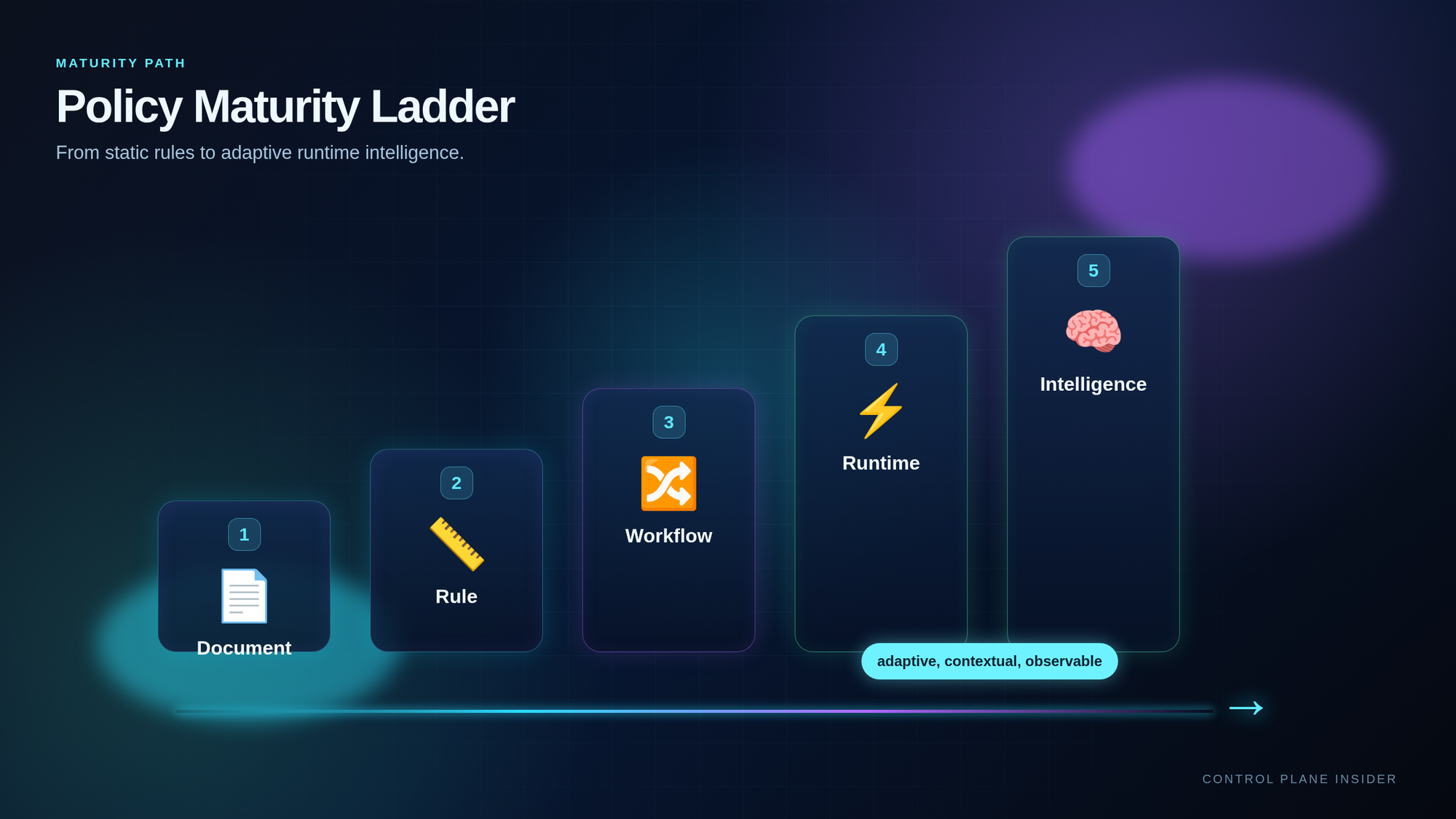
The Policy-as-Intelligence Maturity Ladder
Most organizations will not jump directly to fully adaptive governance. They will climb a maturity ladder.
- Policy-as-document — Standards exist, but enforcement is manual.
- Policy-as-rule — Controls are hardcoded into systems.
- Policy-as-workflow — Approvals and exceptions are routed through process.
- Policy-as-runtime control — Policies evaluate actions as systems operate.
- Policy-as-intelligence — Policies adapt using context, telemetry, risk signals, and learning loops.
The practical question is not whether an organization has AI policies. The question is whether those policies can shape AI behavior while it happens.
The Executive Test
Before scaling agentic AI, leaders should ask five questions:
- Can our policies evaluate agent actions at runtime?
- Can we apply different decisions based on identity, data sensitivity, tool risk, reversibility, and business impact?
- Can we route only the right exceptions to humans, with enough context to make a decision?
- Can we audit the full chain of actions, not just the final output?
- Can our governance system learn from approvals, incidents, overrides, and outcomes?
If the answer is no, the enterprise does not yet have AI governance at agent speed. It has policy artifacts around AI activity.
Closing
The future of AI governance is not more policy binders. It is policy that can reason about context, enforce boundaries, escalate uncertainty, and learn from outcomes.
Enterprises do not need governance theater. They need governance that can operate at the speed of agents.
That is policy-as-intelligence.
Source Notes
- NIST AI Risk Management Framework and Generative AI Profile: https://www.nist.gov/itl/ai-risk-management-framework
- CISA, NSA, and international partner guidance on careful adoption of agentic AI services: https://www.cisa.gov/resources-tools/resources/careful-adoption-agentic-ai-services
- NSA release on agentic AI guidance: https://www.nsa.gov/Press-Room/Press-Releases-Statements/Press-Release-View/Article/4475134/nsa-joins-the-asds-acsc-and-others-to-release-guidance-on-agentic-artificial-in/
- OWASP Agentic AI Threats and Mitigations: https://genai.owasp.org/resource/agentic-ai-threats-and-mitigations/
- ISO/IEC 42001 AI management systems: https://www.iso.org/standard/42001
Social Post Draft
A policy that cannot act when an AI agent acts is not governance. It is documentation.
Agentic AI changes the governance problem. Agents do not just generate content. They make decisions, call tools, access data, and trigger workflows.
That means governance has to move from static rules to runtime intelligence.
The future is policy-as-intelligence: governance that understands identity, context, risk, intent, data sensitivity, reversibility, and business impact — then allows, blocks, constrains, escalates, or learns.
Governance theater will not survive the agent era.