OCI and the Enterprise AI Control Plane
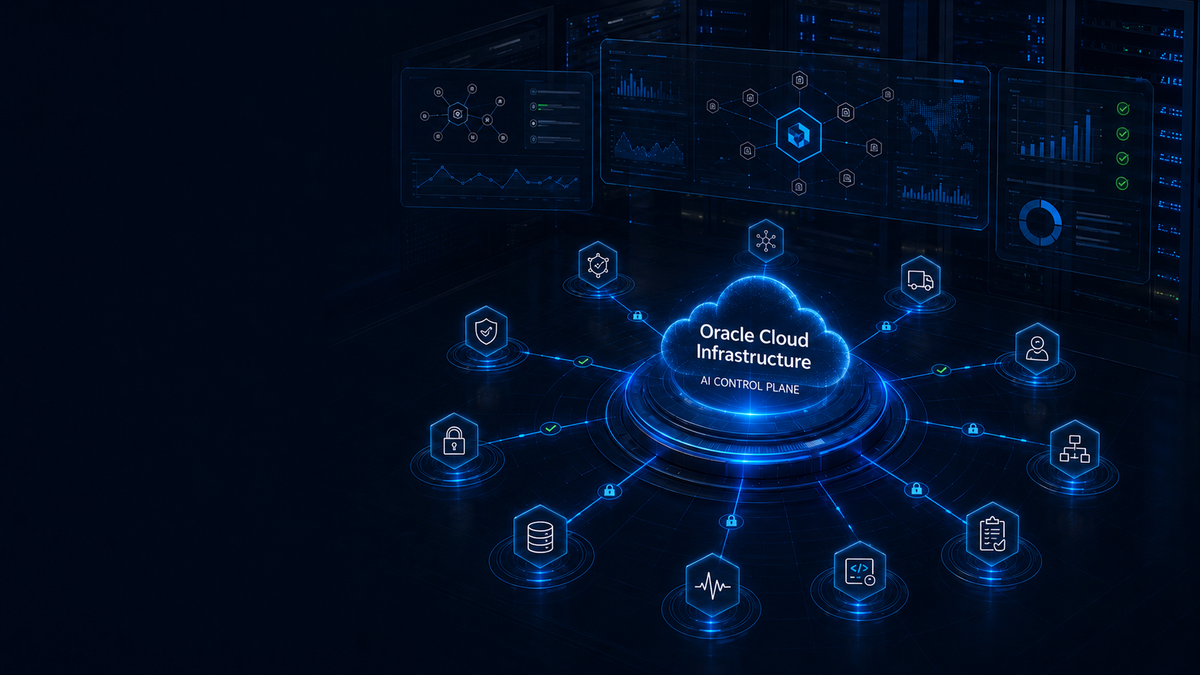
Enterprise AI is not failing because companies lack models. It is failing because data, security, latency, cost, governance, and operations are hard to control. OCI’s advantage is that it addresses those problems as infrastructure, not as slogans.
Enterprise AI is entering an uncomfortable phase.
The experiments worked. The demos were impressive. The board approved more investment. Business units are asking for agents, copilots, AI search, AI analytics, code assistants, customer-service automation, document intelligence, workflow automation, and industry-specific AI applications.
But when companies try to move from pilots to production, the hard problems show up.
The problem is not simply, “Which model should we use?”
The harder questions are:
- Where does enterprise data live?
- Can AI use that data without copying it everywhere?
- Can agents remember state without creating a governance mess?
- Can sensitive data stay inside the right legal and operational boundaries?
- Can workloads run with predictable latency?
- Can GPU capacity scale without locking the enterprise into one architecture?
- Can AI systems work across clouds without creating cost and security chaos?
- Can agents be sandboxed before they are allowed to touch real systems?
- Can security teams prove what happened after an AI system acts?
This is why enterprise AI needs a control plane.
Not another dashboard. Not another isolated AI service. A real control plane: the layer that governs data, memory, models, tools, infrastructure, security, networking, cost, observability, and compliance while AI systems operate.
OCI is interesting because it is built around several of the problems that are now blocking enterprise AI at scale. That does not mean OCI magically solves every AI challenge. It means Oracle has strengths in places where enterprise AI is most likely to break: data, infrastructure isolation, network design, multicloud connectivity, security, and regulated deployment.
The better way to understand OCI is not as a sales pitch for “another cloud.”
It is as a potential answer to a practical question:
What breaks when enterprise AI becomes real, and what infrastructure is needed to keep it under control?
1. Challenge: Enterprise AI Needs Data, but Enterprise Data Is Hard to Move
Consumer AI can often work from public data, user prompts, and general knowledge.
Enterprise AI cannot.
Enterprise AI needs contracts, invoices, customer records, operational logs, policies, claims, maintenance records, product data, call transcripts, financial history, supply-chain events, engineering documents, emails, ERP data, CRM data, and industry-specific knowledge.
That data is not cleanly packaged for AI. It is scattered across databases, applications, data lakes, SaaS platforms, file stores, warehouses, and legacy systems. Some of it is structured. Some is unstructured. Some is sensitive. Some is regulated. Some is stale. Some is duplicated. Some is authoritative. Some should never leave a particular region, cloud, system, or security boundary.
This is the first enterprise AI problem: AI wants context, but context is trapped inside complex data estates.
Many AI architectures respond by copying data into new retrieval layers, vector databases, application-specific stores, or external model environments. That may be fine for a pilot. It becomes risky at scale.
Every copy creates questions:
- Who is allowed to access it?
- Is it still current?
- Does it preserve permissions?
- Does it violate residency rules?
- Can it be deleted or expired?
- Can it be audited?
- What happens when the source record changes?
How OCI helps
OCI’s strongest answer is Oracle’s database architecture.
Oracle AI Database is positioned as a converged data platform: relational, JSON, vector, graph, text, spatial, columnar, and other data types can live under one database engine with enterprise-grade transactions, security, and governance. For AI, that matters because the database can become more than a system of record. It can become the memory and state layer for enterprise agents.
That is important because enterprise AI memory should not just be “a vector store attached to a chatbot.” It should be governed memory.
An agent should be able to ask:
- Is this the authoritative customer record?
- Am I allowed to retrieve this clause?
- Is this document governed by regional restrictions?
- Can this memory be used with this model?
- Should this context expire?
- Can the retrieval path be audited later?
OCI does not remove the need for data governance. But Oracle’s data stack gives enterprises a credible way to keep AI closer to governed enterprise data instead of scattering memory across disconnected systems.
2. Challenge: AI Memory and State Become a Governance Problem
Traditional applications usually have well-defined state. They store records, update fields, and follow predictable workflows.
AI agents are different.
Agents need working memory, long-term memory, conversation history, retrieved context, tool results, user preferences, intermediate reasoning artifacts, embeddings, task plans, and execution logs. They may need to remember what they did yesterday, why they made a recommendation, which tool they called, and which data they used.
This creates a new enterprise problem: agent memory can become an uncontrolled data layer.
If every team builds memory differently, the enterprise ends up with fragmented AI state:
- one vector store for support;
- another for finance;
- another for engineering;
- another for HR;
- another embedded in a SaaS tool;
- another attached to a model provider;
- another living in logs no one governs.
That is not sustainable.
How OCI helps
OCI’s advantage is the possibility of bringing memory and state back into the governed data layer.
Oracle’s converged database architecture can support structured records, semantic search, document retrieval, graph relationships, JSON application state, and transactional consistency in one environment. That makes it easier to build enterprise agents whose memory is secured, versioned, auditable, and connected to systems of record.
The point is not that every AI memory must live in one database.
The point is that enterprises need a governed memory core. OCI is well suited to that idea because Oracle’s center of gravity has always been enterprise data management.
For agentic AI, that becomes a strategic asset.
3. Challenge: Data Movement Costs Distort AI Architecture
Enterprise AI is data-intensive. Retrieval, embeddings, model calls, logs, telemetry, evaluations, replication, backups, and cross-cloud workflows all move data.
In many clouds, data movement becomes a hidden tax. Teams discover that the architecture that looks best technically is expensive operationally because data egress costs punish movement between systems, regions, and clouds.
That creates bad incentives.
Instead of designing for latency, compliance, resilience, and model quality, teams design around data tolls. They keep workloads in places that are not ideal because moving the data is too expensive. They duplicate data to avoid repeated charges. They avoid multicloud patterns even when the business already runs multicloud.
This is the third enterprise AI problem: AI needs data mobility, but cloud economics often penalize it.
How OCI helps
OCI has a comparatively strong data movement story.
Oracle offers a large monthly public internet egress allowance, does not charge outbound data transfer fees for FastConnect private peering, and has interconnect arrangements with Azure and Google Cloud that are designed for private, low-latency cross-cloud traffic without the usual egress penalty in supported configurations. Oracle has also expanded its multicloud strategy with AWS, Google Cloud, and Microsoft Azure.
This matters for AI because the control plane may need to place different parts of a workflow in different places:
- data in Oracle Database;
- applications in Azure, AWS, or Google Cloud;
- model endpoints in multiple environments;
- GPU training in OCI;
- regulated workloads in a sovereign or dedicated region;
- inference close to users;
- memory close to systems of record.
OCI’s lower-friction data movement does not eliminate architecture discipline. But it reduces one of the biggest barriers to practical enterprise AI: the fear that every cross-system decision will become a billing surprise.
4. Challenge: Latency Becomes a Product and Operations Problem
AI latency is not just model latency.
A single enterprise AI request may involve:
- user authentication;
- policy checks;
- retrieval from multiple data sources;
- vector search;
- reranking;
- prompt construction;
- model inference;
- tool calls;
- database writes;
- audit logging;
- response generation.
If any step is slow, the entire experience feels slow. For internal productivity tools, that reduces adoption. For customer-facing systems, it affects satisfaction. For operational systems, latency can make the difference between useful automation and unusable automation.
This is the fourth enterprise AI problem: AI systems are distributed systems, and distributed systems fail at the seams.
How OCI helps
OCI has several ingredients for latency-first architectures:
- bare-metal compute that avoids virtualization overhead where performance isolation matters;
- low-latency networking for HPC and distributed workloads;
- GPU clusters for high-throughput AI workloads;
- private interconnects to reduce public-internet dependency;
- database and compute proximity for workloads built around Oracle data;
- Oracle Acceleron, which Oracle positions around more efficient data movement and reduced communication overhead for HPC and distributed workloads.
The practical value is not “everything should run on bare metal.”
The value is choice.
A serious AI platform needs to decide which workloads need the lowest latency, which can tolerate delay, which should run near data, which should run near users, and which should run on dedicated infrastructure. OCI gives architects more options for these placement decisions than a purely abstracted platform.
5. Challenge: GPU Strategy Is Now an Enterprise Architecture Decision
Accelerated compute is no longer only a research concern. Enterprises need GPUs for model training, fine-tuning, inference, computer vision, synthetic data, simulation, digital twins, retrieval pipelines, and evaluation workloads.
But GPU strategy is difficult.
Enterprises face supply constraints, fast-changing chip roadmaps, cost volatility, software compatibility questions, model portability issues, and uncertainty about whether workloads should run on NVIDIA, AMD, CPU inference, specialized accelerators, or external model APIs.
This is the fifth enterprise AI problem: accelerated compute is strategic, but the market is moving too fast for single-path bets.
How OCI helps
OCI’s AI infrastructure includes NVIDIA and AMD GPU options, including bare-metal GPU instances and large cluster configurations. Oracle lists OCI Supercluster support across NVIDIA GB200, B200, H200, H100, A100, L40S, and AMD MI300X options.
That flexibility matters because enterprises need optionality.
The control plane should be able to route workloads based on:
- model size;
- latency requirement;
- training versus inference;
- cost;
- availability;
- software stack;
- data sensitivity;
- geographic requirement;
- dedicated versus shared infrastructure.
OCI’s GPU story is strongest when it is tied to this broader architecture: accelerated compute connected to data, networking, security, sovereignty, and bare-metal performance.
GPUs alone are not the control plane.
But a control plane without GPU strategy will not support serious AI at scale.
6. Challenge: Multicloud Is Reality, but Multicloud AI Can Become Chaos
Most enterprises are already multicloud, whether they planned it or not.
One business unit uses Azure. Another uses AWS. Data science teams use Google Cloud. Core databases run on Oracle. SaaS applications live everywhere. Acquisitions add more platforms. Regulatory requirements create regional exceptions. Edge environments add another layer.
AI makes this mess more visible.
Models need data. Agents need tools. Workflows cross systems. Logs need to be centralized. Identity must be consistent. Security teams need visibility. Finance teams need cost control. Legal teams need audit trails.
This is the sixth enterprise AI problem: multicloud AI multiplies integration, governance, cost, and latency problems.
How OCI helps
Oracle has leaned into multicloud instead of pretending enterprises will consolidate everything into one cloud.
OCI connects with Azure through Oracle Interconnect for Azure. Oracle announced Oracle Interconnect for Google Cloud. Oracle Database services are being made available in Microsoft Azure, Google Cloud, and AWS environments through Oracle Database@Azure, Oracle Database@Google Cloud, and Oracle Database@AWS initiatives.
The strategic value is not simply connectivity.
It is architectural realism.
Enterprises often want Oracle data services close to applications running in other clouds. They want private paths between clouds. They want to modernize without rewriting everything at once. They want AI architectures that can use multiple model providers and infrastructure environments without losing control.
OCI’s multicloud posture supports that reality.
It says: the enterprise will be multicloud, so the control plane must govern across clouds rather than deny the problem.
7. Challenge: Security Must Move from Perimeter Control to Runtime Control
AI changes enterprise security because agents are active systems.
A reporting tool shows information. An agent may retrieve information, interpret it, call an API, write a record, send a message, open a ticket, generate code, or trigger a workflow.
That means security must answer new questions:
- Which agent is acting?
- Which user delegated authority?
- Which data can the agent retrieve?
- Which tools can it call?
- Which network paths are allowed?
- Which secrets are exposed?
- Which actions need approval?
- How do we detect abnormal behavior?
- How do we prove what happened?
This is the seventh enterprise AI problem: security has to govern action, not just access.
How OCI helps
OCI has several security layers that matter for agentic AI:
- IAM for least-privilege identity and access.
- Vault for secrets and key management.
- Cloud Guard for posture management, misconfiguration detection, and workload risk visibility.
- Security Zones for compartments where security policies are enforced.
- Database security tools such as Data Safe, Database Vault, encryption, and Autonomous Database security features.
- Logging, Monitoring, Audit, and Events for evidence and response.
- Zero Trust Packet Routing for intent-based network enforcement.
This creates a foundation for always-on security.
The phrase matters: security cannot be something an AI team adds after deployment. It must be built into identity, network, data, runtime, and audit layers from the beginning.
OCI’s strength is that many of these controls are native infrastructure primitives rather than separate governance theater.
8. Challenge: Network Security Is Too Brittle for Agentic Systems
Traditional network security often depends on IP addresses, ports, subnets, route tables, security lists, and firewall rules.
Those controls are still important. But they become hard to reason about as environments scale. They are especially difficult for AI systems, where agents, tools, data stores, and model endpoints may change frequently.
This is the eighth enterprise AI problem: network policy needs to describe intent, not just topology.
How OCI helps
OCI Zero Trust Packet Routing, or ZPR, is one of the more interesting pieces of the OCI story.
ZPR uses security attributes and intent-based policies to define which resources are allowed to communicate. Instead of relying only on IP-based rules, security teams can describe allowed paths based on resource roles and data sensitivity. OCI then enforces those policies at the network layer.
For agentic AI, this is highly relevant.
An enterprise may want to express policies such as:
- this approved agent runtime can access this contract database;
- this sandboxed agent cannot reach production finance systems;
- this analytics service can access masked data but not raw sensitive records;
- this workload can communicate with this model endpoint only through an approved path;
- sensitive data cannot be accessed from untrusted compute.
This is the kind of security model AI systems need: workload-aware, data-aware, and intent-driven.
ZPR does not replace identity, application security, or database controls. But it adds a valuable network-level guardrail for reducing exfiltration risk and limiting damage from misconfiguration.
9. Challenge: Regulated AI Cannot Ignore Sovereignty
AI wants to centralize intelligence. Regulation often requires boundaries.
Healthcare, finance, government, telecom, defense, utilities, and critical infrastructure organizations must care about where data resides, who operates the infrastructure, where metadata goes, which administrators have access, how logs are stored, and which laws apply.
This is the ninth enterprise AI problem: the most valuable AI use cases often involve the most sensitive data.
That creates tension. The enterprise wants powerful AI, but it cannot simply ship all context to the easiest model endpoint.
How OCI helps
OCI has a strong story for regulated and sovereign environments:
- public cloud regions;
- sovereign cloud offerings;
- dedicated regions;
- isolated regions;
- distributed cloud patterns;
- database services with strong security and compliance controls.
OCI Dedicated Region is especially important because it brings a full OCI public cloud region into a customer or partner data center. For organizations with strict sovereignty, residency, latency, or operational control requirements, that changes the architecture discussion.
The AI control plane can choose where to run based on policy, not just convenience.
Some workloads can run in public cloud. Some need dedicated infrastructure. Some need sovereign operations. Some need multicloud proximity. Some need to stay close to existing systems.
OCI does not make regulatory complexity disappear. But it gives enterprises more deployment patterns for matching AI architecture to regulatory reality.
10. Challenge: Agents Need Sandboxes Before They Need More Autonomy
Agentic AI introduces a simple but serious risk: an agent with too much authority can become an automated insider threat.
A poorly bounded agent might retrieve the wrong data, call the wrong tool, expose sensitive information, overwrite records, trigger workflows, generate insecure code, or create actions that no human intended.
This is the tenth enterprise AI problem: agent autonomy without sandboxing is not enterprise-ready.
How OCI helps
OCI can support agent sandboxing through existing infrastructure primitives:
- compartments for isolation;
- IAM policies and dynamic groups for scoped authority;
- VCNs, network security groups, and security lists for network boundaries;
- ZPR for intent-based allowed paths;
- Vault for secrets;
- OKE, Functions, and compute isolation for controlled execution;
- API Gateway for governed tool access;
- Logging, Monitoring, and Audit for traceability;
- Cloud Guard and Security Zones for detection and policy enforcement;
- database controls for sensitive data access.
The right pattern is not to give an agent broad access to the enterprise.
The right pattern is to give each agent a governed work cell:
- specific tools;
- specific data;
- specific network paths;
- specific secrets;
- specific approval gates;
- specific logs;
- specific rollback options.
OCI’s architecture is well suited to this because it already emphasizes compartments, policy, network isolation, and database security.
For enterprise AI, sandboxing is not optional.
It is the difference between useful autonomy and unmanaged risk.
11. Challenge: AI Governance Cannot Stay in Committees
Most AI governance programs begin with principles, review boards, risk registers, acceptable-use policies, and compliance workflows.
Those are necessary.
They are not enough.
Once AI systems act inside business processes, governance must become executable. It has to show up in runtime decisions:
- Which model can be used for this task?
- Which data can be retrieved?
- Which memories can be written?
- Which tools can be called?
- Which network paths are allowed?
- Which actions require human approval?
- Which logs must be retained?
- Which jurisdiction applies?
- Which workload placement is compliant?
- Which result needs review?
This is the eleventh enterprise AI problem: governance must move from policy documents to infrastructure controls.
How OCI helps
OCI’s value is that many governance requirements map to infrastructure primitives:
- identity and access policies;
- database permissions;
- encryption and key control;
- network security;
- ZPR policies;
- compartments;
- audit logs;
- monitoring;
- security zones;
- sovereign and dedicated deployment options;
- multicloud connectivity patterns;
- controlled compute environments.
This is what makes OCI a plausible enterprise AI control plane. It can connect governance to the runtime environment where AI actually operates.
Governance becomes less about asking, “Did the team follow the AI policy?”
It becomes more about enforcing, “The agent cannot do that from this environment with this data under this policy.”
That is the shift enterprises need.
12. Challenge: AI Operations Need Continuous Optimization
Enterprise AI will not be static.
Models will change. Costs will change. GPU availability will change. Data will change. Regulations will change. Business processes will change. Prompts will drift. Agents will fail in unexpected ways. Latency will vary by region and model. Security policies will need tightening. Some workflows will need more human review. Others will become safe to automate further.
This is the twelfth enterprise AI problem: AI platforms must continuously optimize across quality, cost, latency, risk, and compliance.
How OCI helps
OCI has the building blocks for this kind of operational loop:
- monitoring and logging for telemetry;
- audit for accountability;
- cost and usage visibility;
- database performance tooling;
- infrastructure placement options;
- GPU and CPU choices;
- multicloud connectivity;
- security posture management;
- policy-based controls;
- dedicated and sovereign deployment options.
The long-term opportunity is an AI control plane that can learn from operations:
- Which model route gives the best answer per dollar?
- Which agent creates too many escalations?
- Which data source creates stale or risky answers?
- Which cross-cloud path adds latency?
- Which workload should move to bare metal?
- Which memory policy is too permissive?
- Which GPU jobs should be scheduled differently?
- Which security rule is blocking legitimate work?
OCI’s value will depend on how well these pieces are integrated into practical AI operations. But the ingredients are aligned with the real operational problems enterprises face.
What This Means for CIOs, CTOs, and AI Platform Leaders
The wrong question is: Which cloud has the best AI announcement?
The better question is: Which platform helps us control enterprise AI when it becomes operational?
That means evaluating OCI against practical criteria:
- Can it keep AI close to governed enterprise data?
- Can it support memory and state without creating uncontrolled data sprawl?
- Can it reduce the cost and friction of moving data?
- Can it support NVIDIA and AMD accelerated compute at scale?
- Can it provide bare-metal and low-latency options where performance matters?
- Can it support model flexibility instead of forcing one AI stack?
- Can it work across Azure, Google Cloud, AWS, and OCI environments?
- Can it enforce always-on security across identity, network, data, and runtime?
- Can ZPR-style policies reduce network misconfiguration and exfiltration risk?
- Can it support sovereign, dedicated, isolated, and regulated deployments?
- Can it sandbox agents before giving them access to real systems?
- Can it provide the logs and audit trails needed to explain what happened?
These are not marketing questions.
They are production AI questions.
The Bottom Line
Enterprise AI does not fail only because models are weak.
It fails because the surrounding system is not ready.
Data is fragmented. Memory is unmanaged. Security is bolted on. Latency is unpredictable. GPU strategy is unclear. Multicloud is messy. Data movement is expensive. Sovereignty is complicated. Agents are too powerful for the sandboxes around them. Governance lives in documents instead of runtime controls.
OCI is compelling because many of its strongest capabilities line up with those problems:
- Oracle’s converged database architecture can serve as governed memory and state.
- OCI’s data movement economics and interconnects reduce architectural friction.
- NVIDIA and AMD GPU clusters support serious accelerated AI workloads.
- Bare-metal infrastructure supports low-latency and non-shared performance needs.
- Oracle Acceleron and low-latency networking support distributed compute patterns.
- ZPR brings intent-based network security to cloud workloads.
- Cloud Guard, Security Zones, Vault, IAM, logging, audit, and database security support always-on protection.
- Multicloud partnerships make OCI more open than the old one-cloud model.
- Sovereign and dedicated deployment options address regulated environments.
- OCI primitives can support agent sandboxing and operational governance.
That is the real argument.
OCI is not the ultimate control plane because it has a long list of services.
OCI is a serious candidate because enterprise AI needs control over data, memory, infrastructure, networks, security, sovereignty, and agents — and those are areas where Oracle has meaningful architectural depth.
The future of enterprise AI will not be won by models alone.
It will be won by the platforms that make AI operational, governable, secure, low-latency, connected, and accountable.
That is the control-plane problem.
And that is where OCI has a credible case.
Suggested Sources / Further Reading
- Oracle Cloud Infrastructure: https://www.oracle.com/cloud/
- Oracle AI Infrastructure: https://www.oracle.com/ai-infrastructure/
- OCI GPU instances: https://www.oracle.com/cloud/compute/gpu/
- OCI bare metal and Oracle Acceleron: https://www.oracle.com/cloud/compute/bare-metal/
- Oracle AI Database: https://www.oracle.com/database/
- Oracle AI Database features: https://www.oracle.com/database/features/
- Oracle AI Vector Search: https://www.oracle.com/database/ai-vector-search/
- OCI Virtual Cloud Network pricing and egress: https://www.oracle.com/cloud/networking/virtual-cloud-network/pricing/
- Oracle Interconnect for Azure: https://www.oracle.com/cloud/azure/interconnect/
- Oracle Interconnect for Google Cloud announcement: https://blogs.oracle.com/cloud-infrastructure/announcing-oracle-interconnect-google-cloud
- Oracle multicloud solutions: https://www.oracle.com/cloud/multicloud/
- Oracle multicloud expansion with AWS, Google Cloud, and Microsoft Azure: https://www.oracle.com/news/announcement/ocw24-oracle-expands-multicloud-capabilities-with-aws-google-cloud-and-microsoft-azure-2024-09-11/
- Oracle and AWS multicloud networking announcement: https://www.oracle.com/news/announcement/oracle-and-aws-collaborate-to-expand-multicloud-networking-2026-04-16/
- OCI Zero Trust Packet Routing overview: https://docs.oracle.com/iaas/Content/zero-trust-packet-routing/overview.htm
- OCI Zero Trust Packet Routing product page: https://www.oracle.com/security/cloud-security/zero-trust-packet-routing/
- Oracle Cloud Guard: https://www.oracle.com/security/cloud-security/cloud-guard/
- Oracle Cloud Security services: https://www.oracle.com/security/cloud-security/
- Oracle Dedicated Region: https://www.oracle.com/cloud/cloud-at-customer/dedicated-region/
- Oracle Sovereign Cloud: https://www.oracle.com/cloud/sovereign-cloud/
- Oracle Distributed Cloud: https://www.oracle.com/cloud/distributed-cloud/