The AI Control Plane Is the New Enterprise Security Boundary

The biggest mistake enterprises can make is treating AI governance as a committee process only. Committees are useful. Policies are necessary. Risk reviews matter.
But agentic AI operates at runtime.
It makes decisions in context. It calls tools dynamically. It may interact with other agents. It may act faster than humans can review every step.
That means AI governance has to move closer to execution.
The future of enterprise AI governance looks less like a PDF policy and more like infrastructure:
• Policy-as-code
• Agent identity
• Tool-level permissions
• Real-time monitoring
• Approval orchestration
• Automated evidence collection
• Continuous risk scoring
• Runtime containment
This is the same pattern enterprises have seen before. Cloud forced governance to become infrastructure. DevOps forced security into pipelines. Zero Trust pushed access decisions closer to the resource.
Agentic AI will force governance into the control plane.
The new enterprise security boundary
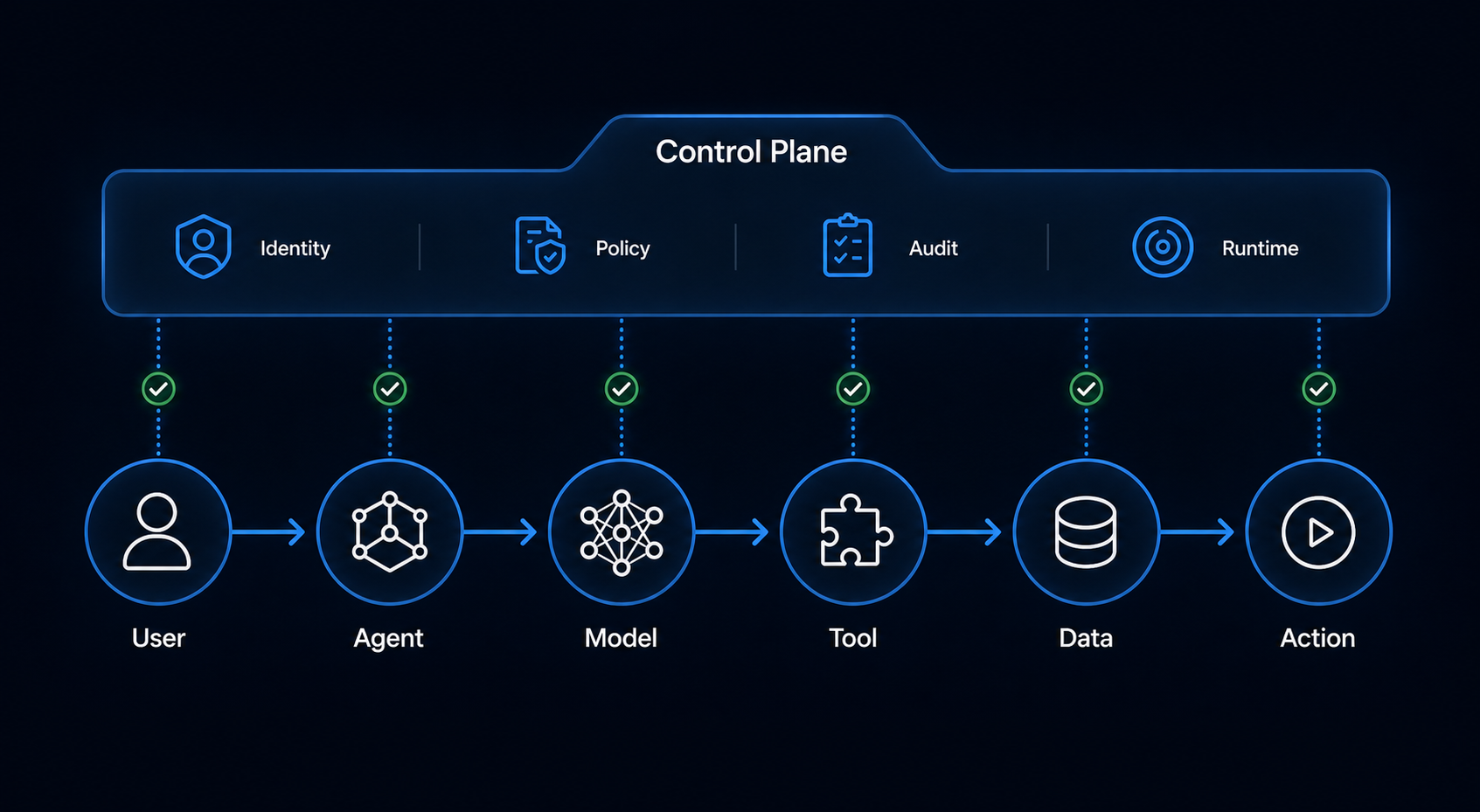
The enterprise security boundary used to be the network. Then cloud, SaaS, APIs, and remote work made identity the new perimeter.
AI changes the boundary again.
When autonomous agents can reason, access systems, and act on behalf of users, the boundary becomes the control layer around those actions.
The question is no longer only: “Can this user access this system?”
It is also:
“Can this AI agent, for this user, using this model, with this context, call this tool, on this data, for this purpose, right now?”
That is a control plane question.
The companies that win will be the companies that can prove control
Enterprise AI will not slow down. Business teams want the productivity. Vendors are embedding AI into everything. Developers are building agents because the capability is too powerful to ignore.
The answer is not to block AI.
The answer is to make it governable.
The companies that scale AI successfully will not simply be the ones with the most agents or the biggest model budgets. They will be the ones that can prove:
• What every agent is
• Who owns it
• What it can access
• Which actions it can take
• What it actually did
• Why it made a decision
• Which controls were enforced
• How it can be stopped
That is the promise of the AI control plane.
It turns AI from an unmanaged experiment into enterprise infrastructure.
And in the agentic era, that may become the most important security boundary of all.
Sources referenced
• Cloud Security Alliance, “Securing the Agentic Control Plane”: <https://cloudsecurityalliance.org/blog/2026/03/20/2026-securing-the-agentic-control-plane>\
• OWASP Top 10 for Agentic Applications 2026: <https://genai.owasp.org/resource/owasp-top-10-for-agentic-applications-for-2026/>\
• OWASP Agentic AI Threats and Mitigations: <https://genai.owasp.org/resource/agentic-ai-threats-and-mitigations/>\
• NIST AI Risk Management Framework: <https://www.nist.gov/itl/ai-risk-management-framework>\
• NIST Generative AI Profile, AI 600-1: <https://nvlpubs.nist.gov/nistpubs/ai/NIST.AI.600-1.pdf