AI-Native Transformation Requires More Than Models
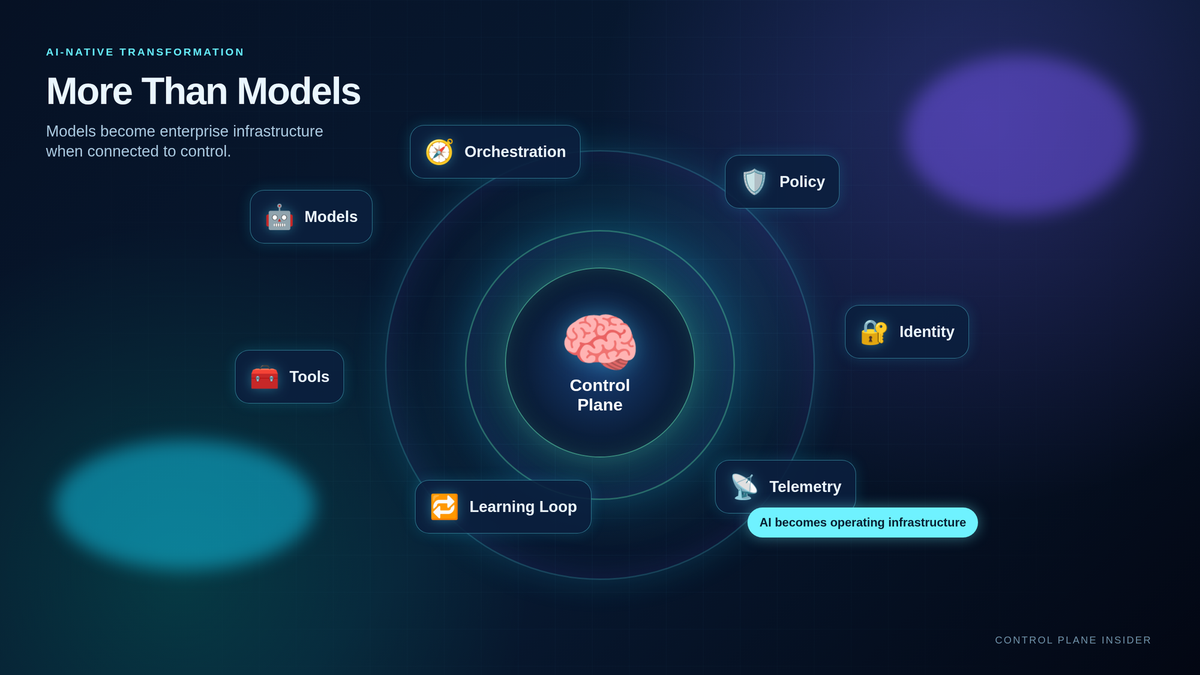
The winners will not be the companies with the most models. They will be the companies with the best control plane for orchestration, observability, policy, and trust.
Most AI transformation programs are still asking the wrong question.
They ask: Which model should we use?
That question mattered in the first phase of enterprise AI, when the main challenge was getting access to capable foundation models, proving that generative interfaces could improve productivity, and finding the first credible use cases. But it is no longer enough.
The better question is: What control plane lets us safely scale intelligent work across the enterprise?
Because once AI systems move beyond answering questions and start taking action, the problem changes. Models generate outputs. Agents invoke tools. They retrieve data, call APIs, write code, update records, trigger workflows, and hand work to other agents or humans. At that point, AI transformation is no longer just a model-selection exercise. It becomes an operating model problem.
The model is not the transformation. The model is the engine. But an engine without steering, telemetry, brakes, road rules, maintenance, and accountability is not a vehicle. It is a risk multiplier.
AI-native transformation requires the full operating system around the model — and that operating system is the control plane.
The model era created excitement. The agent era creates operating complexity.
The first wave of enterprise generative AI was relatively easy to understand. A user typed a prompt. A model produced a response. The output could be reviewed, copied, edited, accepted, or rejected.
That pattern is already giving way to something more complex.
Agentic systems are designed to interpret goals, reason through steps, use tools, access external data, and take action. Recent government guidance on agentic AI describes these systems as combining a model with external tools, data sources, memory, planning workflows, privileges, and measurable goals. In other words, the model is only one component in a broader execution system.
That shift matters because execution creates operational risk. A bad answer is one class of problem. A bad action is another.
When an AI system can open a ticket, change a configuration, send a customer message, modify a repository, query sensitive data, or trigger a financial workflow, the enterprise has to answer a new set of questions:
- Who or what authorized this action?
- Which model, agent, tool, data source, and workflow were involved?
- What policy applied at the moment of execution?
- Was the action reversible?
- Was a human approval required?
- What telemetry was captured?
- How will the system learn from the outcome?
A model-first architecture cannot answer those questions consistently. A control-plane architecture can.
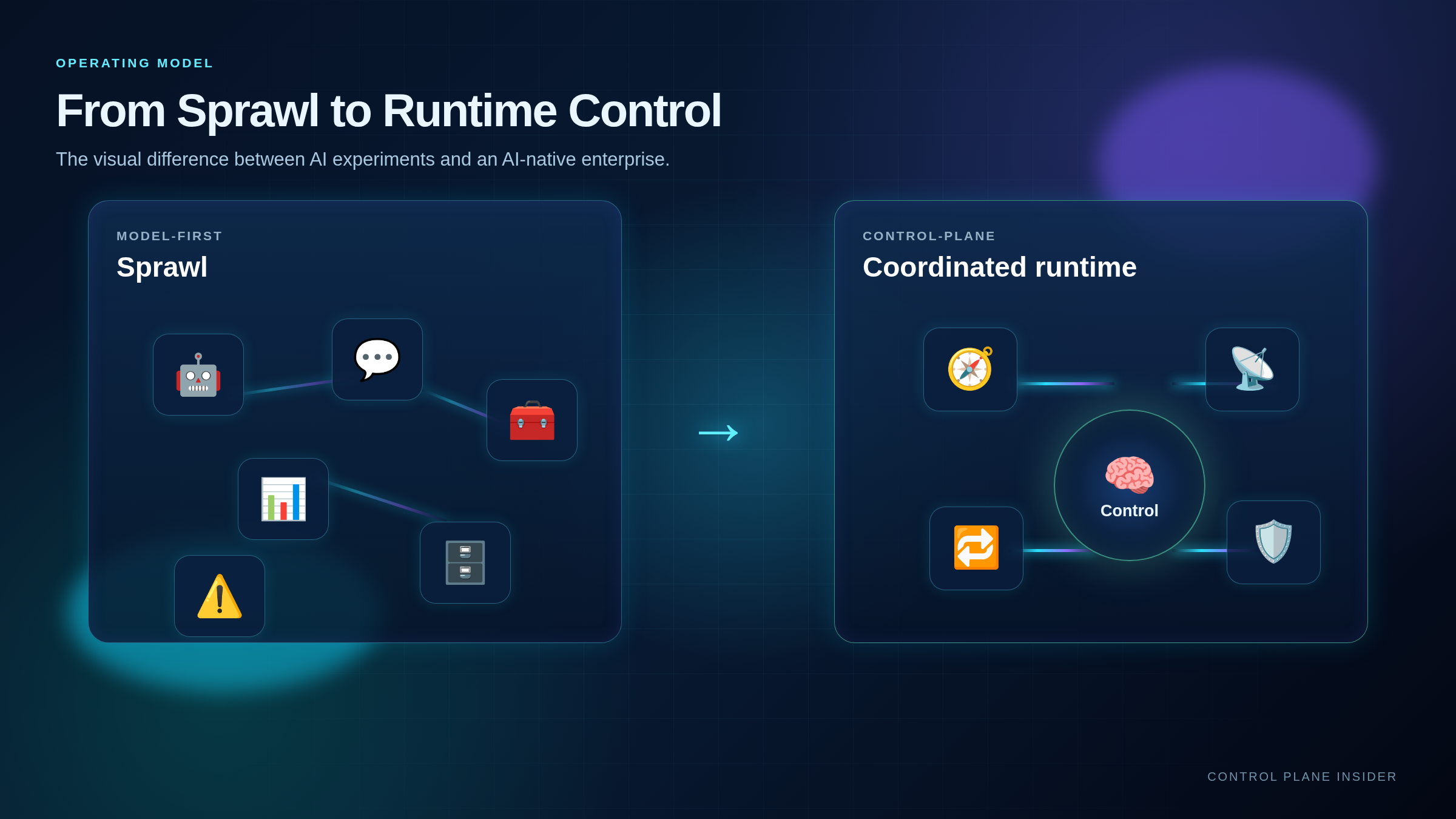
AI sprawl is the natural result of model-first transformation.
Every enterprise wants innovation. Every team wants speed. Every business unit sees a different opportunity for AI.
So the organization accumulates copilots, SaaS assistants, internal agents, prompt chains, workflow automations, embedded model calls, and one-off scripts. Each local experiment may be useful. Each team may have a rational reason for adopting its own tooling.
But local success can create global fragmentation.
Without a shared control plane, the enterprise loses visibility into what AI is doing across the business. Leaders may know which tools were purchased, but not which agents are acting, what data they are touching, which decisions they are influencing, which policies are enforced at runtime, or where risk is accumulating.
This is how AI transformation becomes AI sprawl.
The problem is not that teams are experimenting. The problem is that experiments harden into production workflows without shared orchestration, observability, governance, or learning loops.
That is the line between AI activity and AI-native transformation.
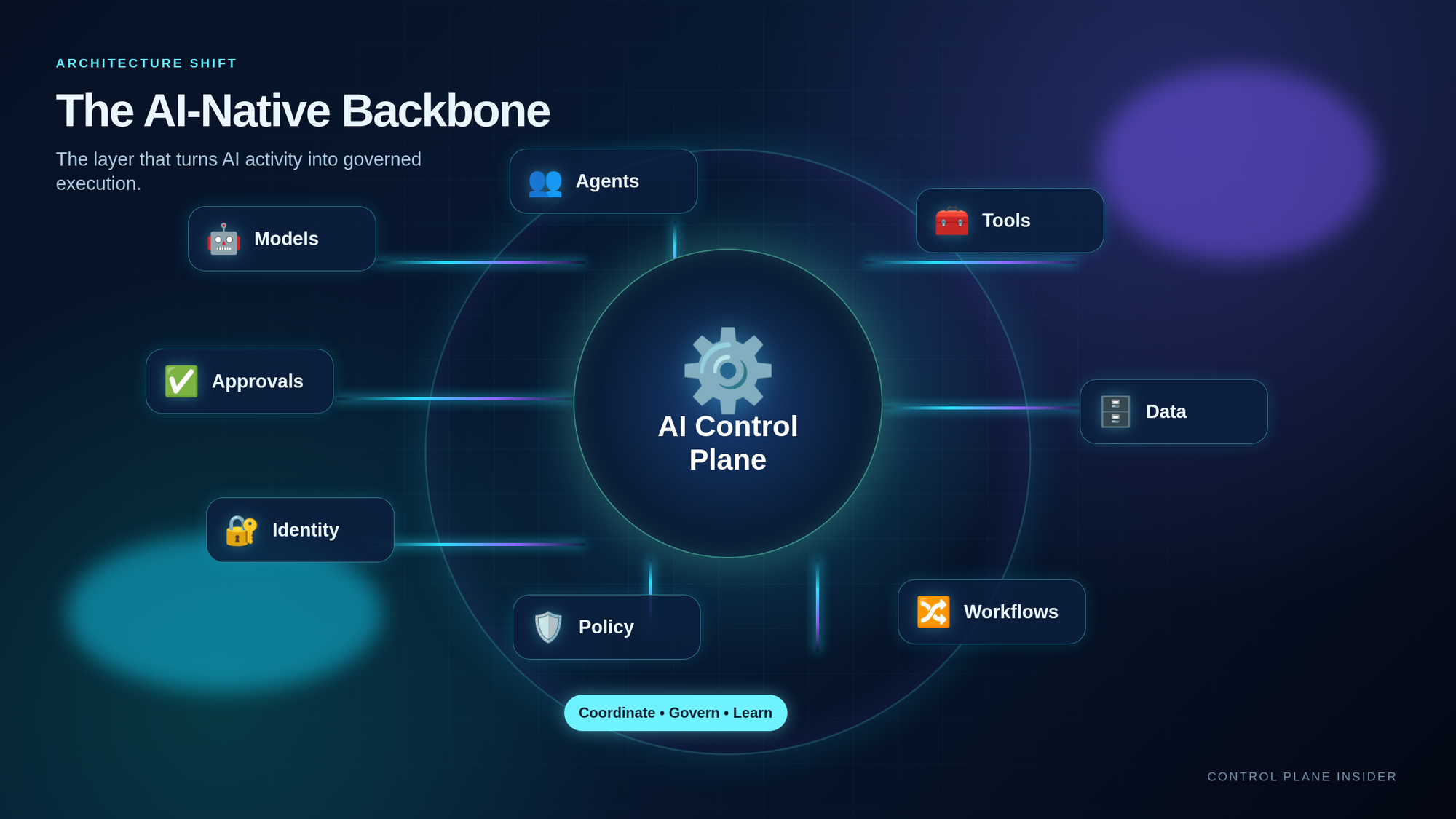
The enterprise backbone has four required capabilities.
A control plane is not just a dashboard. It is the enterprise backbone for intelligent work. At minimum, it needs four capabilities.
1. Orchestration
Orchestration coordinates models, agents, tools, humans, workflows, approvals, data sources, and business processes.
In a simple AI application, orchestration may mean routing a request to the right model. In an AI-native enterprise, it means coordinating work across multiple agents and systems while preserving state, context, permissions, and accountability.
The orchestration layer should answer:
- Which agent is responsible for this task?
- Which tools may it use?
- Which systems may it access?
- Which steps require human review?
- What happens when the agent fails, loops, escalates, or hands off work?
This is where intelligent work becomes operationally legible.
2. Observability
Traditional software observability captures logs, metrics, and traces. AI systems need that and more: prompts, retrieved context, model choices, tool calls, decision paths, latency, cost, failures, exceptions, approvals, and outcomes.
OpenTelemetry’s AI agent observability work reflects this direction: agent systems need standardized ways to report metrics, traces, and logs so organizations can monitor, compare, and improve them across frameworks.
Observability is not only for debugging. In AI-native systems, telemetry becomes the foundation for trust, governance, cost control, evaluation, and continuous improvement.
If the enterprise cannot trace what happened, it cannot explain what happened. If it cannot explain what happened, it cannot govern what happens next.
3. Governance
AI governance cannot live only in a PDF, a committee agenda, or a quarterly review.
The NIST AI Risk Management Framework emphasizes governance, mapping, measurement, and management as core functions for trustworthy AI. ISO/IEC 42001 similarly frames AI management as a systematic governance approach covering accountability, transparency, privacy, risk assessment, and continuous improvement.
Those ideas have to become executable.
In an AI-native enterprise, governance must be applied at runtime. Policy has to understand identity, data sensitivity, tool risk, workflow state, business impact, reversibility, and confidence. The system should be able to allow, deny, constrain, redact, escalate, log, quarantine, or require human approval before impact.
The important shift is from governance as documentation to governance as an operating capability.
4. Learning loop
The control plane should not only coordinate and monitor. It should help the organization get better.
Every trace, approval, incident, override, failure, exception, cost spike, customer complaint, and successful completion contains signal. That signal should improve prompts, policies, tools, routing, agent design, evaluation sets, and workflow patterns.
Without a learning loop, the enterprise repeats the same mistakes at greater scale. With one, AI transformation becomes compounding infrastructure.
Dashboards are not enough.
Many organizations will try to solve AI complexity with dashboards.
Dashboards have value. They help leaders see adoption, usage, cost, incidents, and performance. But dashboards are not a control plane.
A dashboard describes what happened. A control plane can intervene while work is happening.
That distinction is critical. Agentic AI compresses the time between decision and action. If governance only appears after the action completes, the enterprise is always reviewing yesterday’s risk.
AI-native systems need intervention points:
- before a high-risk tool call
- before sensitive data leaves a boundary
- before an agent escalates privileges
- before a workflow triggers customer, financial, legal, or security impact
- before an ambiguous task becomes an irreversible action
Passive reporting is not enough for active systems. Enterprises need runtime control.
The new transformation question
The old question was: Which model should we use?
The better question is: What control plane lets us safely scale intelligent work across the enterprise?
That question changes the roadmap.
It moves the conversation from model access to operating architecture. From isolated productivity tools to shared execution infrastructure. From governance theater to runtime accountability. From dashboards to intervention. From experiments to enterprise learning.
The companies that win will not simply have the most models. They will have the best system for coordinating, observing, governing, and improving intelligent work.
That is what makes an organization AI-native.
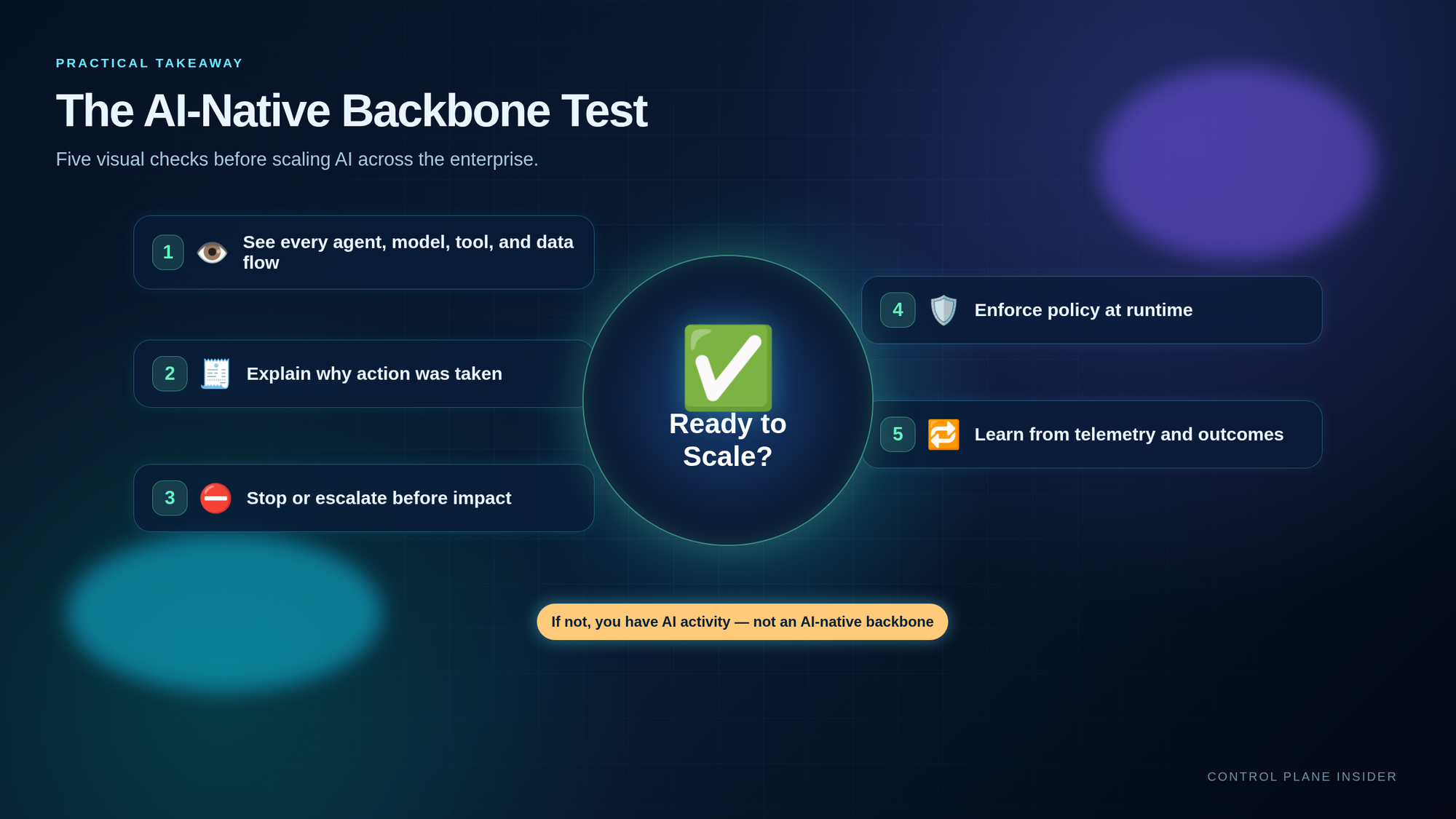
The AI-Native Backbone Test
Before scaling an AI initiative, ask five questions:
- Can we see every agent, model, tool, and data flow involved?
- Can we explain why an action was taken?
- Can we stop or escalate high-risk actions before impact?
- Can we enforce policy at runtime, not just during review?
- Can we learn from outcomes and improve the system continuously?
If the answer is no, the organization does not yet have an AI-native backbone.
It has AI activity.
Sources
- NIST AI Risk Management Framework: https://airc.nist.gov/airmf-resources/airmf/
- Careful Adoption of Agentic AI Services, co-authored by ASD ACSC, CISA, NSA, CCCS, NCSC-NZ, and NCSC-UK: https://media.defense.gov/2026/Apr/30/2003922823/-1/-1/0/CAREFUL ADOPTION OF AGENTIC AI SERVICES_FINAL.PDF
- OpenTelemetry, “AI Agent Observability - Evolving Standards and Best Practices”: https://opentelemetry.io/blog/2025/ai-agent-observability/
- ISO, “AI management systems: What businesses need to know”: https://www.iso.org/artificial-intelligence/ai-management-systems