AI-Native Economics: How Intelligence Changes the Cost Structure of Business

Artificial intelligence is not just a new technology layer. It is a new economic layer.
For most of the software era, companies used technology to digitize workflows, centralize data, automate repeatable tasks, and improve coordination. The economic logic was familiar: software reduced marginal costs, improved scale, and made information easier to move.
AI changes that logic again.
AI does not only move information. It interprets it. It generates work. It makes recommendations. It calls tools. It writes code. It retrieves context. It summarizes complexity. It monitors systems. It learns from feedback. Increasingly, it acts through agents, robots, applications, and business processes.
That means AI-native companies will not simply be companies that “use AI.” They will be companies whose economics are designed around intelligence as a scalable input.
The central question of AI-native economics is simple:
What happens when cognition, coordination, and execution become cheaper, faster, and more available?
The answer will reshape labor, software, services, infrastructure, margins, business models, and competitive advantage.
1. From Software Economics to AI-Native Economics
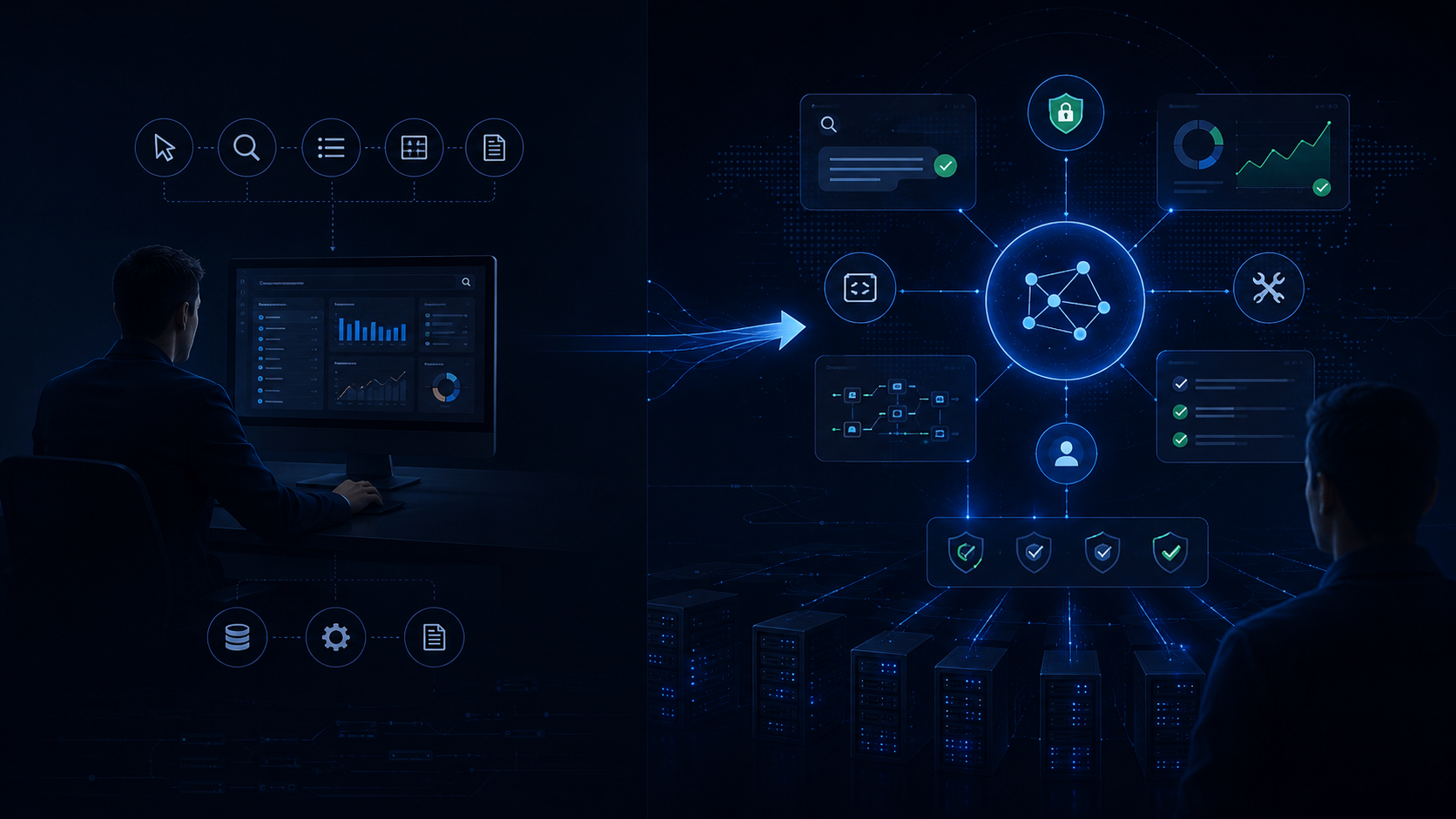
Software economics changed business because software could be built once and distributed many times. A product could serve one customer or one million customers with relatively low marginal cost. That created SaaS, platforms, app stores, marketplaces, cloud infrastructure, and data-driven operating models.
AI-native economics builds on that foundation but changes the unit of leverage.
Software scaled workflows.
AI scales judgment, language, analysis, content creation, pattern recognition, and task execution.
Traditional software usually requires users to know what button to click, what query to run, what workflow to follow, or what report to read. AI-native systems can increasingly infer intent, retrieve context, generate an answer, suggest a next step, and execute through tools.
That shifts the economic bottleneck.
In the software era, the constraint was often access to information and workflow automation.
In the AI-native era, the constraint becomes control: how to govern intelligence that can read, reason, decide, and act.
2. The New Cost Curve: Cognition Gets Cheaper
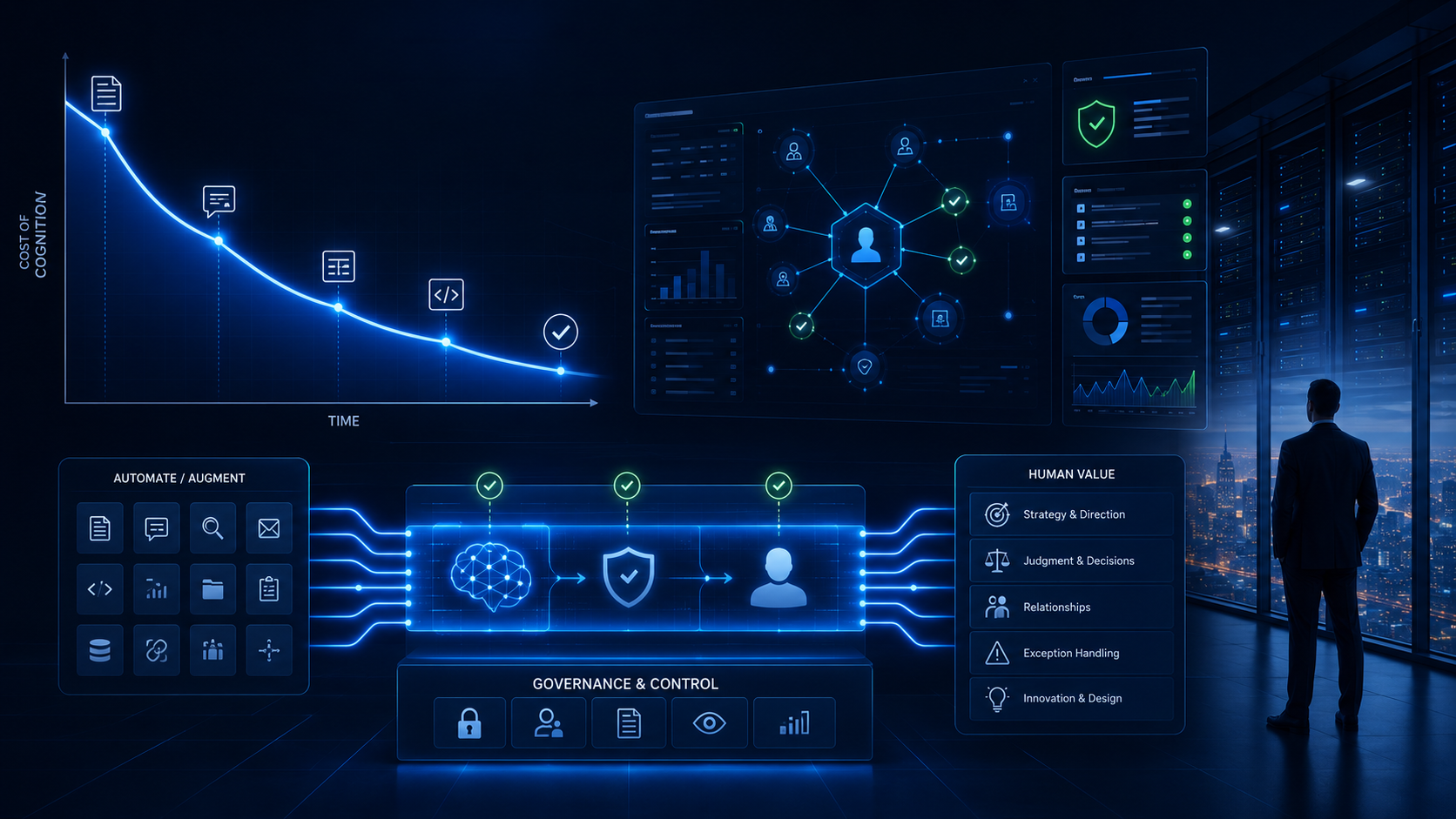
Every business pays for cognition.
It pays people to read documents, answer questions, write emails, analyze spreadsheets, review contracts, create content, troubleshoot systems, classify tickets, prepare reports, generate proposals, summarize meetings, monitor risk, and make decisions.
AI reduces the cost of many cognitive tasks.
Not to zero. Not perfectly. Not without oversight. But meaningfully enough to change business design.
Tasks that once required scarce human attention can now be partially automated, accelerated, or augmented:
- drafting and editing;
- summarization;
- research synthesis;
- customer support triage;
- code generation;
- data analysis;
- document review;
- knowledge retrieval;
- meeting follow-up;
- marketing production;
- sales enablement;
- compliance monitoring;
- workflow orchestration.
This does not mean humans disappear. It means human work moves up the stack.
People spend less time producing first drafts, searching for context, or manually coordinating routine actions. They spend more time setting direction, validating outputs, handling exceptions, building relationships, making high-stakes decisions, and designing better systems.
The economic effect is a compression of cognitive cycle time.
A company that can learn, decide, and execute faster has a structural advantage.
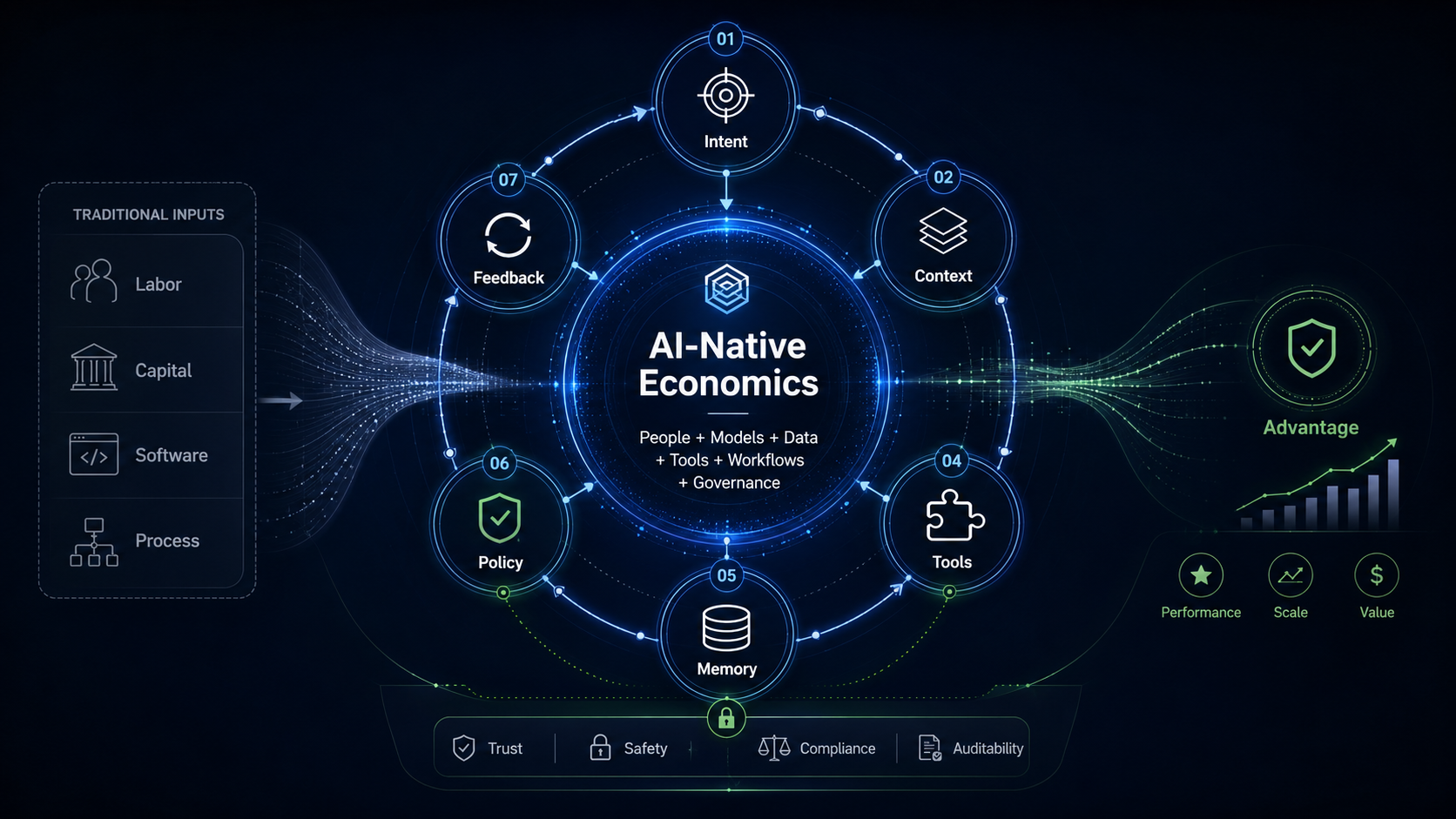
3. The New Production Function: People + AI + Tools + Data
Classic business productivity often depends on labor, capital, software, and process.
AI-native productivity depends on a different combination:
people + models + data + tools + workflows + governance.
The model alone is not the business advantage. Everyone can access powerful models. The advantage comes from combining models with proprietary context, integrated tools, trusted workflows, and strong governance.
An AI-native workflow has several components:
- Intent — what the user or business wants done.
- Context — the data, documents, records, policies, and history needed to act intelligently.
- Model — the reasoning, generation, classification, or planning capability.
- Tools — APIs, applications, databases, workflows, and systems the AI can use.
- Memory — what the system remembers about users, tasks, customers, decisions, and outcomes.
- Policy — what the AI is allowed to see, say, change, trigger, or store.
- Feedback — signals that improve future performance.
The companies that integrate these components well will outperform companies that treat AI as a chatbot attached to old workflows.
4. Marginal Cost Changes, but So Does Marginal Risk
AI can reduce the marginal cost of work.
A support response, sales email, design concept, code snippet, report summary, training module, or data analysis may become cheaper to produce.
But AI also introduces a new kind of marginal risk.
Every AI-generated action raises questions:
- Is the answer accurate?
- Was the right data used?
- Was sensitive information exposed?
- Was the user authorized?
- Was the output compliant?
- Was the action reversible?
- Can the decision be audited?
- Did the system hallucinate?
- Did the agent call the wrong tool?
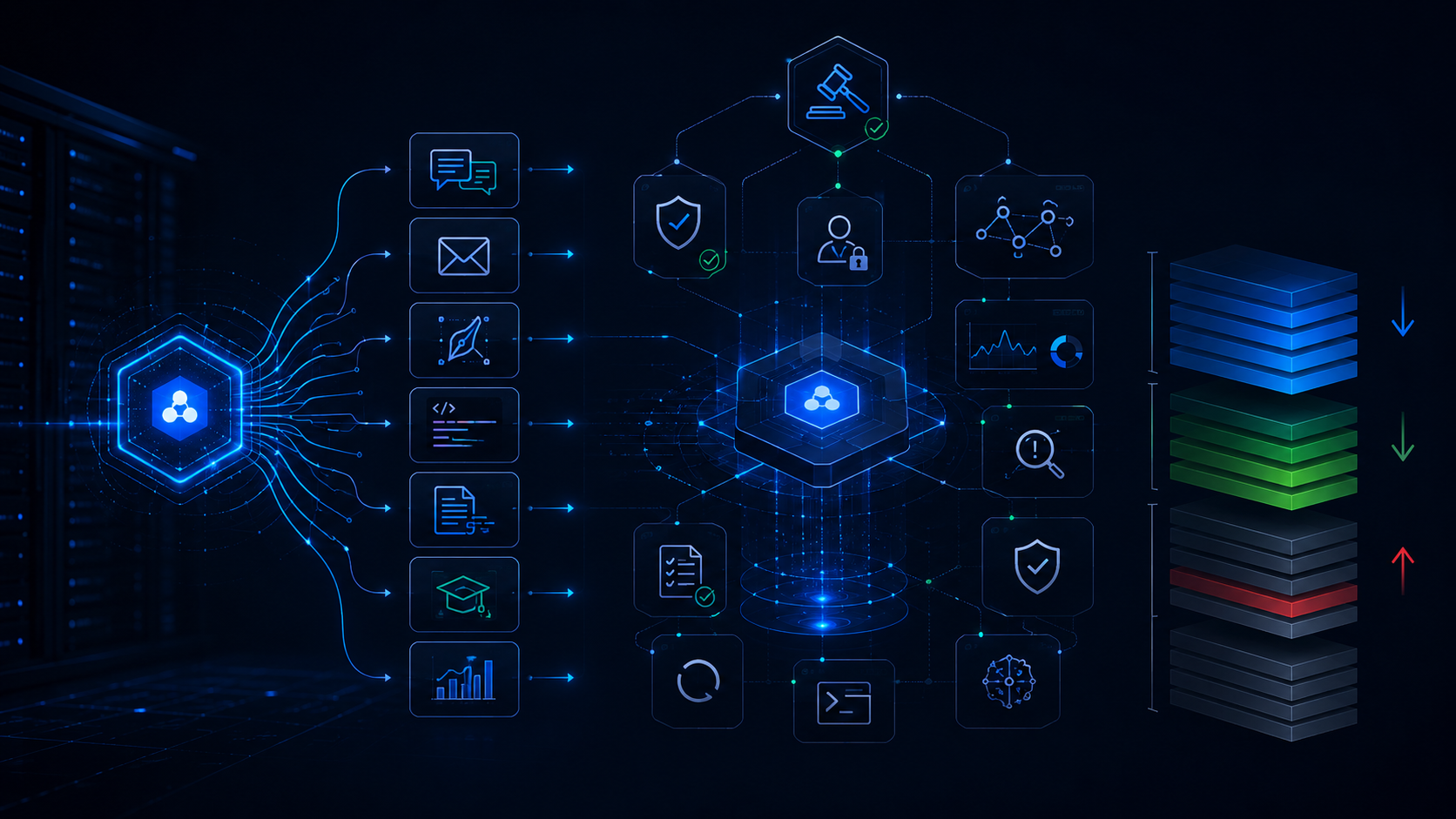
This is why AI-native economics cannot be understood only as cost reduction.
It is cost reduction plus control cost.
The true economics of AI are not:
model cost versus human cost.
They are:
model cost + data cost + integration cost + governance cost + supervision cost + error cost + infrastructure cost versus the value of faster, better, cheaper execution.
Companies that ignore the control cost will overestimate AI margins.
Companies that design for control from the beginning will compound advantages.
5. The Rise of Agentic Leverage
The first wave of enterprise AI helped people produce outputs: text, code, images, summaries, and answers.
The next wave helps systems complete tasks.
That is the shift from generative AI to agentic AI.
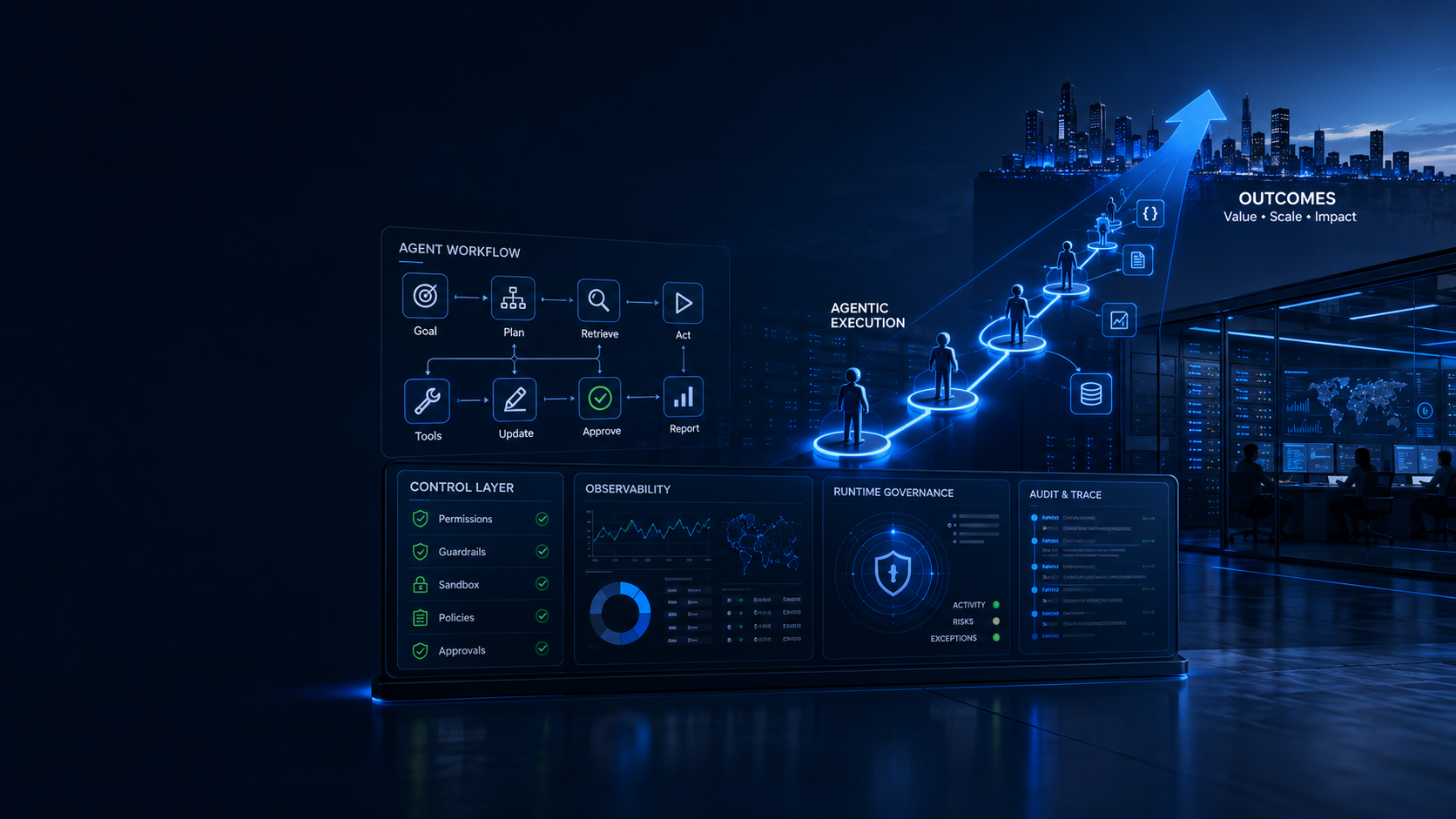
An agentic system can receive a goal, break it into steps, retrieve context, call tools, update systems, request approvals, and report progress. This changes economics because it moves AI from content production into workflow execution.
Agentic leverage is powerful because many businesses are full of coordination costs:
- routing requests;
- following up;
- updating systems;
- reconciling records;
- preparing documents;
- checking compliance;
- scheduling work;
- monitoring exceptions;
- escalating issues;
- translating between teams.
Agents can reduce coordination drag.
But agents also require stronger permissions, observability, sandboxing, memory governance, and human approval paths. The more an AI system can do, the more important it becomes to define what it cannot do.
This creates a new economic principle:
Autonomy increases leverage only when control increases with it.
6. AI-Native Companies Will Have Different Org Charts
AI-native economics will change organizational design.
In traditional companies, growth often means adding headcount to handle more customers, more content, more support tickets, more operations, more analysis, and more coordination.
In AI-native companies, growth can increasingly mean adding better systems.
Small teams will be able to operate with more leverage:
- one marketer can run more campaigns;
- one developer can ship more product;
- one analyst can monitor more signals;
- one support team can handle more volume;
- one consultant can package more expertise;
- one operations team can coordinate more workflows.
The result is not necessarily “no employees.” It is a different ratio between revenue, headcount, and output.
AI-native companies may have:
- smaller teams;
- more automation engineers;
- more AI operations roles;
- more data stewards;
- more workflow designers;
- more governance and security specialists;
- fewer purely repetitive coordination roles;
- more human experts supervising AI-assisted systems.
The org chart becomes a map of human judgment plus machine execution.

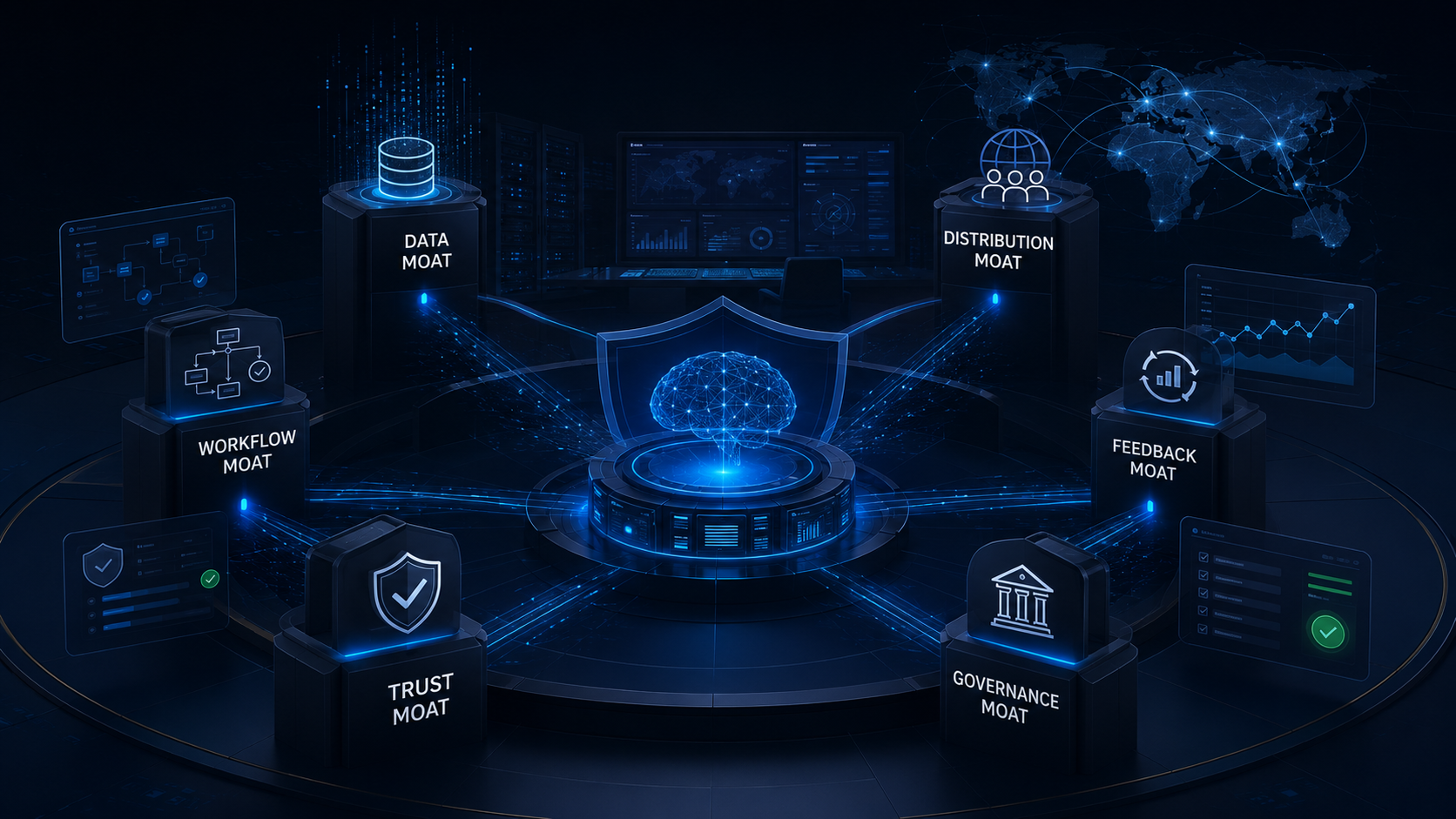
7. The New Moats: Data, Workflow, Trust, and Distribution
AI models are becoming widely available. That means model access alone is not a durable moat.
The stronger AI-native moats are elsewhere.
Data moat
Companies with proprietary, high-quality, permissioned, well-structured data can create better AI experiences than companies using generic data.
Workflow moat
Companies deeply embedded in business processes can turn AI into action, not just advice.
Trust moat
Companies that can prove security, accuracy, compliance, auditability, and reliability will win enterprise buyers.
Distribution moat
Companies with existing customer relationships can deploy AI into workflows faster than unknown startups.
Feedback moat
Systems that learn from usage, outcomes, corrections, and operational data can improve over time.
Governance moat
In high-stakes environments, the ability to control AI safely becomes a competitive advantage.
The best AI-native businesses combine several of these moats.
8. Business Models Will Shift from Seats to Outcomes
Traditional SaaS economics often depend on seats: more users, more licenses, more recurring revenue.
AI complicates seat-based pricing.
If AI reduces the need for users to do certain tasks manually, charging only by user count may no longer align with value. A single AI-assisted user may produce the output of several unassisted users. An agent may complete work without a human seat at all.
This pushes business models toward:
- usage-based pricing;
- task-based pricing;
- outcome-based pricing;
- workflow-based pricing;
- AI credits;
- managed automation fees;
- performance-based contracts;
- hybrid subscriptions plus consumption.
The economic question becomes:
What unit of value does the AI create?
For example:
- support tickets resolved;
- leads qualified;
- documents reviewed;
- code changes merged;
- invoices processed;
- meetings summarized;
- risks detected;
- employees onboarded;
- customers retained;
- hours saved;
- revenue generated.
AI-native businesses will price closer to value creation, not just software access.
9. Services Become Software, and Software Becomes Services
AI blurs the line between software and services.
Many services businesses sell expertise, analysis, content, strategy, operations, implementation, or support. AI can package parts of that expertise into repeatable workflows. This allows services firms to become more productized.
At the same time, software companies are adding service-like intelligence: copilots, agents, advisors, automated workflows, and managed outcomes.
The result is a convergence:
- agencies become AI-enabled platforms;
- consultants become productized intelligence providers;
- SaaS companies become workflow operators;
- training companies become AI coaching systems;
- infrastructure companies become control planes;
- marketplaces become intelligent matching and execution layers.
AI-native economics rewards companies that know how to combine human expertise, software scale, and automated execution.
10. The Infrastructure Bill Becomes a Strategic Variable
AI is not free.
Model inference, training, fine-tuning, vector search, storage, observability, evaluation, and agent orchestration all create infrastructure costs.
In traditional SaaS, gross margins were often high because serving another user was relatively cheap. In AI-native systems, marginal cost can be more variable because each interaction may consume tokens, GPU capacity, retrieval, tool calls, and logging.
That means AI-native companies need a cost discipline that looks more like cloud financial operations plus product design.
They need to manage:
- model selection;
- prompt size;
- context window usage;
- retrieval efficiency;
- caching;
- batching;
- routing;
- inference latency;
- GPU utilization;
- evaluation cost;
- observability cost;
- human review cost.
The best companies will treat AI cost as a design constraint, not an afterthought.
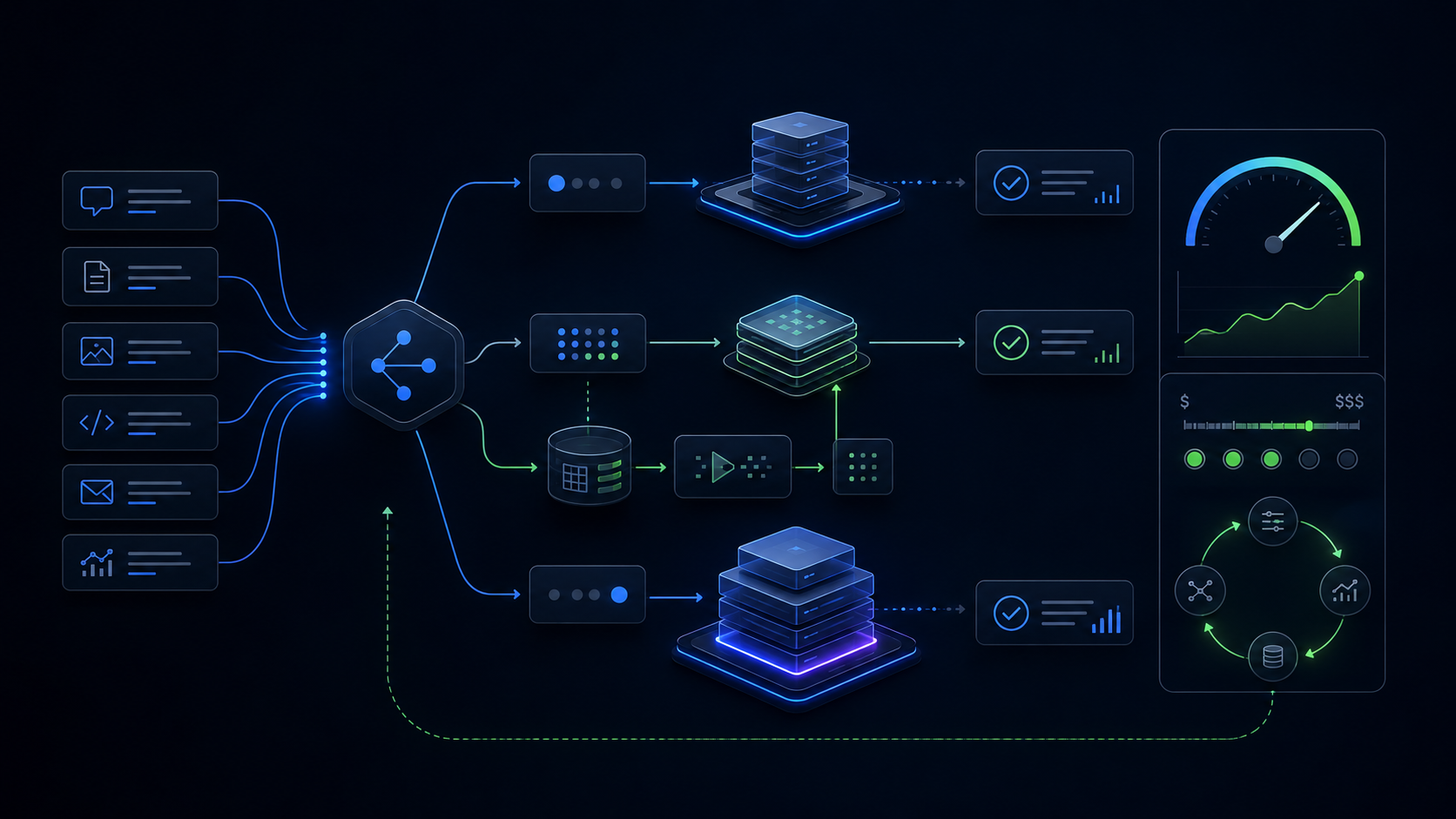
They will route simple tasks to cheaper models, reserve expensive models for high-value work, cache repeated context, compress prompts, evaluate quality per dollar, and continuously tune the system.
AI-native margin will depend on intelligence efficiency.
11. The Control Plane Becomes an Economic Layer
As AI becomes more capable, control becomes more valuable.
The AI-native enterprise needs to know:
- which model was used;
- which data was retrieved;
- which tools were called;
- which user authorized the action;
- which policy applied;
- which memory was written;
- which output was blocked;
- which action was escalated;
- which cost was incurred;
- which outcome occurred.
This is why the AI control plane becomes an economic layer.
It does not merely reduce risk. It improves resource allocation. It helps the business decide which models to use, which workflows to automate, which agents to trust, which data to expose, which actions to approve, and which systems to optimize.
Control planes will become the operating layer for AI-native economics because they connect cost, risk, performance, and governance.
12. What Leaders Should Measure
AI-native economics requires new metrics.
Traditional metrics still matter: revenue, gross margin, CAC, LTV, churn, productivity, retention, and operating margin.
But AI adds new operating metrics:
- cost per AI task;
- cost per successful outcome;
- human review rate;
- escalation rate;
- automation success rate;
- hallucination or correction rate;
- latency by workflow;
- model quality per dollar;
- retrieval accuracy;
- tool-call success rate;
- agent rollback rate;
- memory usefulness;
- policy violation rate;
- time saved per workflow;
- revenue per employee;
- output per employee;
- customer satisfaction per automated interaction.
The best companies will not ask only, “How much AI are we using?”
They will ask, “Where is AI improving unit economics?”
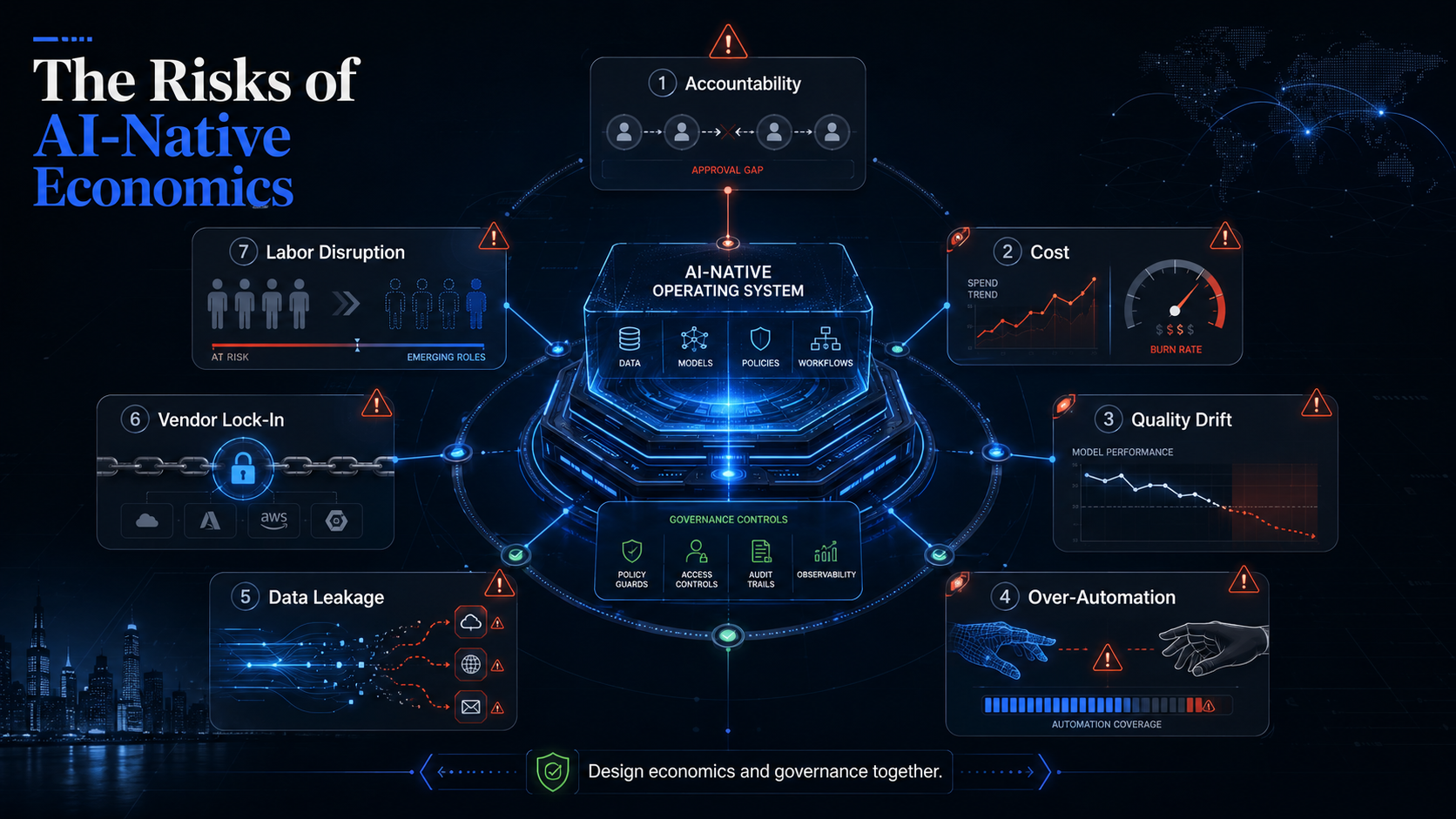
13. The Risks of AI-Native Economics
AI-native economics is powerful, but it comes with risks.
Automation without accountability
If AI systems act without clear ownership, mistakes become hard to trace and harder to fix.
Cost explosions
Poorly designed AI workflows can become expensive if they rely on large models, long prompts, repeated retrieval, and unnecessary tool calls.
Quality drift
Models, prompts, data, and user behavior change over time. Without evaluation, performance can degrade silently.
Over-automation
Not every task should be automated. Some require empathy, judgment, negotiation, creativity, or accountability.
Data leakage
AI systems increase the number of paths through which sensitive information can move.
Vendor dependence
Companies that build too tightly around one model or provider may lose flexibility.
Labor disruption
AI-native economics can change roles quickly, requiring retraining, redesign, and thoughtful change management.
The lesson is not to avoid AI. The lesson is to design AI-native systems with economics and governance together.
14. Strategic Takeaway
AI-native economics is not about replacing people with models.
It is about redesigning how work gets done when intelligence becomes a scalable resource.
The winners will be companies that understand five principles:
- Cognition is becoming cheaper, but control is becoming more important.
- The model is not the moat; data, workflow, trust, and distribution matter more.
- Agents create leverage only when permissions, observability, and sandboxing scale with autonomy.
- AI pricing will move closer to usage, tasks, and outcomes.
- The AI control plane becomes the economic layer that manages cost, risk, performance, and governance.
The software era rewarded companies that digitized workflows.
The AI-native era will reward companies that turn intelligence into governed, measurable, scalable execution.
That is the new economic frontier.
Not AI as a feature.
AI as a production function.
AI as an operating model.
AI as a new foundation for business economics.