Agentic Security Is the New Cloud Security

Cloud security taught enterprises how to secure dynamic infrastructure. Agentic security will teach them how to secure autonomous action.
The security model is shifting again
Every major technology platform creates a new security model.
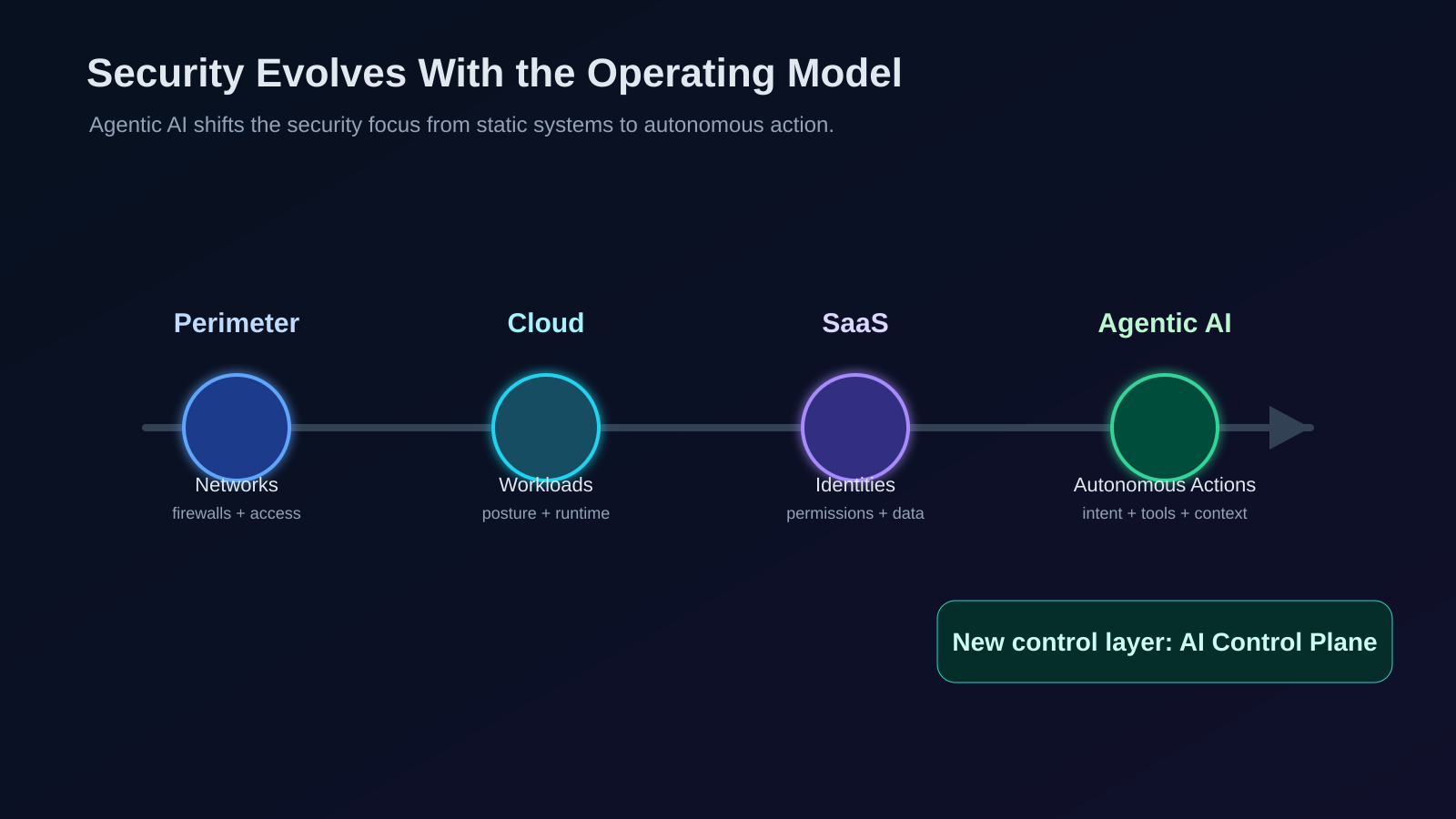
The mainframe created centralized access control. The internet created perimeter security. Mobile created device and identity management. Cloud created shared responsibility, infrastructure-as-code scanning, workload protection, posture management, and continuous monitoring.
Now AI agents are creating the next shift.
Enterprises are moving from software that waits for instructions to software that can interpret goals, choose tools, retrieve data, make decisions, and take action. That changes the security conversation.
Agentic AI is not just another application category. It is a new operating surface.
And that is why agentic security is becoming the new cloud security.
Cloud security emerged because infrastructure became programmable, distributed, and fast-moving. Agentic security is emerging because work itself is becoming programmable, distributed, and fast-moving.
The question is no longer only, “Is this system configured securely?”
The new question is:
Is this autonomous system allowed to take this action, with this data, through this tool, in this business context, right now?
That is the security question of the agentic era.
What cloud security taught us
Cloud security became a major discipline because cloud changed the nature of enterprise infrastructure.
Servers were no longer static assets sitting in a data center. Infrastructure could be created with APIs. Networks could be reconfigured in minutes. Data could move across regions, platforms, and services. Developers could deploy quickly. Security teams had to govern a faster, more dynamic environment.
That shift forced enterprises to build new capabilities:
- Cloud asset inventory
- Identity and access management
- Configuration posture management
- Continuous compliance
- Workload protection
- Runtime monitoring
- Threat detection across distributed systems
- Policy enforcement through automation
The common thread was control over a dynamic environment.
Cloud made infrastructure elastic. Security had to become continuous.
Agentic AI now creates a similar transformation, but at the level of decisions and actions.
Agents can operate across SaaS applications, internal systems, cloud APIs, data repositories, development pipelines, customer workflows, and security tools. They may not own infrastructure directly, but they can influence outcomes across the enterprise.
That makes agent behavior a new security surface.
The agent is the new workload
In cloud security, the workload became a primary unit of protection.
Security teams needed to understand what each workload was, what it could access, where it was running, how it communicated, and whether it was behaving normally.
In the agentic enterprise, the AI agent becomes a similar unit of protection.
An agent has identity. It has permissions. It has goals. It has access to tools. It may have memory. It may retrieve context. It may call APIs. It may produce outputs that affect customers, employees, systems, or decisions.
That means every enterprise will need to answer basic questions about its agents:
- Who owns this agent?
- What business process does it support?
- What data can it access?
- What tools can it call?
- What actions can it take automatically?
- What actions require approval?
- What does normal behavior look like?
- How do we detect misuse, drift, or compromise?
These are not theoretical governance questions. They are operational security questions.
An unmanaged agent with access to sensitive systems is not just a productivity tool. It is a potential control gap.
The new agentic attack surface
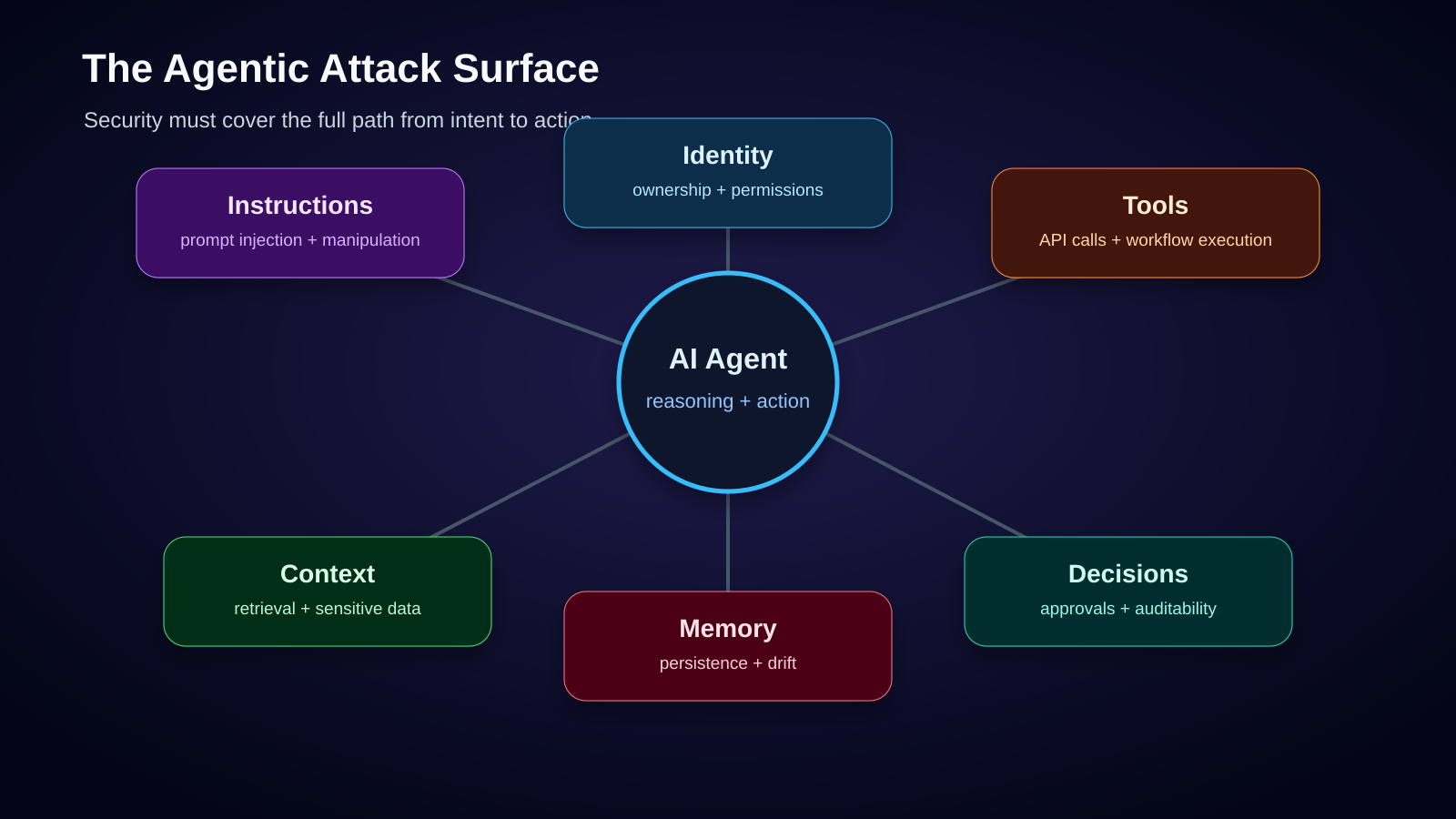
Agentic systems introduce risks that traditional security programs were not designed to manage on their own.
Some risks look familiar. Others are new.
1. Prompt and instruction manipulation
Agents can be influenced by user instructions, retrieved content, emails, documents, websites, tickets, or other inputs. If malicious or misleading instructions enter the workflow, the agent may take actions that violate policy.
The issue is not only what the model says. It is what the agent does after interpreting the instruction.
2. Tool misuse
An agent that can call tools can create real business impact. It may query a database, modify a record, send a message, create a support ticket, deploy code, or trigger an operational workflow.
Tool access must be governed with the same seriousness as API access, privileged access, and service account permissions.
3. Data overreach
Agents often need context to be useful. But they can also retrieve more information than a task requires. This creates risk around sensitive data, regulated information, intellectual property, and customer records.
Security teams need to govern not just whether a user can access data, but whether an agent should use that data for a specific purpose.
4. Autonomy drift
An agent may begin as a narrow assistant and gradually gain more tools, broader permissions, more memory, and more workflow responsibility. Over time, its actual risk profile may exceed the original approval.
This is similar to cloud permission sprawl, but with reasoning and action layered on top.
5. Invisible decision chains
Agentic workflows can involve multiple steps: user intent, model reasoning, retrieval, tool calls, policy checks, approvals, outputs, and downstream actions.
If the enterprise cannot reconstruct that chain, it cannot confidently investigate incidents, prove compliance, or improve controls.
Why traditional controls are not enough
Existing security controls still matter. Identity, access management, data loss prevention, logging, endpoint security, cloud security posture management, and application security are all still essential.
But agentic AI adds a layer that traditional controls do not fully understand: intent-driven action.
A normal API call may tell you that a system accessed a record. An agent trace should tell you why the agent accessed the record, what instruction triggered it, what context it used, which policy was evaluated, what tool it called, and whether the final action matched the approved business purpose.
That is a richer form of observability.
Security teams will need controls that are AI-aware:
- Agent identity and ownership
- Tool-level authorization
- Context-aware data access
- Runtime policy evaluation
- Human approval routing
- Behavioral baselines for agents
- Prompt and retrieval inspection
- Full agent workflow traces
- Real-time block, allow, redact, or escalate decisions
In cloud security, teams learned that periodic audits were not enough for dynamic infrastructure.
In agentic security, periodic reviews will not be enough for autonomous action.
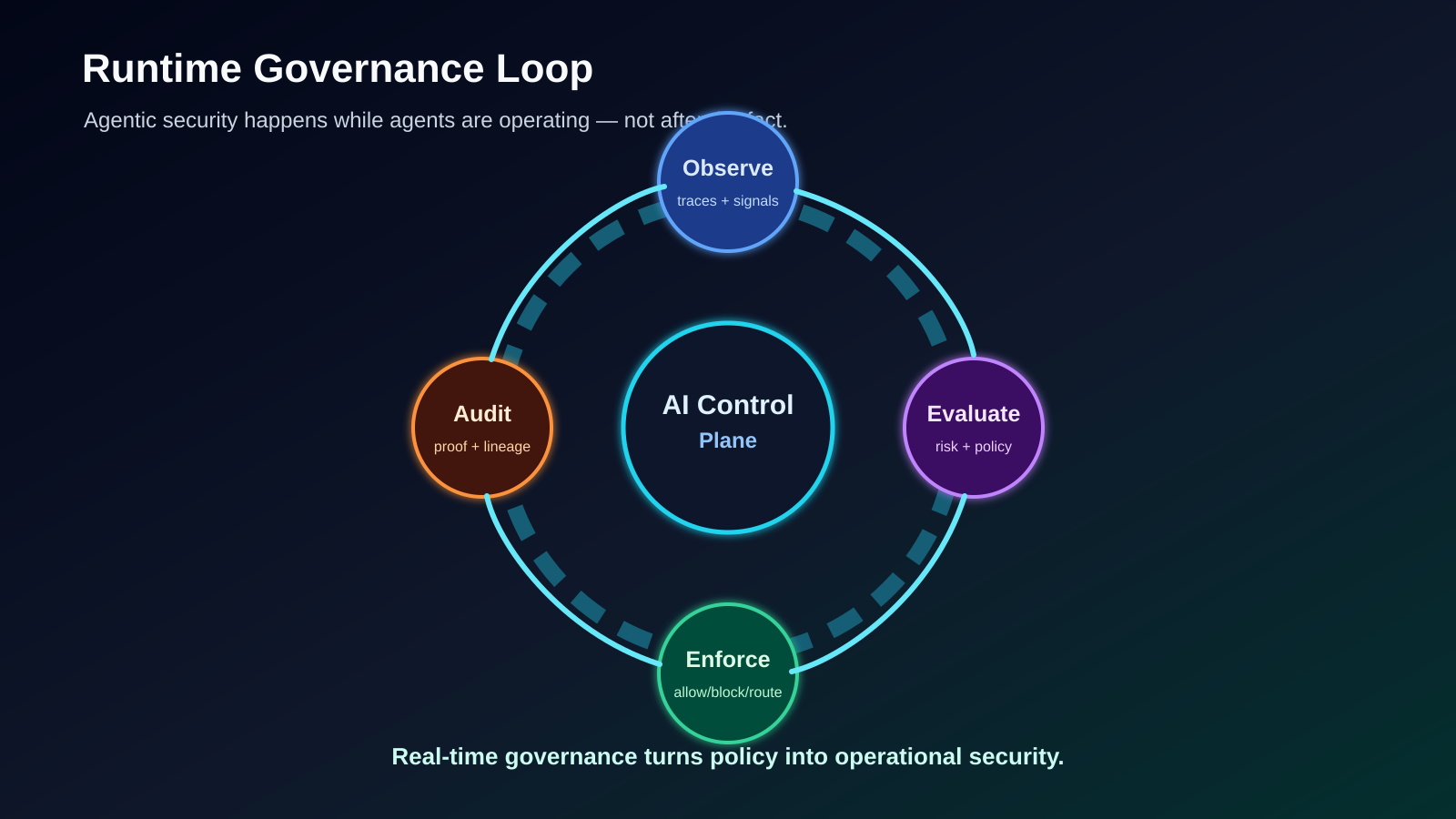
Governance has to move into runtime.
Agentic security needs a control plane
Agentic security cannot be solved by scattered checklists. It needs an operating layer.
That layer is the AI control plane.
An AI control plane gives the enterprise a way to see, govern, and enforce security across agents, models, data, tools, workflows, and decisions.
It connects security policy to agent behavior.
It helps determine whether an action should be allowed, blocked, modified, escalated, or routed for human approval.
It creates the audit trail needed to understand what happened.
It gives CIOs, CISOs, compliance leaders, data teams, and business owners a shared view of agentic risk.
Most importantly, it allows security to become real time.
Because if agents can act in seconds, security has to evaluate in seconds.
The cloud security analogy matters
The phrase “agentic security is the new cloud security” is not just a slogan.
It is a warning and a roadmap.
When cloud adoption accelerated, many organizations initially treated it as an infrastructure project. Eventually, they realized cloud required new governance, new skills, new platforms, new operating models, and new executive accountability.
The same pattern is happening with AI agents.
At first, agents may look like productivity enhancements. Then they become embedded in workflows. Then they connect to systems of record. Then they begin influencing decisions, customer experiences, operations, and risk.
By that point, agentic security is no longer optional.
It becomes a foundation for scale.
The enterprises that learned cloud security early were able to move faster with more confidence. The enterprises that delayed often faced sprawl, misconfigurations, audit gaps, and incident response challenges.
The agentic era will follow a similar curve.
Organizations that build agentic security early will be better positioned to scale AI-native transformation responsibly.
What enterprises should do now
Agentic security is still emerging, but enterprises can start building the right foundations today.
1. Create an agent inventory
Know which agents exist, who owns them, what they do, what tools they use, and what data they access.
2. Define autonomy levels
Not every agent should have the same freedom. Classify agents by whether they can only suggest, draft, execute with approval, or execute autonomously.
3. Govern tool access
Treat agent tools like privileged capabilities. Apply least privilege, approval requirements, risk scoring, and logging.
4. Add context boundaries
Limit what agents can retrieve and use based on task, identity, data sensitivity, and business purpose.
5. Capture agent traces
Preserve the chain of intent, context, reasoning, tool calls, policy checks, approvals, and outcomes.
6. Move enforcement into runtime
Build the ability to allow, block, redact, route, escalate, or terminate actions while agent workflows are happening.
7. Make security a co-owner of AI transformation
AI-native transformation is not only a technology strategy. It is a control strategy. Security leaders need a seat at the design table early.
The strategic takeaway
Cloud security became essential because the enterprise perimeter dissolved and infrastructure became programmable.
Agentic security will become essential because business action is becoming programmable.
That is the big shift.
AI agents will not simply generate answers. They will participate in workflows, influence decisions, and operate across enterprise systems.
This creates enormous opportunity, but also a new class of risk.
The solution is not to slow AI adoption. The solution is to give AI adoption a secure operating model.
That operating model requires visibility, policy, identity, observability, and real-time governance.
It requires an AI control plane.
Agentic security is the new cloud security because the center of enterprise risk is moving again.
From networks to cloud workloads.
From cloud workloads to autonomous agents.
And from static controls to real-time control plane intelligence.