Agent Identity Is the Missing Layer in Enterprise AI
If AI agents can act, they need identity, ownership, permissions, scope, auditability, and lifecycle management; not just prompts and guardrails.
Executive Summary
Enterprises are preparing for a world where AI agents do real work.
That means agents will not only answer questions. They will open tickets, query databases, draft customer communications, update CRM records, create pull requests, trigger workflows, call APIs, and coordinate with other agents.
The uncomfortable truth is simple: anything that can act inside the enterprise needs an identity.
Today, many AI agents are treated like applications, automations, or model endpoints. That is too loose. An agent is not just software. It is an operational actor. It may represent a person, a team, a business process, or a system. It may inherit access, invoke tools, make decisions, and create business consequences.
If the enterprise cannot answer who the agent is, who owns it, what it is allowed to do, on whose behalf it is acting, and how its actions are audited, then the enterprise does not have agent governance. It has autonomous activity with unclear accountability.
Agent identity is the missing layer.
Agents Are Becoming Enterprise Actors
The first wave of enterprise AI was mostly advisory. A user asked a question. A model generated an answer. The risk was real, but the blast radius was often bounded by the human who copied, approved, or ignored the output.
Agentic AI changes the posture.
Agents can take multi-step actions. They can operate across tools. They can access systems. They can make plans. They can delegate subtasks. They can run in the background. They can chain decisions faster than a human can review each step.
That makes the agent more like a digital worker than a passive assistant.
But most enterprise identity systems were built around humans, service accounts, applications, devices, and workloads. Agents blur those categories. An agent may be software, but it may act with human-delegated authority. It may be an application component, but it may choose tools dynamically. It may be a workload, but it may make decisions based on goals rather than fixed instructions.
That ambiguity creates risk.
The Wrong Model: Shared Keys and Invisible Authority
Many early AI deployments rely on shortcuts:
- Agents use broad service accounts.
- Tool access is configured once and rarely reviewed.
- Human users delegate authority without clear boundaries.
- Logs show that a system acted, but not which agent made the decision.
- Ownership is unclear when an agent causes an exception.
- Temporary experiments become persistent workflow dependencies.
This is how enterprises create “shadow authority.”
The agent can act, but the organization cannot clearly explain the identity behind the action. It cannot always tell whether the agent acted as itself, as a user, as a team, as an application, or as an unmanaged automation. That is not a small technical detail. It is the foundation of accountability.
Security agencies have warned that agentic AI introduces new risks around autonomy, privilege, accountability, monitoring, and oversight. OWASP’s agentic AI work highlights the security implications of tool use, privilege misuse, supply-chain issues, and multi-step autonomous behavior. NIST’s AI Risk Management Framework emphasizes governance, measurement, management, and trustworthy AI across the lifecycle. NIST’s digital identity guidelines reinforce the broader principle that digital actors need clear identity, authentication, federation, and lifecycle controls.
The enterprise lesson is clear: agents cannot be governed as anonymous capability.
What Agent Identity Requires
Agent identity is not just giving every agent a name.
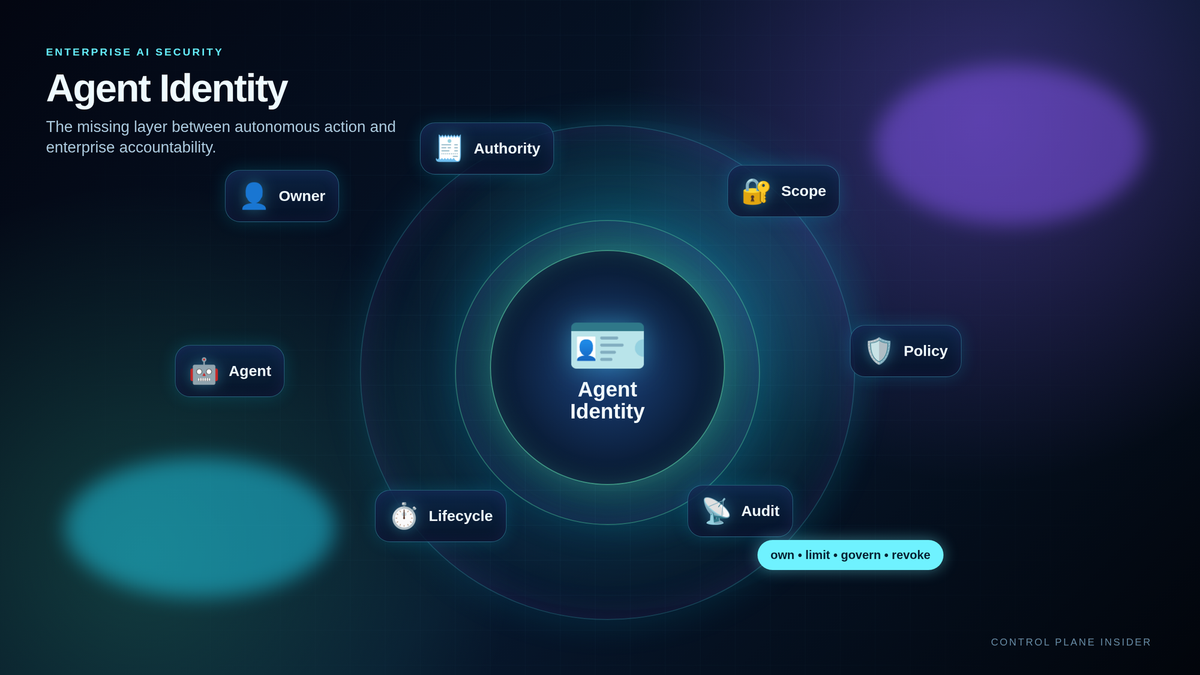
A serious agent identity model needs seven elements.
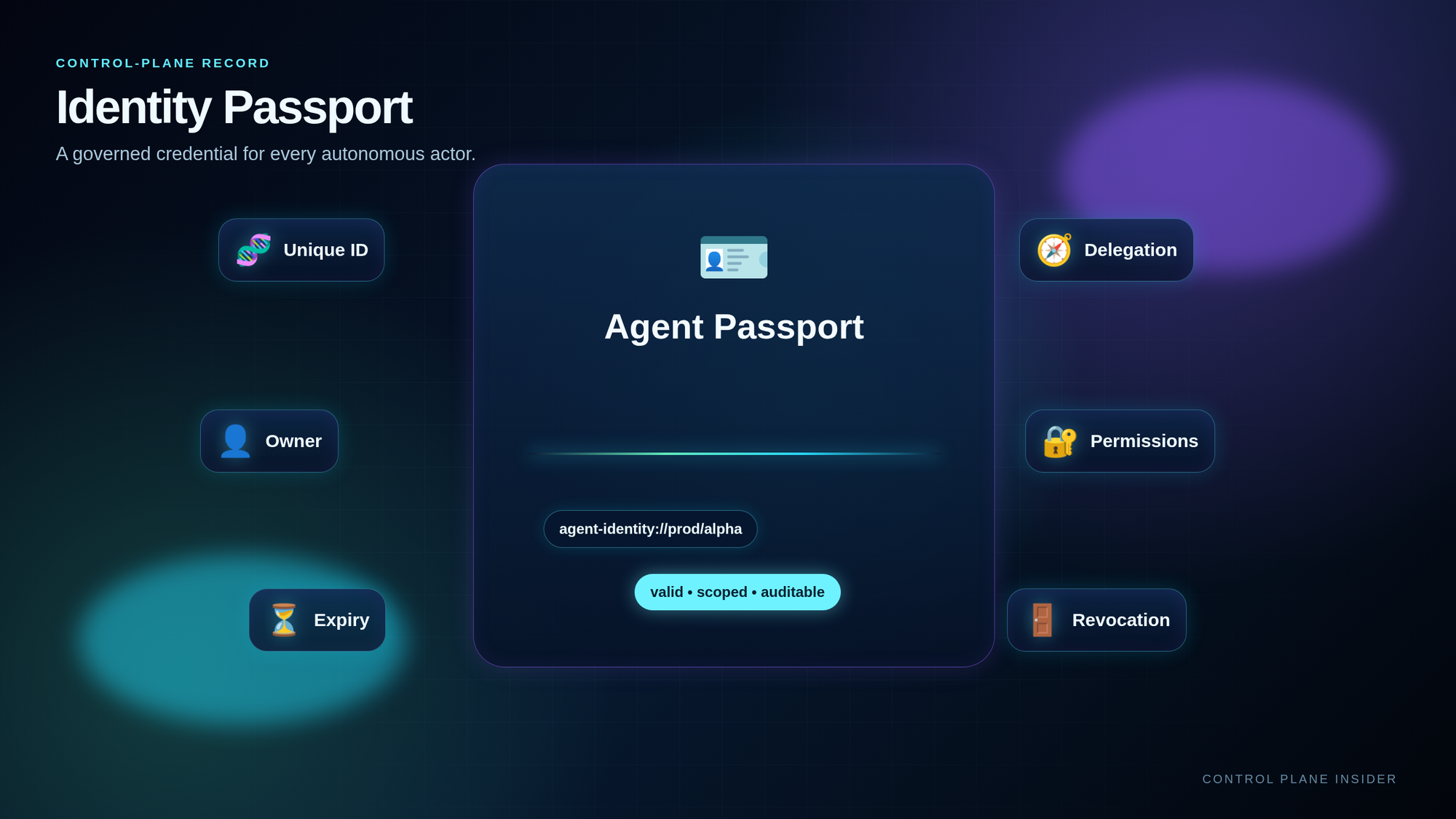
1. Unique identity
Every production agent needs a unique identity that can be referenced in logs, policies, approvals, incidents, and audits.
2. Human owner
Every agent needs an accountable business and technical owner. Autonomy does not remove accountability. It makes accountability more important.
3. Delegation model
The enterprise must know whether the agent is acting for a user, a role, a team, a process, or itself — and what authority is being delegated.
4. Scoped permissions
Agents should not inherit broad access by default. Permissions should be bounded by task, tool, data class, environment, time, and risk level.
5. Runtime policy
Identity should feed policy decisions. The same tool call may be allowed for one agent, constrained for another, and escalated for a third.
6. Audit trail
Logs should show not only what happened, but which agent acted, under whose authority, through which tool, against which data, and with which policy decision.
7. Lifecycle management
Agents need onboarding, testing, approval, deployment, monitoring, review, rotation, suspension, retirement, and incident response.
Without those elements, agent governance becomes a guessing game.
Identity Is the Anchor for Policy and Observability
Policy-as-intelligence and AI observability both depend on identity.
A policy engine cannot evaluate risk precisely if it does not know who or what is acting. Observability cannot create a useful trace if agent actions are hidden behind shared credentials. Human oversight cannot assign accountability if the agent has no owner. Incident response cannot contain risk if the organization cannot disable or constrain the actor.
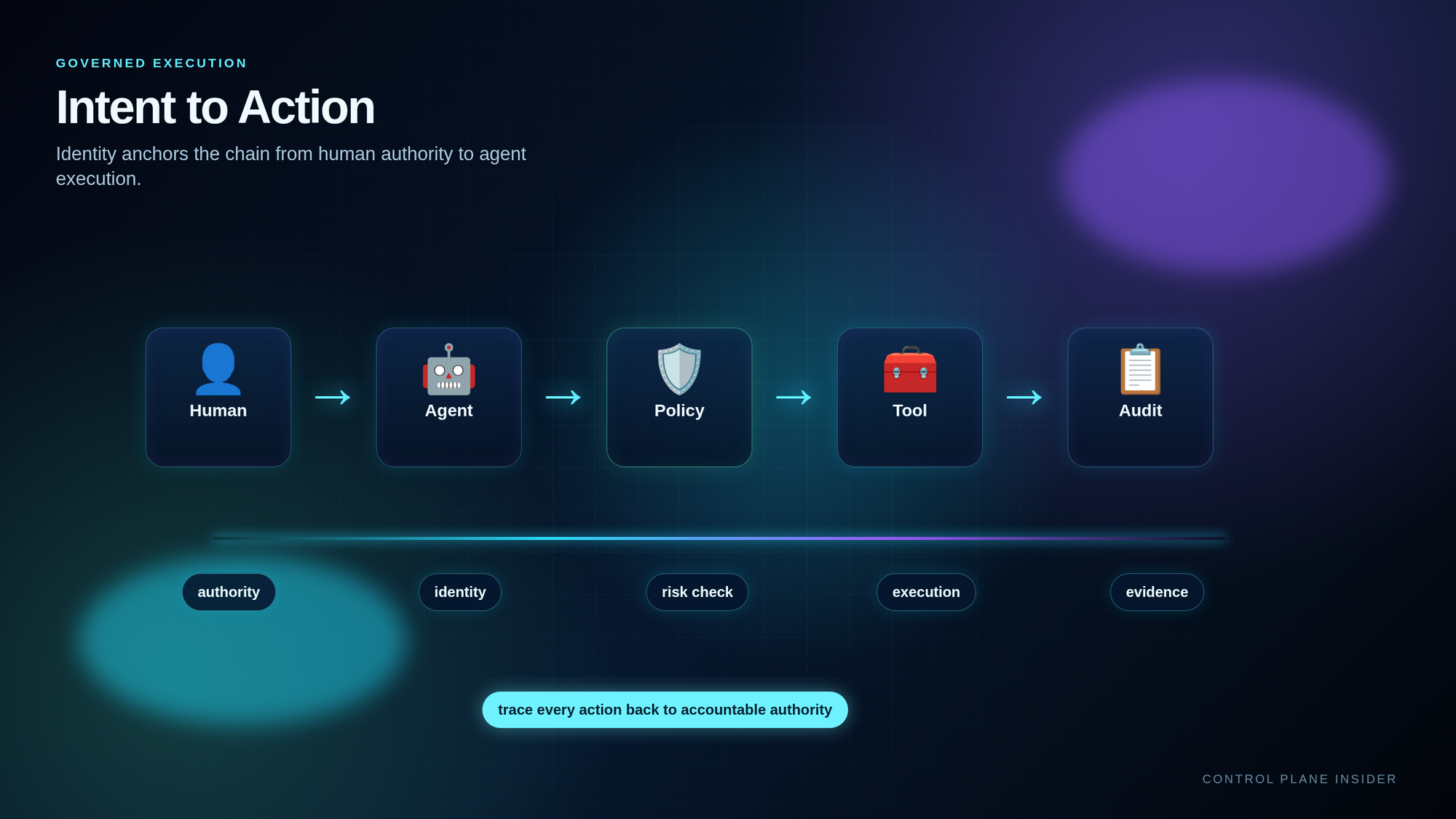
Identity is the anchor that connects:
- agent behavior to ownership,
- tool calls to permissions,
- data access to authorization,
- approvals to accountable humans,
- incidents to root cause,
- telemetry to governance,
- and business outcomes to responsible control.
In other words, agent identity is not an IAM side quest. It is a control-plane primitive.
The Control Plane View
In an AI-native enterprise, the control plane should maintain an agent registry that answers:
- What is this agent?
- Who owns it?
- What business process does it support?
- What tools can it call?
- What data can it access?
- What actions are reversible?
- What policies apply?
- When does it need approval?
- What telemetry does it emit?
- How is it reviewed, suspended, or retired?
This registry should not be static documentation. It should connect to runtime enforcement.
When an agent tries to act, the control plane should evaluate the agent identity, delegated authority, data sensitivity, tool risk, business context, and policy state. Then it should allow, deny, constrain, escalate, log, or revoke.
That is how identity becomes operational.
The Agent Identity Maturity Ladder
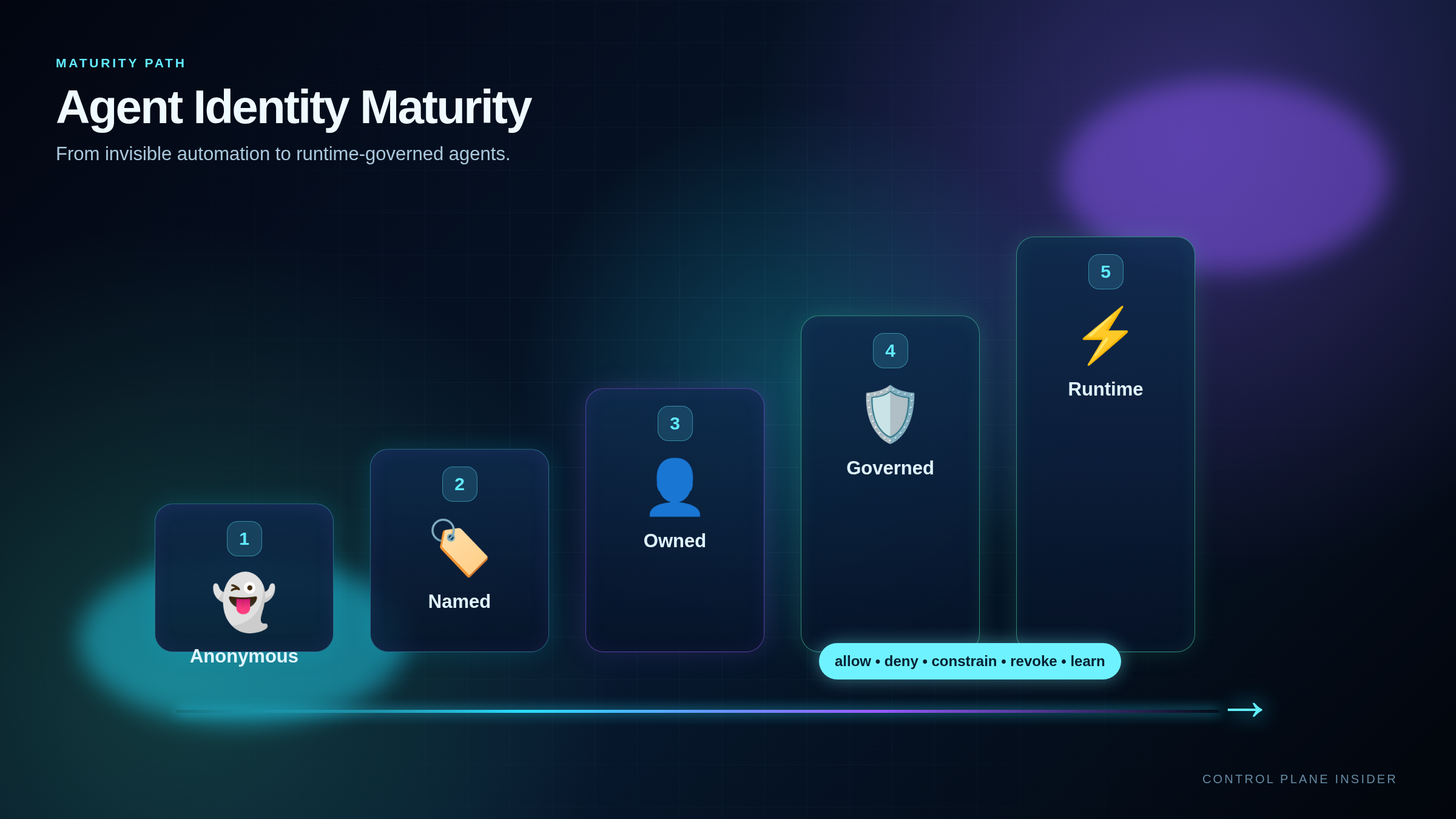
Most organizations will mature through five stages.
- Anonymous agents — Agents act through shared credentials, loose integrations, or experimental access.
- Named agents — Agents are inventoried and labeled, but ownership and permissions remain inconsistent.
- Owned agents — Each agent has a business owner, technical owner, purpose, scope, and review cycle.
- Governed agents — Identity connects to permissions, policies, approvals, telemetry, and audit trails.
- Runtime-governed agents — Agent identity drives real-time allow, deny, constrain, escalate, revoke, and learning-loop decisions.
The maturity question is not whether the enterprise has agents. It is whether those agents are first-class governed identities.
The Executive Test
Before scaling agentic AI, leaders should ask:
- Can we list every production agent and who owns it?
- Can we tell whether an agent acted for itself, a user, a team, or a business process?
- Can we limit agent permissions by task, tool, data class, environment, time, and risk?
- Can we audit every agent action back to identity, delegated authority, policy decision, and business outcome?
- Can we suspend, constrain, rotate, or retire an agent quickly when risk changes?
If the answer is no, the enterprise does not yet have agent identity. It has AI access with partial accountability.
Closing
AI agents will become part of the enterprise workforce. Some will be small assistants. Some will be workflow operators. Some will coordinate complex business processes. Some will act on behalf of humans. Some will act on behalf of systems.
The enterprise cannot govern that future with anonymous autonomy.
If an agent can act, it needs an identity. If it has an identity, it needs ownership. If it has ownership, it needs scoped authority. If it has authority, it needs policy, telemetry, audit, and lifecycle control.
Agent identity is not a backend detail. It is the missing layer of enterprise AI governance.
Source Notes
- CISA careful adoption of agentic AI services: https://www.cisa.gov/resources-tools/resources/careful-adoption-agentic-ai-services
- CISA and partners release guidance on adopting agentic AI services: https://content.govdelivery.com/accounts/USDHSCISA/bulletins/41544ff
- OWASP Agentic AI Threats and Mitigations: https://genai.owasp.org/resource/agentic-ai-threats-and-mitigations/
- OWASP Top 10 for Agentic Applications 2026: https://genai.owasp.org/resource/owasp-top-10-for-agentic-applications-for-2026/
- NIST AI Risk Management Framework: https://www.nist.gov/itl/ai-risk-management-framework
- NIST SP 800-63-4 Digital Identity Guidelines: https://pages.nist.gov/800-63-4/