From Cloud-First to Latency-First Architecture
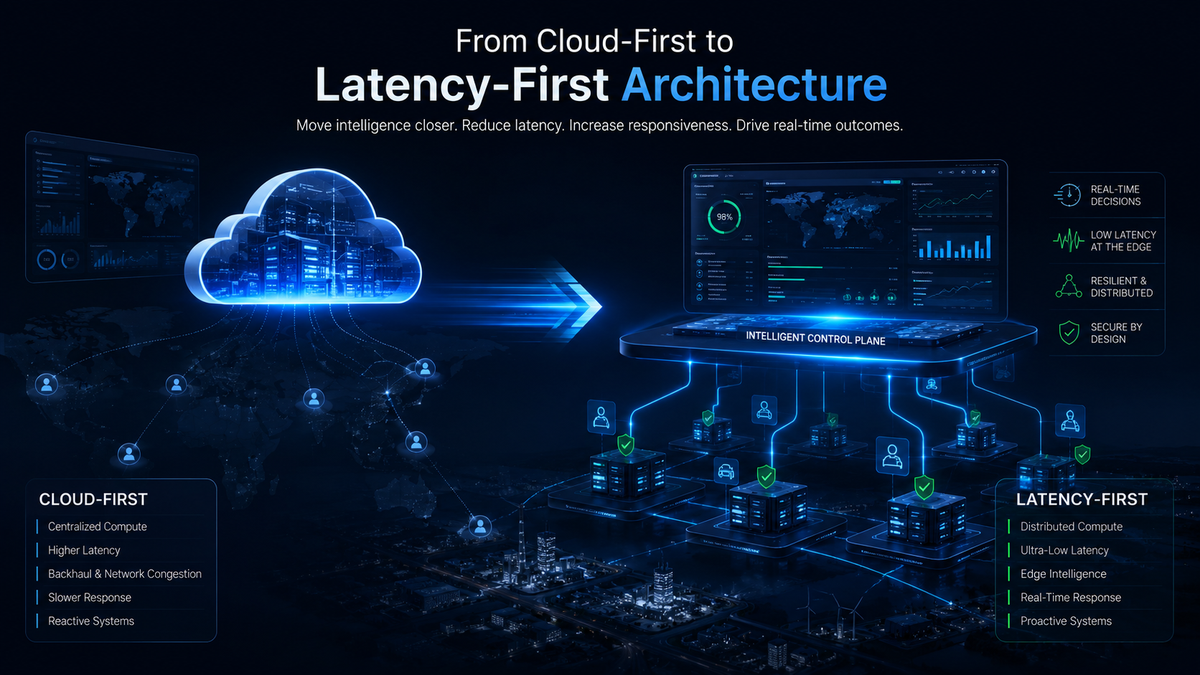
For more than a decade, “cloud-first” was the default answer to enterprise architecture.
If a new system was being built, it should run in the cloud. If an old system was being modernized, it should move toward cloud-native services. If a team needed scale, resilience, speed of deployment, or access to managed platforms, the cloud was the strategic destination.
That mindset made sense.
Cloud-first helped organizations escape the limits of on-premises infrastructure. It accelerated software delivery. It gave enterprises elastic capacity, global reach, better developer tooling, and access to managed data, analytics, and AI services.
But AI is changing the architecture question.
The issue is no longer simply where systems can scale.
The issue is where intelligence can respond in time.
As AI moves from chat interfaces into voice agents, robots, factories, vehicles, call centers, hospitals, field operations, security systems, smart glasses, and autonomous workflows, latency becomes a first-order design constraint.
The next enterprise architecture shift is not cloud-first versus cloud-last.
It is cloud-first to latency-first.
Cloud-First Was Built for the Software Era
Cloud-first architecture emerged from a specific set of enterprise problems.
Companies needed to move faster. They needed to reduce dependency on long hardware procurement cycles. They needed infrastructure that could scale up and down with demand. They needed better availability, global deployment patterns, managed services, and modern developer platforms.
The cloud solved those problems elegantly.
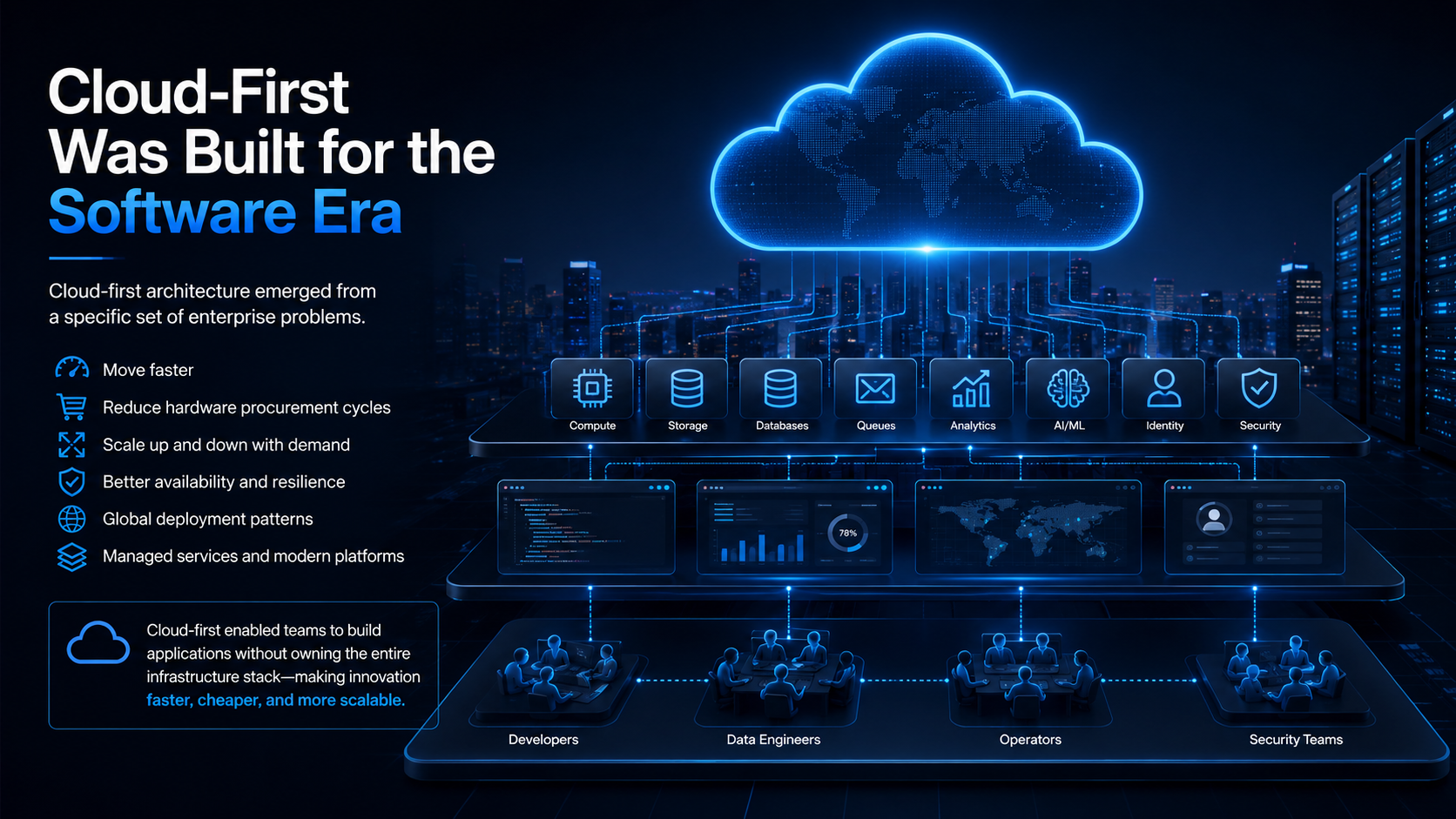
It allowed teams to build applications without owning the entire infrastructure stack. It made experimentation cheaper. It made scaling easier. It gave enterprises access to databases, queues, storage, analytics, identity, security, and machine learning services through APIs.
For most web, mobile, SaaS, and enterprise applications, cloud-first was the right default.
A user clicks a button. A request travels to a cloud region. Services execute. Data is retrieved. A response returns. If the experience takes hundreds of milliseconds or even a few seconds, the product can still work.
The cloud era optimized for scale, availability, cost efficiency, operational leverage, and global reach.
Those priorities still matter.
But AI introduces a different kind of workload.
AI Has a Clock
Traditional software usually responds to explicit user actions.
AI increasingly participates in dynamic loops.
It listens, observes, interprets, decides, recommends, speaks, routes, acts, monitors, and learns. It may operate inside a conversation, a physical environment, a security incident, a manufacturing process, a clinical workflow, or an autonomous system.

Those environments have clocks.
A voice assistant has a conversational clock. Wait too long and the interaction feels broken.
A robot has a motion clock. Wait too long and the physical world has already changed.
A security agent has an incident clock. Wait too long and the attacker moves laterally.
A field technician has an operational clock. Wait too long and the repair stalls.
An augmented reality interface has a perception clock. Wait too long and the overlay no longer matches reality.
A customer support workflow has a trust clock. Wait too long and the user loses confidence.
This is why latency is not just an infrastructure metric for AI.
Latency is part of the user experience, part of the safety model, part of the trust boundary, and part of the business outcome.
A system that is intelligent but late is not intelligent in practice.
Latency-First Does Not Mean Edge-Only
Latency-first architecture is sometimes misunderstood as an argument against the cloud.
It is not.
The cloud remains essential. It will continue to be the center of gravity for large-scale model training, frontier model inference, enterprise data platforms, global orchestration, knowledge indexing, observability, governance, and many asynchronous AI workflows.
Latency-first does not mean every workload should move to the edge.
It means every workload should be placed according to its time budget.

Some workloads can run in the cloud because the user or process can wait. Research synthesis, legal review, strategic analysis, software development agents, large batch processing, and long-running planning workflows may benefit more from deep reasoning than instant response.
Some workloads need to run closer to the user, device, machine, or data source. Voice interaction, robotics, industrial control, AR, frontline support, clinical workflows, security containment, and field operations may need local or regional inference.
Some workloads should be split. A local model handles immediate perception or first response. A cloud model handles deeper reasoning. A human approves consequential action. A long-running agent coordinates the workflow in the background.
Latency-first architecture is not anti-cloud.
It is anti-default.
It refuses to assume that one infrastructure location is correct for every form of intelligence.
The New Architecture Question
Cloud-first asks:
Can this run in the cloud?
Latency-first asks:
Where must each part of this intelligence loop run for the experience to work?
That is a more precise question.
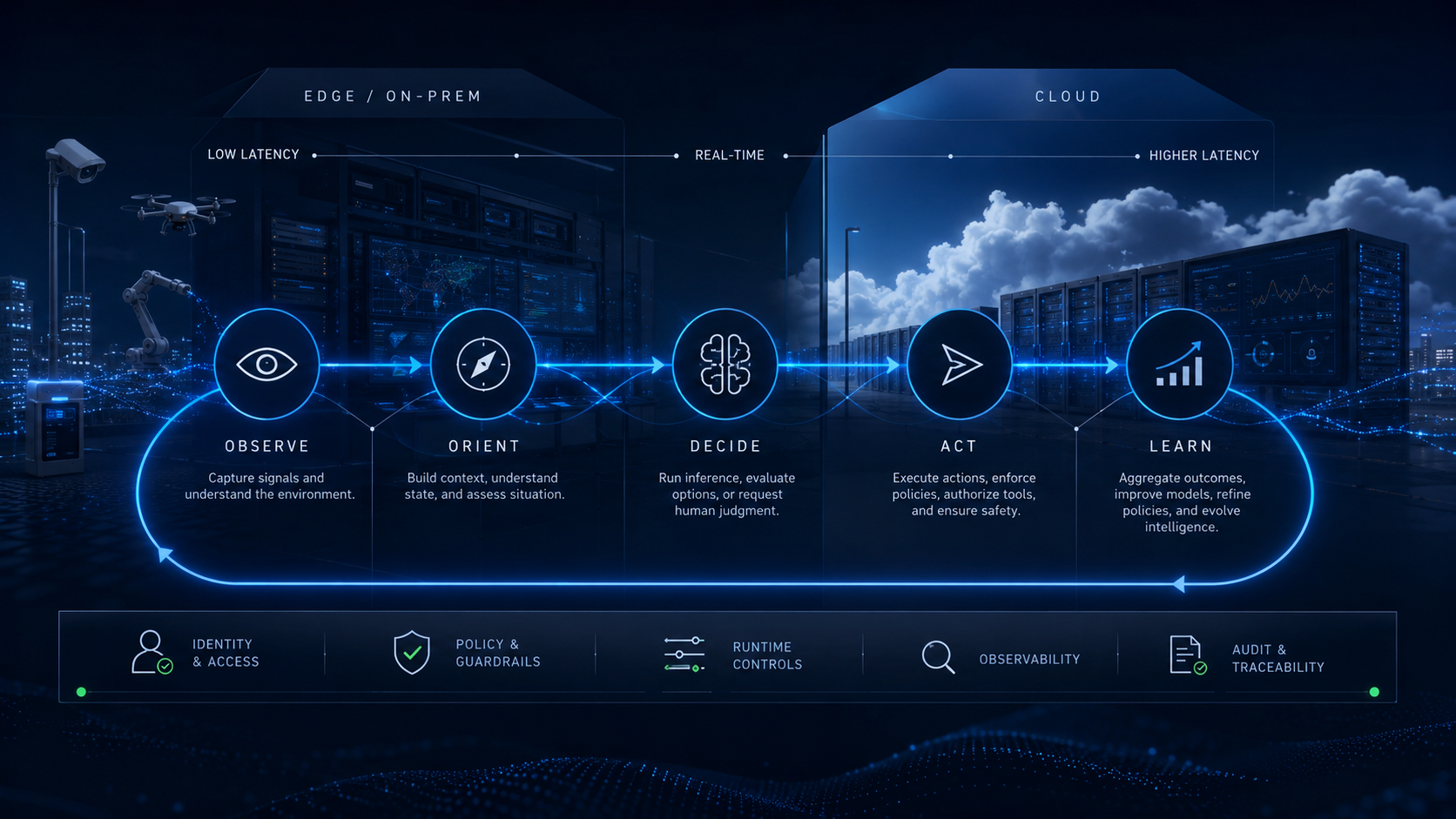
It forces architects and executives to break AI systems into loops:
- Observe
- Orient
- Decide
- Act
- Learn
Each part of the loop may have a different latency requirement.
Observation may need to happen locally because the signal is generated by a device, sensor, customer interaction, or machine.
Orientation may require local context, cached knowledge, recent state, or private data.
Decision may require either a small fast model, a specialized model, a frontier cloud model, or human judgment.
Action may require policy enforcement, approval, tool authorization, audit logging, and rollback.
Learning may happen asynchronously in the cloud as outcomes are aggregated and models, workflows, and policies improve.
Latency-first architecture places each part of the loop where it belongs.
The Latency Budget Becomes a Design Artifact
Enterprise architecture has long used requirements documents, service-level objectives, data classifications, security policies, and integration diagrams.
AI-native architecture needs another artifact: the latency budget.
A latency budget defines how much time an AI system has to produce a meaningful response or action before value degrades.
Different experiences have different budgets.
A long-form research agent may have minutes.
A customer support assistant may have seconds.
A voice interface may have hundreds of milliseconds before the conversation feels unnatural.
A robot or industrial safety system may have milliseconds.
A background document-processing agent may have hours if the task completes before a deadline.
The latency budget should shape the architecture.
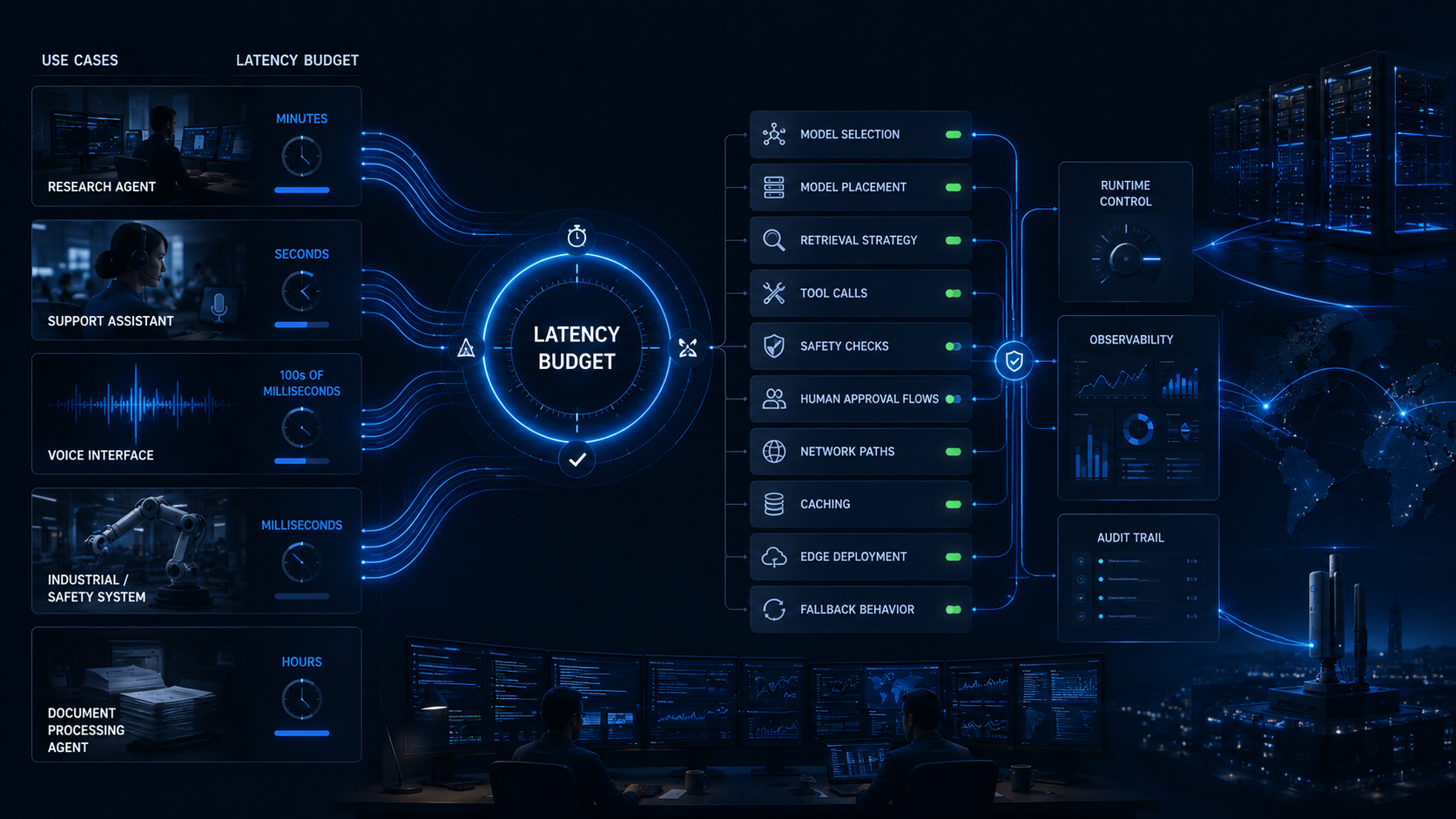
It should influence model selection, model placement, retrieval strategy, tool calls, safety checks, human approval flows, network paths, caching, edge deployment, and fallback behavior.
Without a latency budget, teams optimize blindly.
They may choose a model that is powerful but too slow.
They may add tool calls that improve accuracy but break the experience.
They may centralize context that should be local.
They may route every request through governance layers that are necessary but not designed for real-time operation.
Latency-first design does not eliminate these tradeoffs.
It makes them explicit.
Context Has Latency Too
AI latency is not only model latency.
A model may respond quickly, but the system may still be slow because context is scattered across applications, documents, databases, APIs, and human workflows.
Retrieval takes time.
Authorization takes time.
Tool calls take time.
Network hops take time.
Data transformation takes time.
Policy checks take time.
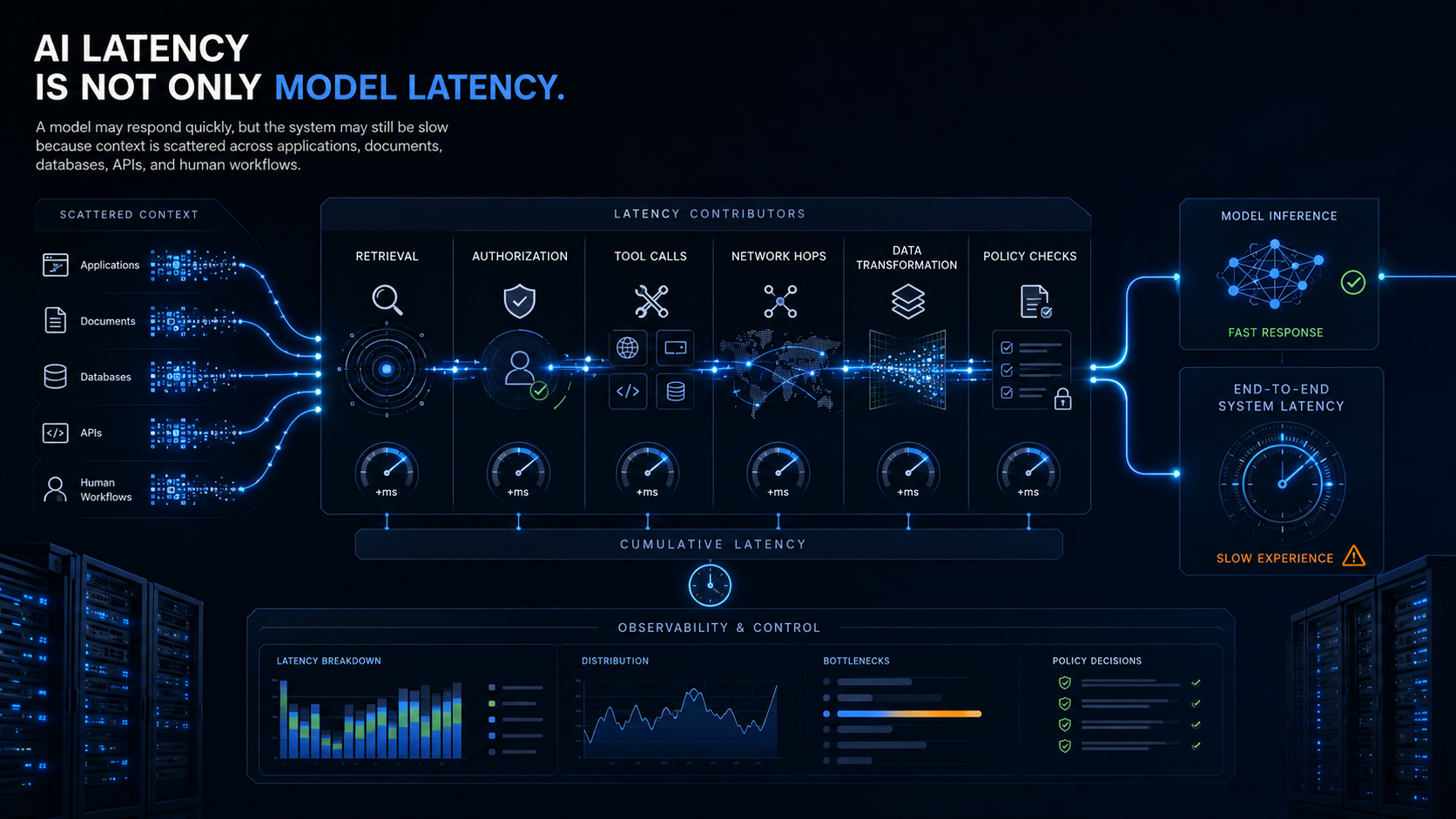
If the system must assemble context from too many distant sources before it can answer, the user experiences latency even if the model itself is fast.
This is why latency-first architecture requires context placement.
Important context should be staged near the workflows that need it.
That may include local caches, edge knowledge stores, regional retrieval indexes, embedded policies, on-device memory, site-level operational state, or precomputed summaries.
A factory AI assistant should have immediate access to machine state, maintenance history, safety rules, and local procedures.
A field-service agent should have offline access to manuals, diagrams, customer history, and troubleshooting flows.
A voice agent should not have to call five slow systems before acknowledging the user.
A security agent should know asset criticality and identity context before recommending containment.
The architecture question becomes:
What context must be close enough to be useful in time?
Agentic Workflows Make Latency Harder
Agents create new latency challenges because they do not simply respond once.
They plan, retrieve, call tools, inspect outputs, revise, ask for approval, execute actions, monitor results, and sometimes coordinate with other agents.
That can create value.
It can also create delay.
A multi-step agentic workflow may be appropriate for a procurement review, code migration, compliance analysis, or research task. The user expects deeper work and can tolerate a longer run.
But the same pattern may fail in a real-time workflow.
A customer in a live conversation cannot wait while an agent slowly reasons through every option.
A security incident cannot wait while an agent performs unnecessary tool calls.
A robot cannot pause while a planner asks a remote system for a second opinion.
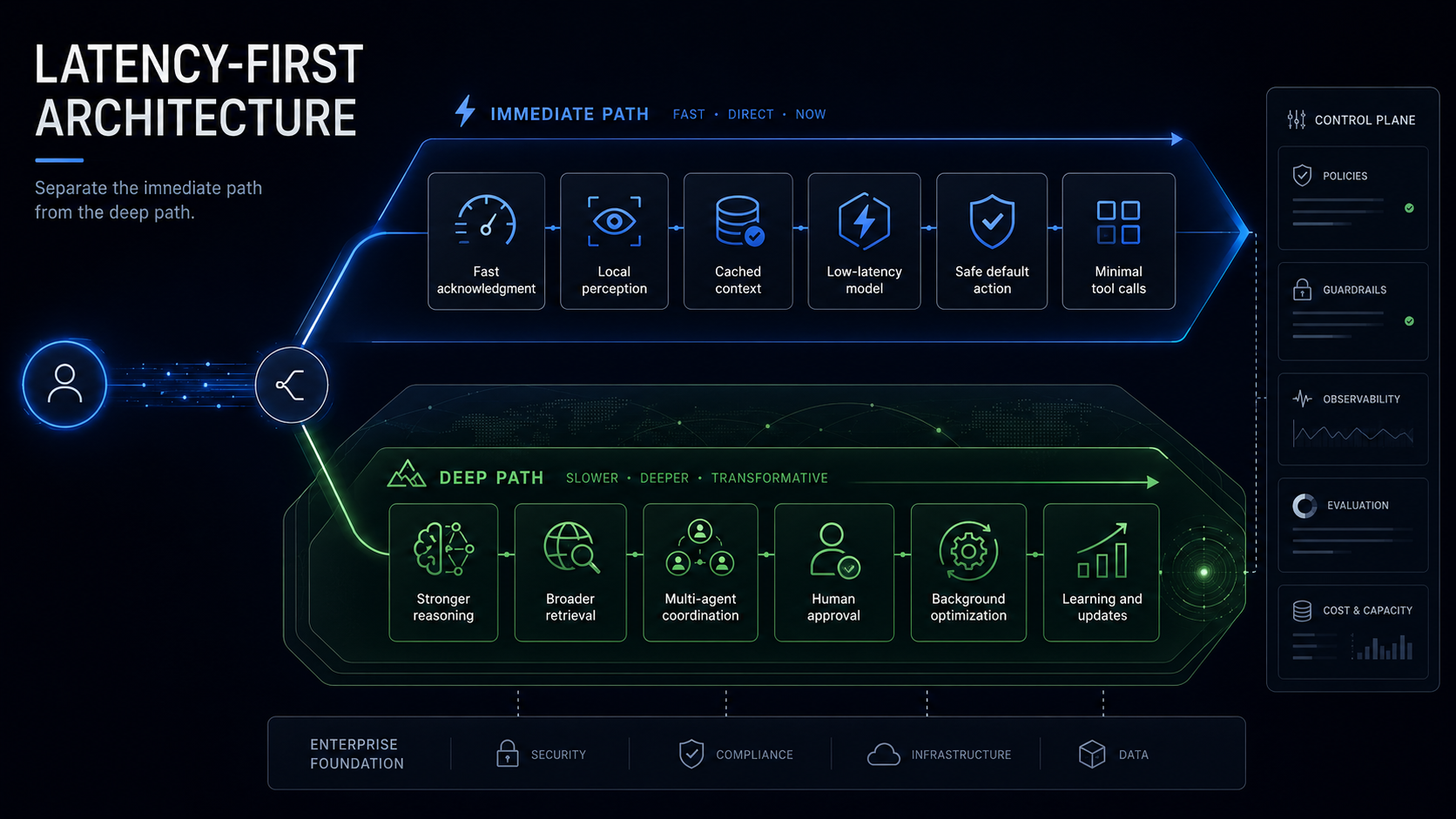
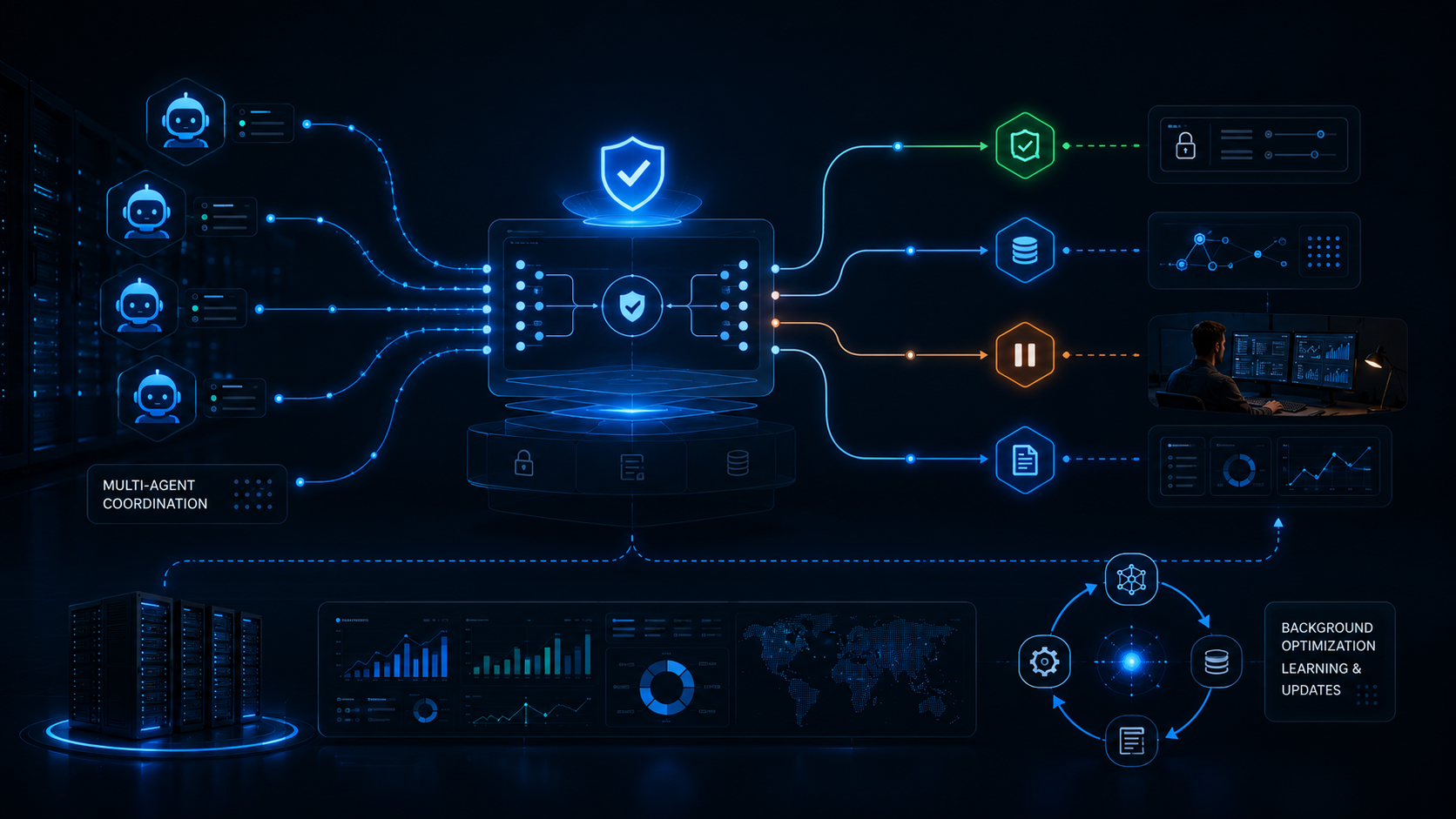
Latency-first architecture forces agent designers to separate the immediate path from the deep path.
Immediate path:
- Fast acknowledgment
- Local perception
- Cached context
- Low-latency model
- Safe default action
- Minimal tool calls
Deep path:
- Stronger reasoning
- Broader retrieval
- Multi-agent coordination
- Human approval
- Background optimization
- Learning and updates
This distinction is critical.
The future of AI will include long-running agents, but not every agentic step belongs in the real-time path.
Governance Must Also Be Latency-Aware
AI governance often adds friction by design.
That is not a criticism. Approval, policy, audit, authorization, and human oversight are necessary when AI systems influence decisions or take action.
But in latency-sensitive workflows, governance cannot be bolted on as a slow external process.
Governance needs to be part of the runtime architecture.
A latency-first control plane should be able to answer quickly:
- Who or what is making the request?
- What data is involved?
- What action is being proposed?
- Is the model approved for this task?
- Is the agent authorized to use this tool?
- Does this require human approval?
- Should the system allow, block, redact, route, log, or escalate?
If policy decisions take too long, teams will bypass them or degrade the experience.
If policy decisions are absent, the system becomes unsafe.
The answer is not less governance.
The answer is faster, more contextual governance.
Runtime policy must be engineered for the latency budget of the workflow.
Some actions can be pre-approved within narrow boundaries.
Some decisions can use local policy caches.
Some high-risk actions can pause for human review.
Some low-risk actions can proceed with logging and post-hoc monitoring.
Latency-first architecture does not weaken control.
It makes control operational.
Resilience Becomes Local
Cloud-first architecture often assumes reliable connectivity to cloud regions.
Latency-first architecture asks what happens when that assumption fails.
For many AI use cases, degraded connectivity should not mean degraded intelligence to zero.
A field technician still needs guidance.
A factory still needs safety systems.
A hospital still needs local workflow support.
A vehicle still needs perception.
A store still needs basic operations.
A security system still needs to detect and respond.
This requires local resilience.
Local models, cached context, edge inference, offline queues, fallback policies, and graceful degradation become important design patterns.
The system may not be able to perform every cloud-enhanced action during an outage, but it should know how to continue safely.
Latency-first architecture treats local continuity as part of the trust model.
The Control Plane for Latency-First AI
The control plane is what makes latency-first architecture manageable.
Without a control plane, teams will make isolated decisions about models, edge nodes, caches, tools, policies, and cloud services. The result will be fragmentation.
With a control plane, the enterprise can route intelligence based on context.
The control plane should understand:
- Latency budget
- Model capability
- User and agent identity
- Data sensitivity
- Context location
- Tool permissions
- Policy requirements
- Local compute availability
- Cloud capacity
- Connectivity quality
- Cost
- Energy conditions
- Business criticality
- Human approval requirements
This is how the architecture decides whether a task should run on device, at the edge, in a regional environment, in the cloud, or across multiple layers.
For example:
- A voice agent may use local speech recognition and interruption handling, regional retrieval, and cloud reasoning for complex issues.
- A factory agent may use edge inference for immediate safety guidance and cloud analytics for longer-term optimization.
- A security agent may run local triage but require central policy approval before containment.
- A customer workflow may provide an instant preliminary answer while a long-running agent completes deeper research in the background.
The control plane turns latency-first architecture from a collection of point solutions into an operating model.
What Enterprises Should Do Now
The move from cloud-first to latency-first does not require enterprises to abandon existing cloud strategies.
It requires them to refine those strategies for AI-native workloads.
A practical roadmap includes six steps.
1. Classify AI Workloads by Time Sensitivity
Separate workloads into real-time, near-real-time, interactive, asynchronous, and background categories.
Do not treat all AI requests as equivalent.
2. Define Latency Budgets
For each priority workflow, define the acceptable response time and the business consequence of delay.
A latency budget should become a standard design requirement.
3. Map Context Location
Identify where critical context lives and how long it takes to retrieve.
Move or cache context closer to the workflows that need it.
4. Build a Model Placement Strategy
Use frontier models, smaller models, local models, specialized models, and deterministic logic according to the constraints of the workload.
The best model is the one that satisfies the task inside the required time, quality, cost, and trust boundaries.
5. Design for Degraded Connectivity
Define what the AI system can still do when cloud access is slow, intermittent, or unavailable.
Local fallback is not optional for physical-world AI.
6. Create Runtime Governance
Ensure identity, authorization, policy, observability, approval, and audit controls work across cloud, edge, and device environments.
Control must follow the workload.
The Strategic Shift
Cloud-first was a powerful architecture principle because it challenged organizations to stop treating infrastructure as a fixed constraint.
Latency-first is the next evolution.
It challenges organizations to stop treating intelligence as if it always belongs somewhere far away.
AI will still need cloud scale.
But it will also need local speed, local context, local resilience, and local control.
The enterprises that understand this will design AI systems around the tempo of the work they support.
They will know which workloads can wait and which cannot.
They will know when to use the cloud brain and when to rely on edge reflexes.
They will know how to govern both through a common control plane.
The future AI-native enterprise will not be cloud-first in the old sense.
It will be latency-first.
Because when intelligence moves into the flow of real work, milliseconds are not a technical detail.
They are the difference between assistance and friction, autonomy and risk, trust and hesitation, action and irrelevance.