Distributed AI as Grid Relief: How Local Compute Could Reduce Data Center Backlash
AI has an infrastructure problem.
Not because the technology is failing. Because the infrastructure required to support it is becoming visible to the public.
For years, cloud infrastructure was mostly abstract. Compute happened somewhere else. Storage happened somewhere else. Networks, data centers, cooling systems, substations, water rights, and power purchase agreements sat behind the interface. Users experienced the application, not the physical footprint behind it.
AI is changing that.
The demand curve is too large, too concentrated, and too local to remain invisible.
Communities are beginning to ask harder questions. Who pays for the grid upgrades? How much water will the facility use? Will electricity bills rise? How many permanent jobs will actually be created? Why are projects negotiated under secrecy? Why should a rural county absorb the costs of infrastructure built to serve global AI demand?
This is the next frontier of AI infrastructure: not just whether we can build enough compute, but whether the public will accept where and how that compute is built.
Centralized AI data centers may be efficient from a hyperscale engineering perspective. But they can feel extractive from a local community perspective: enormous power draw, heavy cooling requirements, land use, water stress, transmission upgrades, tax incentives, and limited visible local benefit.
That is why distributed AI deserves more attention.
If AI is becoming infrastructure, then compute cannot only be centralized in massive campuses. Some of it will need to move closer to where energy is produced, where work happens, where data is created, and where communities can see a more direct benefit.
Solar-backed distributed AI will not replace hyperscale data centers.
But it could reduce the pressure on them, improve local resilience, and make AI infrastructure more acceptable by aligning compute with local energy, local workloads, and local control.
The future of AI infrastructure may not be one giant grid of centralized intelligence.
It may be a network of intelligence substations.
The Data Center Backlash Is No Longer Theoretical
Public concern around data centers has moved from niche environmental debate to mainstream political issue.
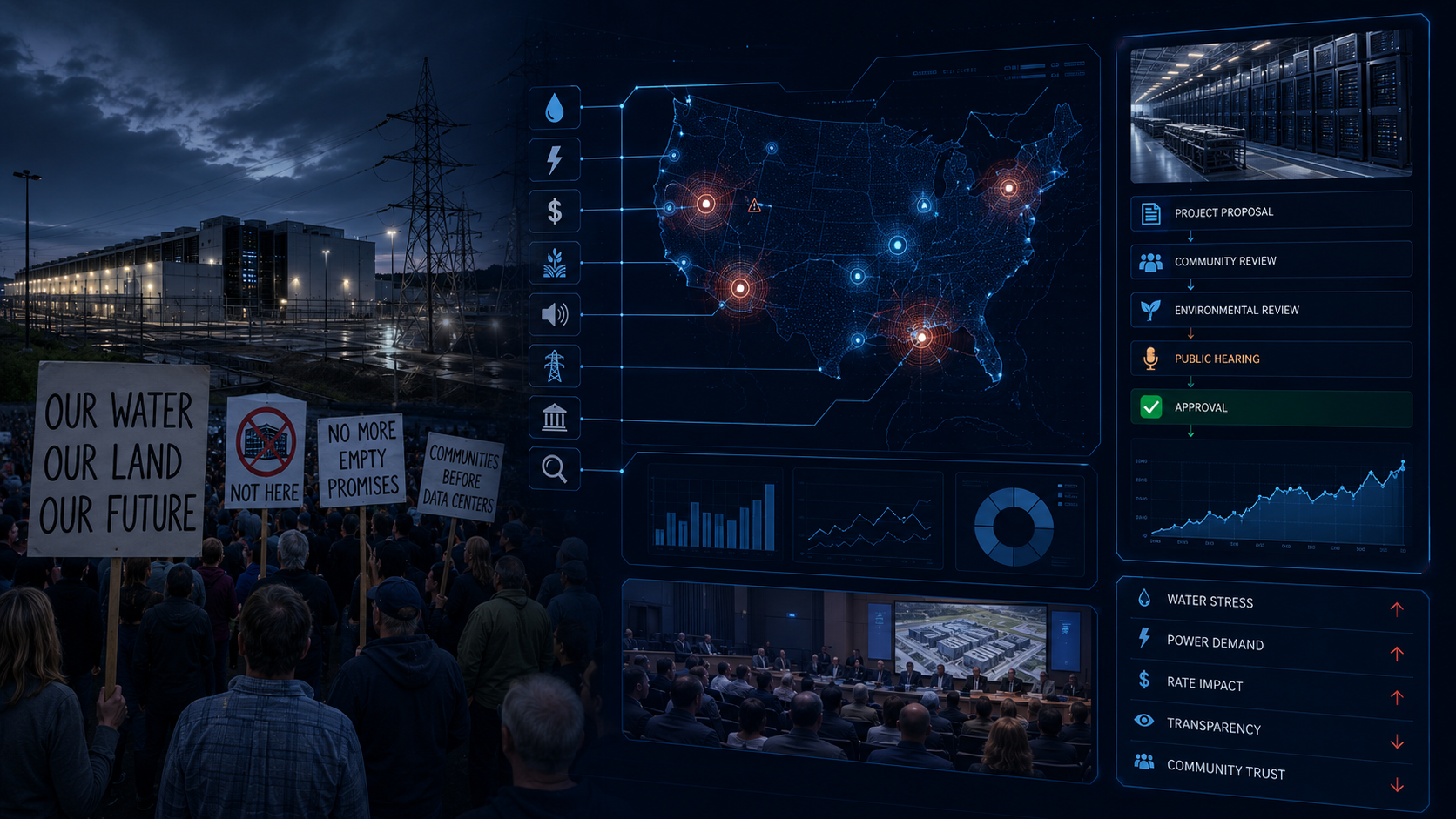
The objections are not all the same. Some communities worry about water. Others worry about electricity prices, farmland, noise, transmission lines, tax incentives, or lack of transparency. In some places, data center disputes have triggered recall efforts against local officials. Recent reporting from The Guardian described growing community opposition across the United States, including residents angry that projects were approved without enough disclosure and worried about power and water strain.
The scale of demand explains why the reaction is intensifying.
The International Energy Agency estimates that data centers consumed about 415 terawatt-hours of electricity in 2024, roughly 1.5% of global electricity consumption, and projects that data center electricity consumption could more than double to around 945 terawatt-hours by 2030. In the United States, the IEA expects data centers to account for nearly half of electricity demand growth through the end of the decade.
That is not a small local permitting issue.
That is an energy-system issue.
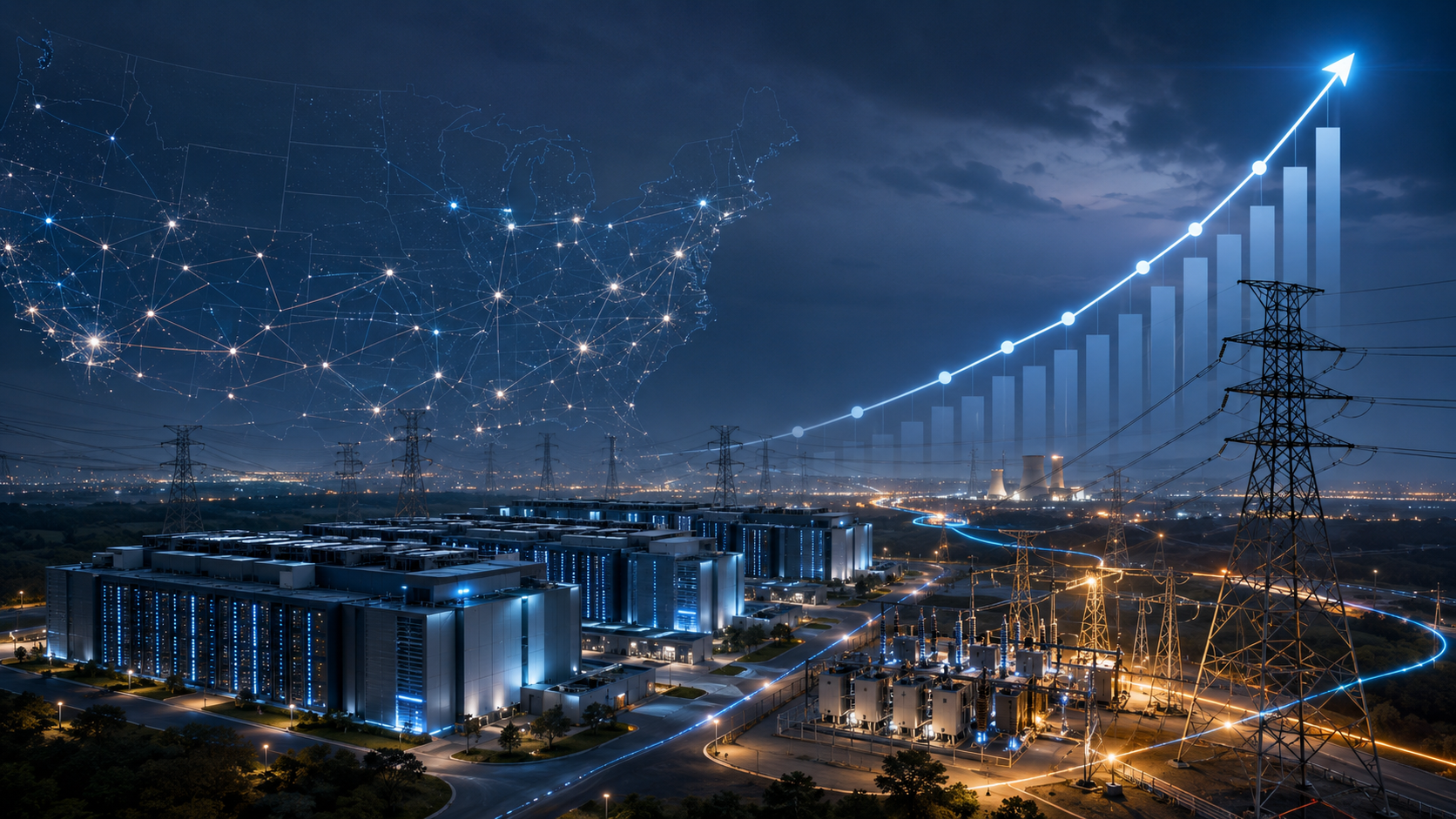
Water is becoming part of the backlash too. Cooling and power generation can create direct and indirect water demand.
The Wall Street Journal recently reported that major technology companies often disclose direct water use but may not fully reflect the indirect water consumed through power generation. In water-stressed regions, communities are increasingly skeptical of promises that large-scale AI infrastructure can expand without local tradeoffs.
And then there is the utility bill problem.
Even when a data center signs its own power agreements, communities worry that transmission upgrades, generation capacity, and infrastructure costs will eventually be socialized through rates. Business Insider recently reported that rural residents are increasingly concerned that AI data centers could affect personal finances through higher electricity bills, alongside pressure on land and water resources.
This is why the industry cannot treat backlash as a communications problem.
It is an architecture problem.
Centralization Creates Local Friction
Centralized infrastructure has advantages.
Hyperscale data centers can aggregate compute, optimize operations, concentrate talent, negotiate power, and operate at massive efficiency. For training frontier models, large-scale centralized compute will remain essential.
But centralized AI infrastructure also concentrates impact.
A single data center campus can demand hundreds of megawatts or more. It may require new substations, transmission lines, backup generation, water systems, road work, and land conversion. The benefits may accrue globally, while the burdens are felt locally.
That imbalance is the source of much of the political tension.
To the AI industry, the facility is part of a national or global infrastructure race.
To the community, it is a local project that may change utility costs, water availability, land use, and quality of life.
Both views can be true.
The problem is that the current AI infrastructure model often asks local communities to accept global-scale compute demand without giving them a clear local value story.
Jobs may be limited after construction. Tax benefits may be contested. Energy and water claims may be hard to verify. The company using the facility may be hidden behind developers, NDAs, or subsidiaries. The public is asked to trust a system it cannot see.
That is a bad foundation for infrastructure legitimacy.
If AI is going to become part of the operating fabric of society, its infrastructure must feel less like an imposition and more like a shared system.
Distributed AI as Grid Relief
Distributed AI means moving some compute away from a small number of massive centralized facilities and toward a network of smaller, more local compute nodes.
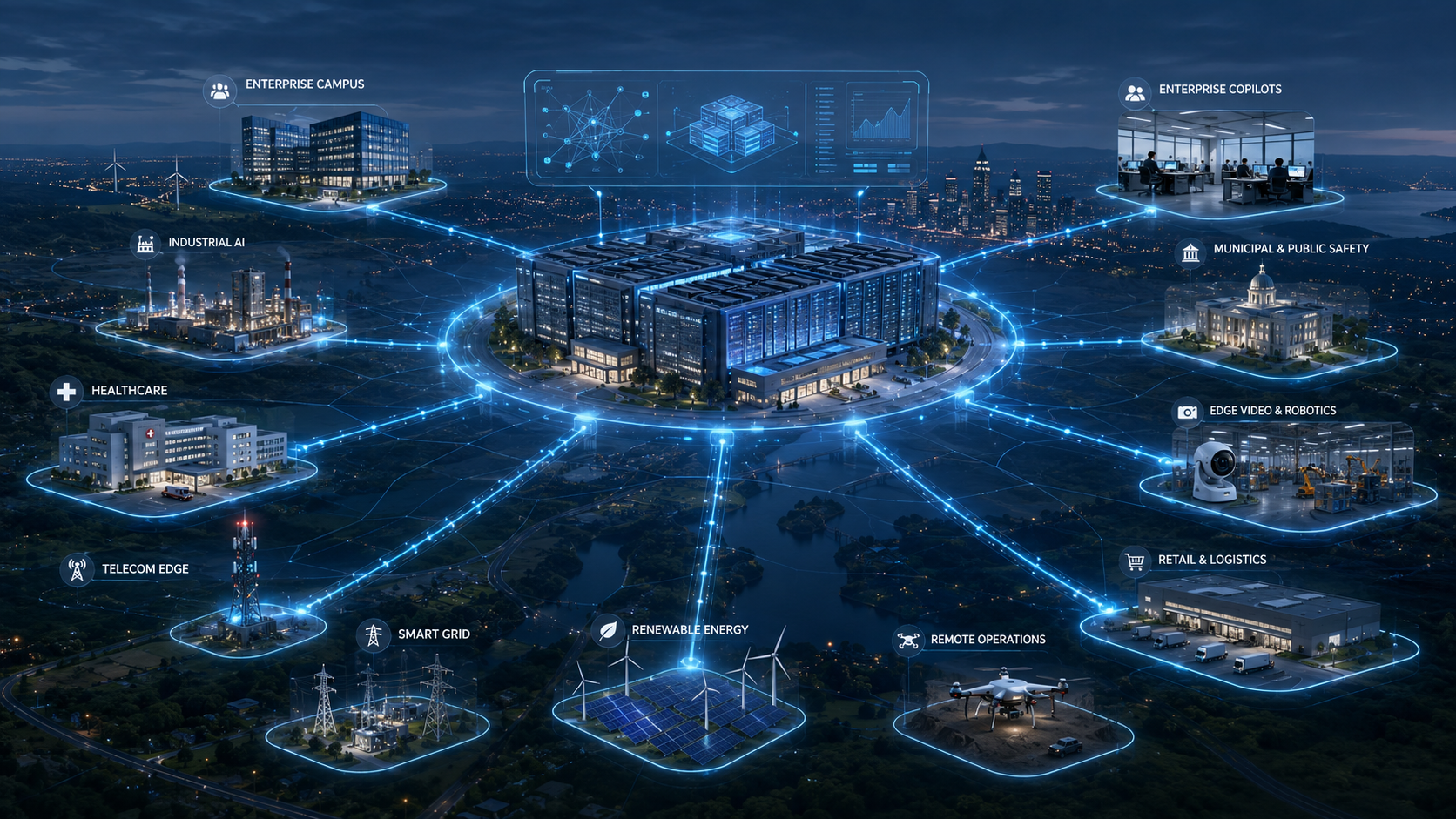
These nodes could live in edge data centers, enterprise campuses, industrial sites, municipal facilities, telecom infrastructure, microgrids, renewable energy zones, or community-scale infrastructure hubs.
The goal is not to decentralize everything.
The goal is to match workloads to the right compute location.
Some AI workloads require hyperscale facilities. Large model training, massive batch processing, and high-density frontier research will remain centralized.
But many AI workloads are different:
- Inference close to users
- Local agent workflows
- Industrial AI
- Healthcare and public sector AI
- Retail, logistics, and field operations
- Smart grid optimization
- Local government services
- Edge video, sensor, and robotics workloads
- Enterprise copilots and workflow agents
- Privacy-sensitive workloads that should stay near the data source
These workloads may not need to travel to a distant hyperscale facility every time. They can often run closer to the point of use, especially as models become smaller, more specialized, and more efficient.
This matters for the grid.
Distributed AI could reduce peak pressure on centralized data center regions. It could locate compute near available renewable generation. It could pair AI workloads with solar, storage, and microgrids. It could shift flexible inference jobs to times when local clean energy is abundant. It could reduce transmission congestion by consuming power closer to where it is generated.
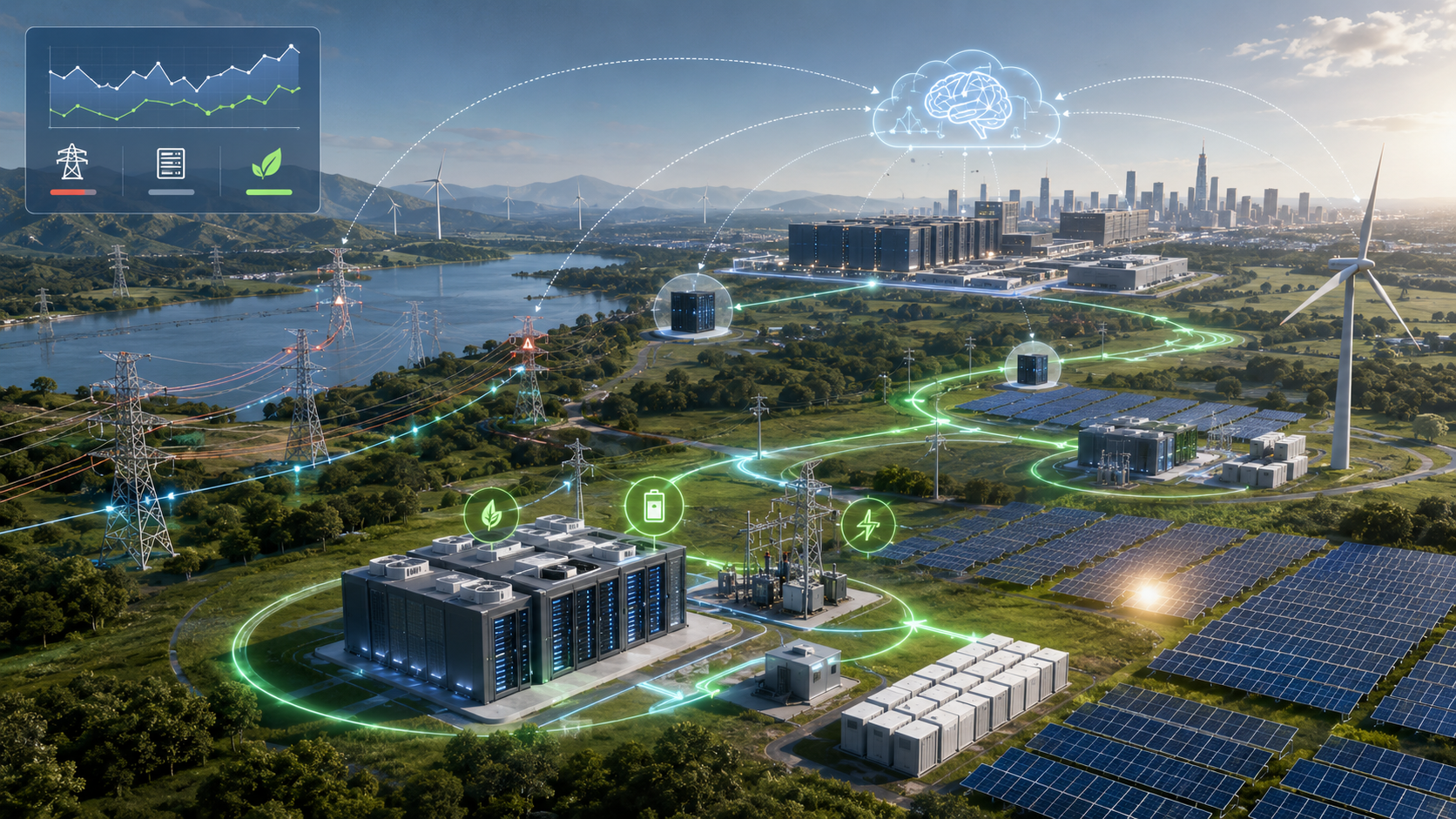
That is grid relief.
Not because local compute eliminates energy demand.
Because it gives the system more places, more timing options, and more control surfaces.
Solar-Backed AI Changes The Local Value Story
Solar-backed distributed AI is especially interesting because it changes the public narrative.
A conventional data center often sounds like this to a community:
A large outside company wants land, power, water, tax treatment, and grid upgrades so it can serve demand somewhere else.
A solar-backed local AI node could tell a different story:
A local compute facility is paired with renewable generation and storage, supports local digital services, provides resilience, reduces grid stress, and participates in demand flexibility.
That is not just a cleaner energy story.
It is a legitimacy story.
Local acceptance improves when infrastructure has local benefits:
- On-site or nearby solar generation
- Battery storage that supports resilience
- Heat reuse where practical
- Water-efficient cooling
- Transparent energy and water reporting
- Community benefit agreements
- Local workforce development
- Public sector and small business access to compute
- Grid services during peak demand
- Clear limits on resource use
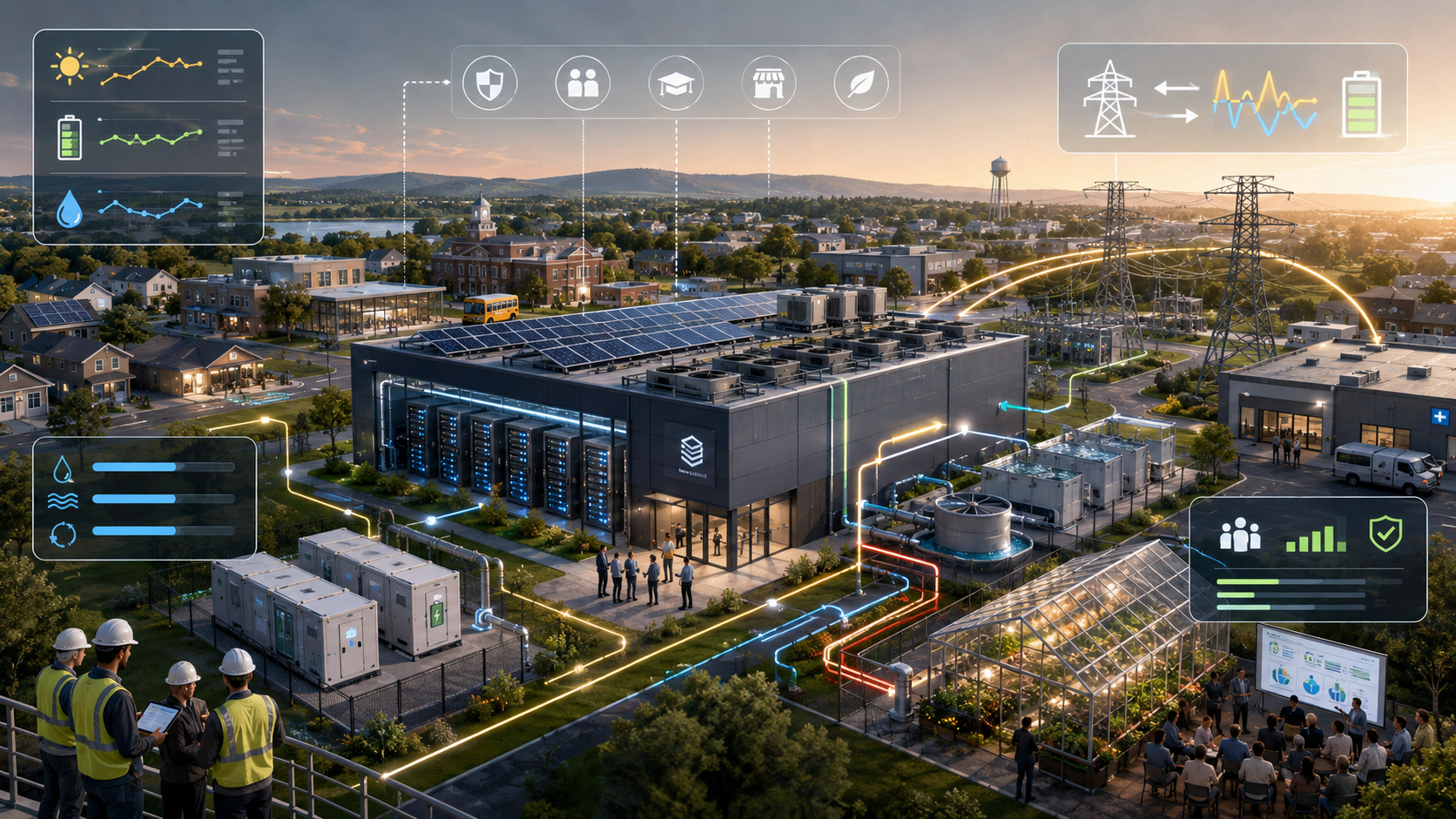
The more AI infrastructure can operate like a community asset rather than a hidden load, the more politically durable it becomes.
This does not mean every distributed AI node will be community-owned or publicly governed. But it does mean the design must account for social license.
Infrastructure that draws from the grid but gives little back will face resistance.
Infrastructure that supports the grid, creates local capability, and is transparent about its impact has a better chance.
The Role of Microgrids and Grid-Interactive Design
Distributed AI becomes more credible when paired with microgrids and grid-interactive design.
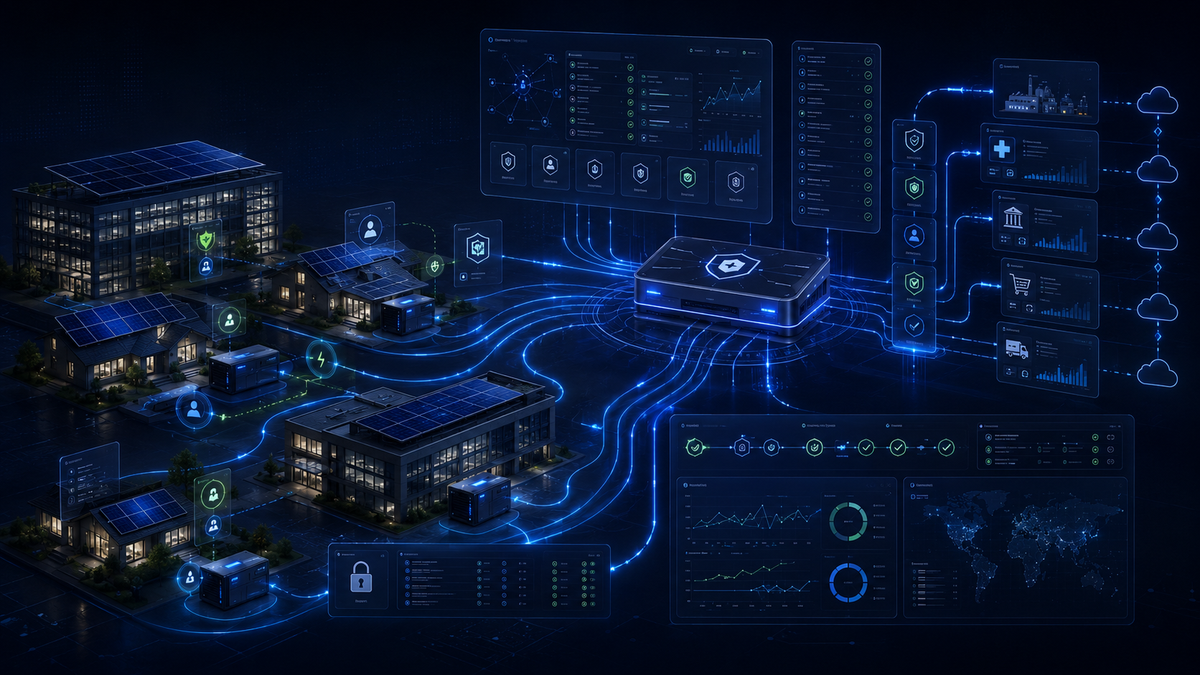
A microgrid can combine local generation, battery storage, load management, and islanding capability. For AI compute, this creates a more flexible relationship with the grid. The compute node can draw from solar when available, rely on storage during peaks, reduce demand when the grid is stressed, and potentially provide grid services when designed appropriately.
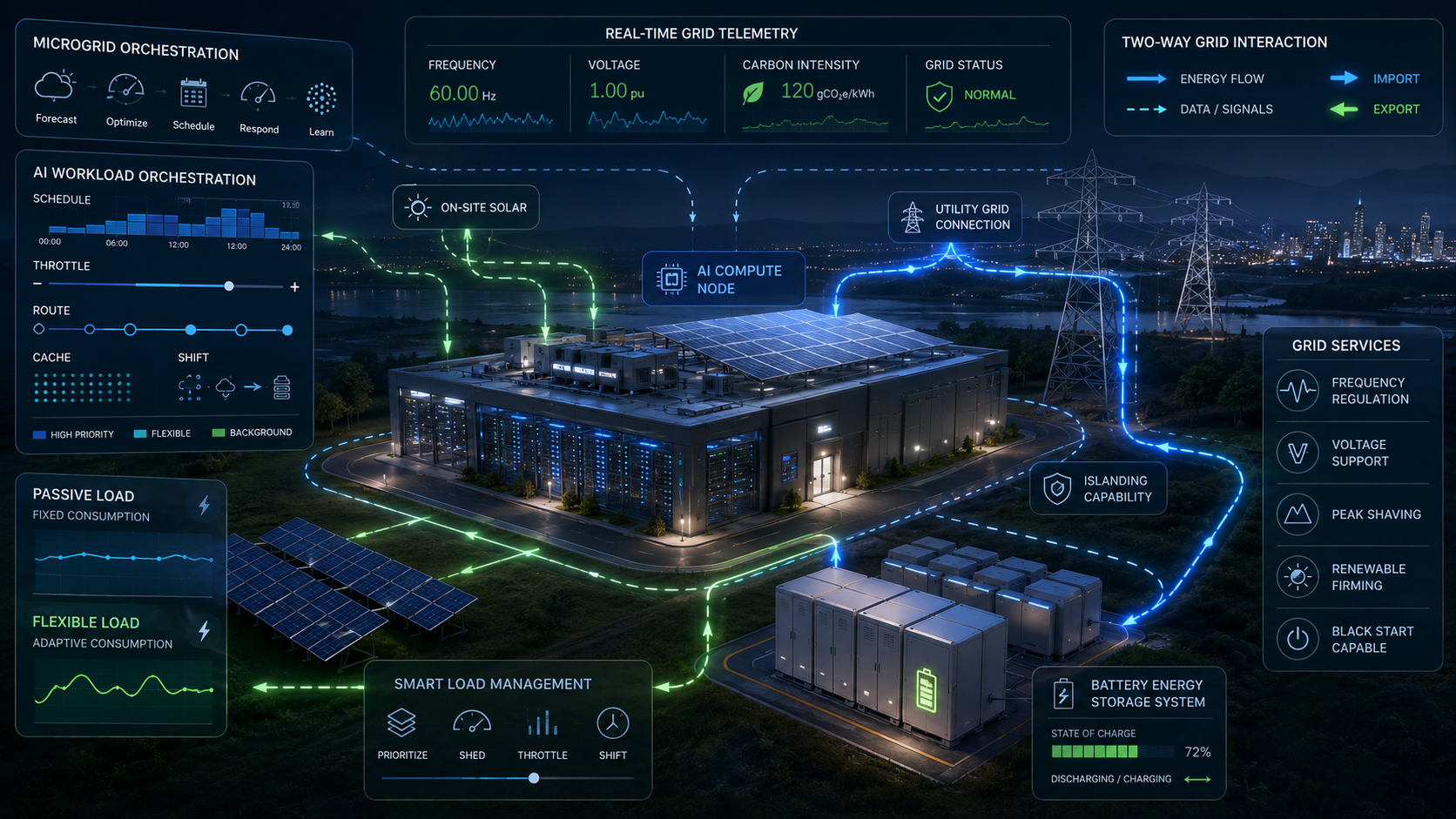
Grid-interactive data center design is already emerging as an important concept. ASHRAE describes grid-interactive design as using real-time communication and coordination with the local or regional electric grid to optimize energy consumption while supporting availability and resiliency. It can include demand flexibility, fast load response, energy export, and other services that support grid stability.
This is where AI infrastructure starts to look less like a passive load and more like an active grid participant.
That distinction matters.
A passive load asks the grid to adapt.
A flexible load adapts with the grid.
If AI workloads can be scheduled, throttled, routed, cached, or shifted based on energy availability and grid conditions, compute becomes part of grid orchestration.
That requires a different kind of control plane.
The AI-Energy Control Plane
Distributed AI will not work simply by scattering GPUs everywhere.
Without coordination, distributed infrastructure can become inefficient, insecure, and hard to manage. The more nodes, models, agents, energy sources, and local constraints exist, the more the system needs orchestration.
The next generation of AI infrastructure will need an AI-energy control plane.
This control plane would manage not only compute and models, but also energy context:
- Where should a workload run?
- Is it latency-sensitive or flexible?
- What is the carbon intensity of local power right now?
- Is solar generation available?
- Is battery capacity constrained?
- Is the local grid under stress?
- Does the workload involve sensitive data that should stay local?
- Which model is efficient enough for the task?
- What policy applies to this region, customer, or use case?
- What should be routed to hyperscale, regional, edge, or on-device compute?
This is a more sophisticated version of model routing.

Today, many organizations think of routing in terms of cost, latency, accuracy, and data sensitivity. In an energy-constrained AI future, routing will also include power availability, grid conditions, carbon intensity, water impact, and local policy.
Compute will need to become energy-aware.
That is the architectural shift.
Local Compute Makes Some AI More Trustworthy
Distributed AI is not only about energy.
It is also about trust.
Many AI workloads involve local context: hospitals, factories, utilities, cities, farms, schools, logistics networks, and public services. Sending every request to a remote centralized data center may create privacy, latency, resilience, and governance concerns.
Local compute can help when:
- Data should remain near its source
- Latency matters
- Connectivity is unreliable
- Regulatory requirements are local
- Community trust matters
- Workloads are mission-critical
- Resilience is more important than raw scale
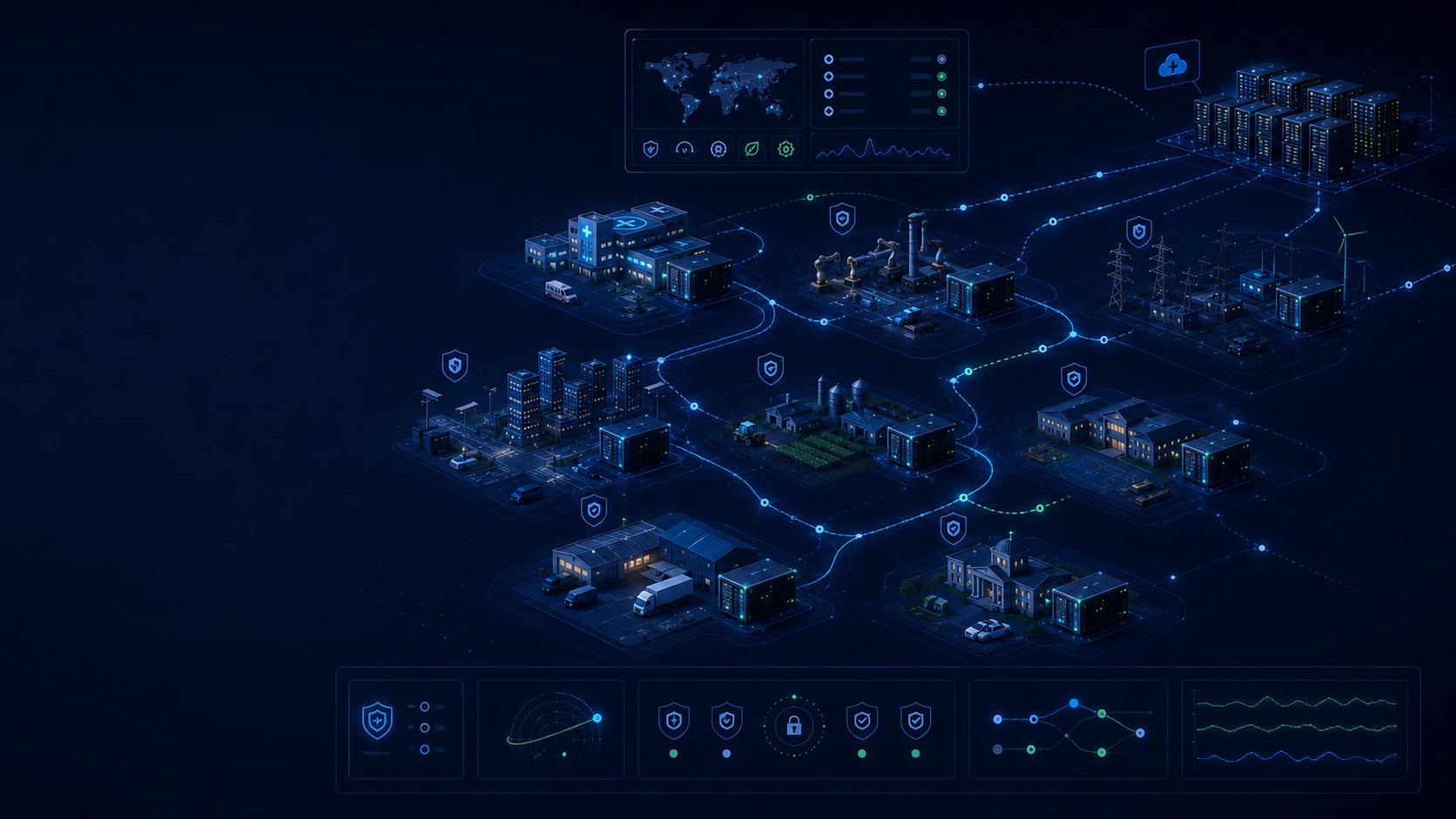
A hospital may prefer local AI inference for certain clinical workflows. A factory may need edge AI for real-time quality control. A utility may need local AI to manage grid operations. A city may want AI services that operate under local transparency and procurement rules.
Distributed compute gives organizations more architectural choices.
It does not remove the need for governance. It increases it.
Local nodes still need identity, access control, model management, policy enforcement, observability, audit trails, patching, incident response, and lifecycle management.
But if designed well, distributed AI can make intelligence feel less remote and more accountable.
What Distributed AI Will Not Solve
The argument for distributed AI should not become hype.
Local compute has tradeoffs.
Smaller facilities may lose some economies of scale. Hardware utilization can be harder to optimize. Operations may become more complex. Security and maintenance become distributed problems. Solar is intermittent. Batteries add cost. Some workloads still require large centralized clusters. Local permitting can still be difficult. And not every community will want compute infrastructure, even if it is cleaner or smaller.
Distributed AI is not a magic answer to data center backlash.
It is a pressure valve.
It gives the AI infrastructure system more flexibility. It creates alternatives to putting every workload into the same hyperscale pattern. It allows energy-aware routing. It supports local resilience. It can reduce some transmission pressure. It can improve the public value story.
But it only works if designed with discipline.
A badly governed distributed AI network could create its own problems: shadow compute, insecure edge nodes, inconsistent policy, opaque energy claims, unmanaged e-waste, and fragmented accountability.
Distributed infrastructure still needs centralized standards.
Local compute still needs global governance.
The New Social Contract for AI Infrastructure
The data center backlash is a warning.
AI infrastructure cannot scale on engineering logic alone. It needs a social contract.
That social contract should include transparency, local benefit, resource accountability, and operational flexibility.
Communities will increasingly expect answers to basic questions:
- How much power will this facility use?
- Who pays for grid upgrades?
- How much water will be consumed?
- What happens during drought or peak demand?
- What jobs and services will remain locally?
- Will the facility support the grid or only draw from it?
- Can workloads be reduced during emergencies?
- What public reporting will exist?
- Who is accountable if promises are missed?
The AI industry should not treat these questions as obstacles.
They are design requirements.
The more AI becomes critical infrastructure, the more it must behave like accountable infrastructure.
A More Acceptable AI Infrastructure Model
The future will likely be hybrid.
Hyperscale data centers will continue to train and serve the largest models. Regional data centers will handle major inference workloads. Edge nodes will support latency-sensitive, privacy-sensitive, local, and resilient applications. On-device AI will handle personal and low-power use cases. Solar, storage, microgrids, and grid-interactive design will become part of the infrastructure mix.
The question is not centralized versus distributed.
The question is what should run where, when, and under whose control.
That is a control plane question.
The companies and communities that get this right will treat AI compute as part of a broader energy, governance, and trust system. They will route workloads based not only on performance, but on social and physical constraints. They will design for flexibility. They will make resource use visible. They will align infrastructure with local value.
AI needs more compute.
But it also needs more legitimacy.
Distributed, solar-backed AI could help provide both.
Not by replacing the data center.
By redesigning the relationship between intelligence, energy, and place.
Sources and Further Reading
- International Energy Agency, “Energy and AI” / data center electricity demand: https://www.iea.org/reports/energy-and-ai/energy-demand-from-ai
- IEA Executive Summary, projected data center electricity consumption and U.S. demand growth: https://www.iea.org/reports/energy-and-ai/executive-summary
- ASHRAE, Grid-Interactive Design / Demand Flexibility for AI data centers: https://www.ashrae.org/technical-resources/ai-data-center-framework/grid-interactive-design-demand-flexibility
- The Guardian, reporting on U.S. data center community backlash and recall efforts: https://www.theguardian.com/us-news/2026/jul/03/datacenter-recall-elections
- Business Insider, rural concerns about AI data centers and utility bills: https://www.businessinsider.com/rural-towns-ai-data-centers-resistance-personal-finance-electricity-bills-2026-7
- Consumer Reports, data centers’ potential impact on electric bills and water: https://www.consumerreports.org/data-centers/ai-data-centers-impact-on-electric-bills-water-and-more-a1040338678/