The AI-Native Transformation Framework (ANTF)
Most AI transformation programs start in the wrong place.
They start with models.
Which model should we use? Which copilot should we buy? Which vendor has the best benchmark? Which team should pilot generative AI first?
Those questions matter, but they are not the foundation of AI-native transformation. They are symptoms of a deeper shift.
AI is not just another application category. It is becoming a new operating layer for the enterprise: one that can interpret context, reason across systems, call tools, generate work, and take action. That means AI transformation is not only about adoption. It is about redesigning how the enterprise senses, decides, governs, automates, secures, and learns.
A company does not become AI-native because it deploys chatbots.
It becomes AI-native when intelligence is embedded into the operating fabric of the business — safely, measurably, and at scale.
That requires a framework.
Why AI-Native Transformation Needs Layers
Traditional digital transformation focused on moving workflows, data, and infrastructure into modern platforms. Cloud transformation changed where systems ran. Data transformation changed how information was stored and analyzed. Automation changed how repeatable work was executed.
AI-native transformation changes something more fundamental: how decisions and actions are produced.
In an AI-native enterprise, software does not simply wait for humans to click buttons. Systems can interpret goals, retrieve context, reason through options, coordinate with other systems, and execute tasks. Agents can become non-human workers. Models can become decision engines. Policies can become runtime constraints. Observability can become the nervous system for autonomous operations.
But this creates a new problem. If AI is everywhere, control must be everywhere too.
Without a layered architecture, AI adoption becomes a collection of disconnected pilots: one team builds a chatbot, another team buys a sales assistant, another connects an agent to a ticketing system, and another experiments with code generation. The result is enthusiasm without an operating model.
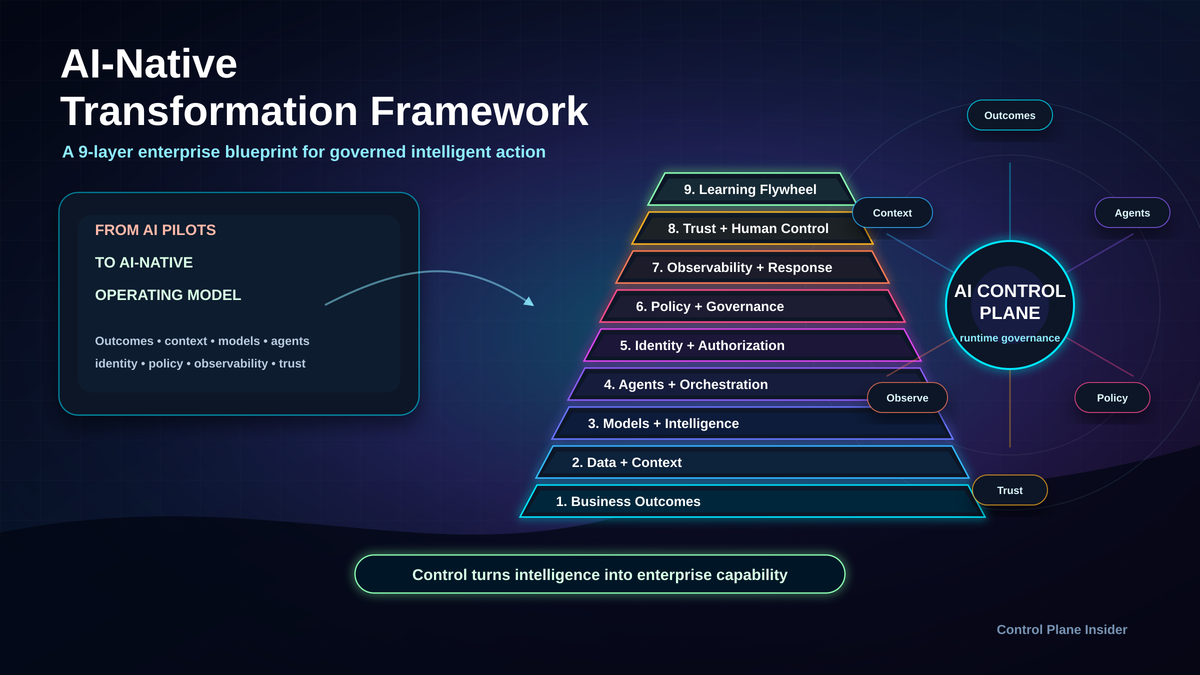
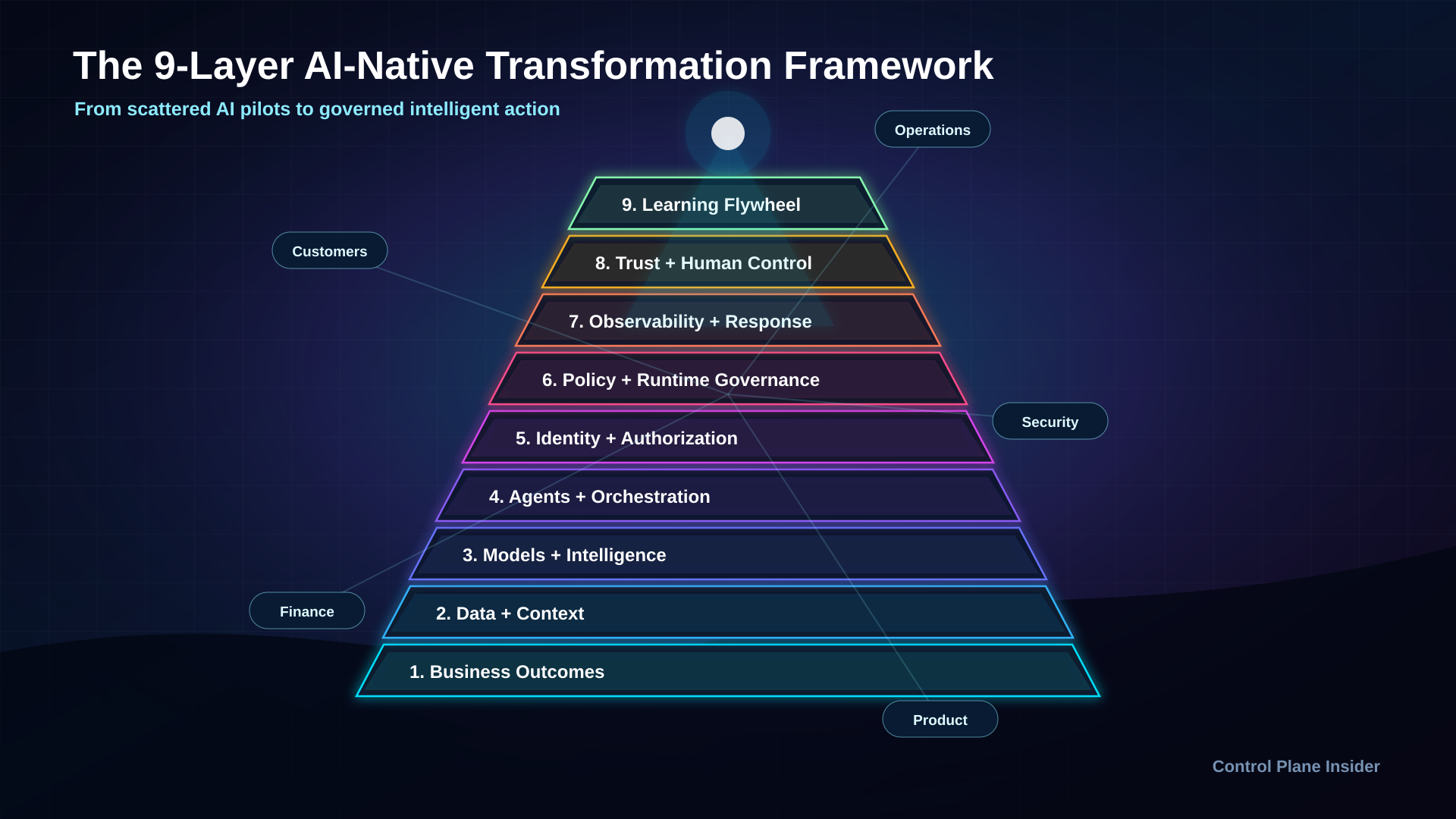
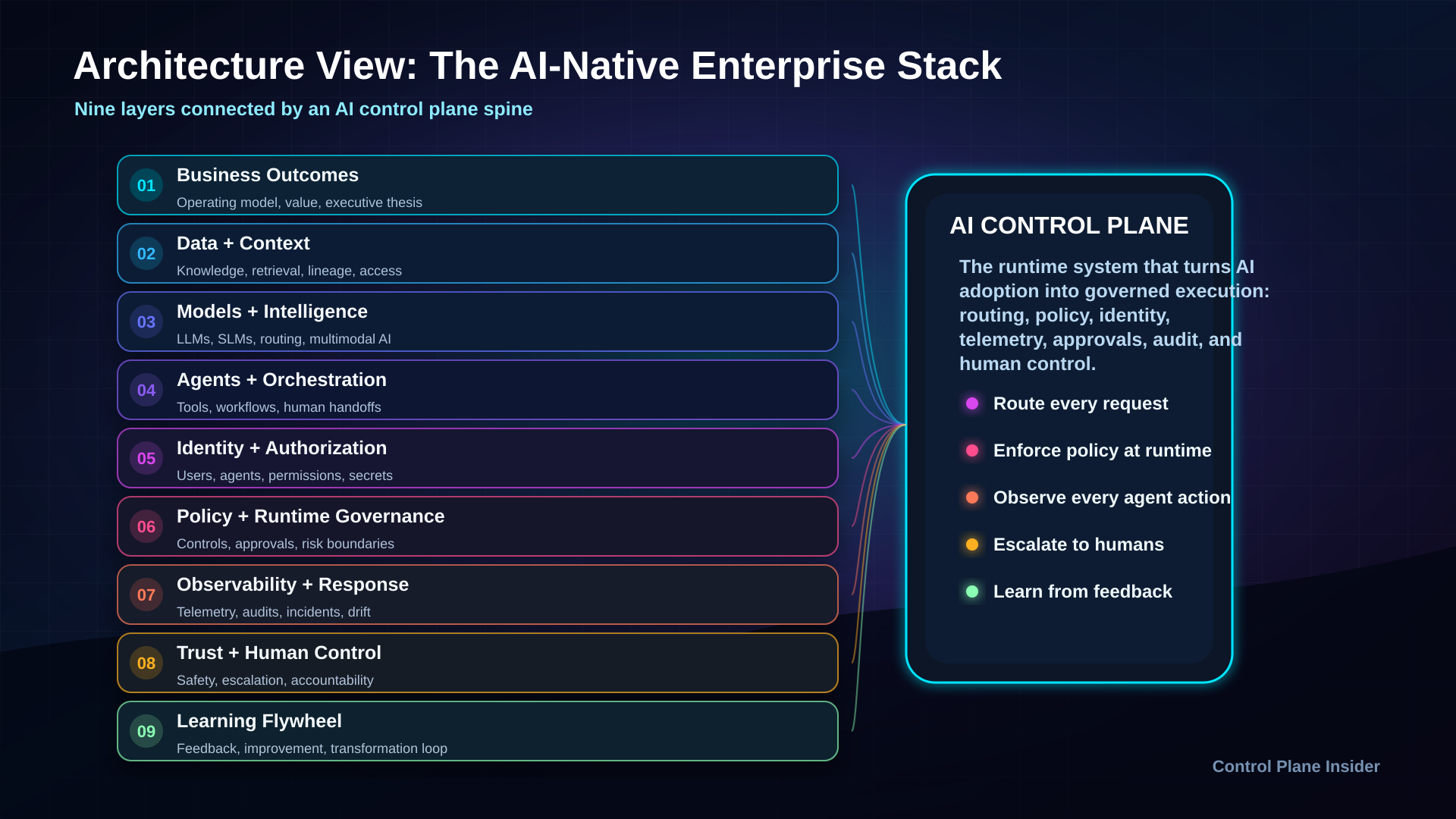
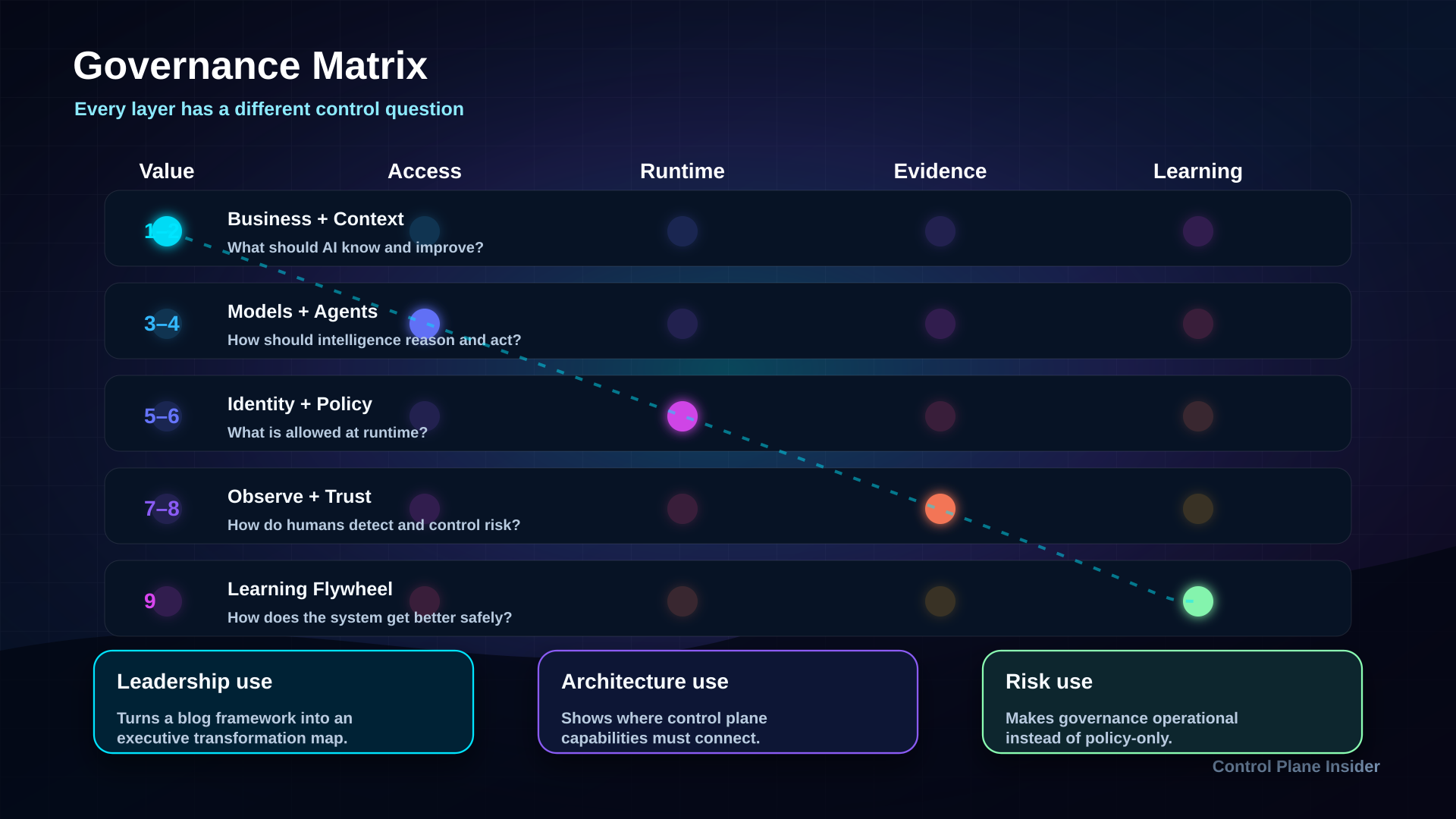
The 9-layer AI-native transformation framework gives leaders a way to think about the full stack.
Layer 1: Business Outcomes and Operating Model
AI transformation should begin with business outcomes, not technology selection.
The first layer answers: what should become faster, smarter, safer, cheaper, or more scalable because of AI?
This includes customer support, software delivery, sales operations, security operations, compliance, finance, HR, supply chain, research, and product development. But the important question is not simply where AI can be inserted. It is where AI changes the operating model.
Can a support function move from reactive ticket handling to proactive resolution? Can security move from alert triage to autonomous containment? Can finance move from manual reconciliation to continuous exception detection? Can product teams move from quarterly research cycles to always-on customer intelligence?
At this layer, leaders define the transformation thesis:
- Which business capabilities should become AI-native?
- Which decisions can be augmented?
- Which actions can be automated?
- Which workflows require human approval?
- Which outcomes will prove value?
Without this layer, AI becomes a demo factory.
Layer 2: Data, Context, and Knowledge
AI systems are only as useful as the context they can access.
The second layer is the enterprise knowledge foundation: structured data, unstructured content, application context, business rules, historical decisions, customer records, product documentation, tickets, logs, contracts, policies, and institutional knowledge.
This layer is not just about having data. It is about making context usable at the moment of action.
AI-native enterprises need to know:
- Where authoritative knowledge lives
- Which data is safe for which agents and models
- How context is retrieved and ranked
- How sensitive information is protected
- How stale or conflicting knowledge is detected
- How memory is managed over time
Retrieval-augmented generation, vector search, knowledge graphs, metadata, lineage, and data access controls all belong here. But the goal is simple: give AI systems the right context without giving them uncontrolled access to everything.
A model without context guesses.
An agent with uncontrolled context leaks risk.
Layer 3: Model and Intelligence Layer
The third layer is where models enter the architecture.
This includes large language models, small language models, multimodal models, embeddings, classifiers, reasoning models, domain-specific models, and local edge models. It also includes model routing: deciding which model should handle which task based on cost, latency, sensitivity, quality, and risk.
The AI-native enterprise will not run on one model.
It will use a portfolio of intelligence:
- Fast models for low-risk, high-volume tasks
- Strong reasoning models for complex decisions
- Domain-tuned models for specialized workflows
- Local models for latency-sensitive or privacy-sensitive use cases
- Multimodal models for voice, image, video, and sensor data
This layer requires evaluation, benchmarking, lifecycle management, and fallback strategies. The question is not “Which model is best?”
The question is: which intelligence should be used for this task, in this context, under this constraint?
Layer 4: Agents, Tools, and Workflow Orchestration
Models become operational when they can use tools.
The fourth layer is where AI moves from generating answers to executing work. Agents connect models to APIs, applications, workflows, databases, documents, calendars, code repositories, ticketing systems, and business processes.
This is the layer where the risk profile changes.
A chatbot can be wrong. An agent can be wrong and take action.
That means orchestration must be designed deliberately:
- What tools can each agent use?
- What permissions does each tool call require?
- What steps need human approval?
- What actions can be undone?
- How are multi-agent workflows coordinated?
- How are failures, retries, and escalations handled?
AI-native transformation depends on this layer because business value comes from action, not just conversation. But action without orchestration becomes chaos.
Layer 5: Identity, Access, and Authorization
If agents can act, they need identity.
The fifth layer treats AI agents, models, and automated workflows as governed actors inside the enterprise. They need owners, permissions, scopes, credentials, audit trails, lifecycle states, and revocation paths.
This is one of the most important shifts in enterprise AI security.
Agents are becoming non-human users.
They may read data, create tickets, send messages, update records, trigger automations, deploy code, or interact with customers. If enterprises cannot answer who or what performed an action, under whose authority, and within which boundary, they cannot govern AI at scale.
This layer includes:
- Agent identity
- Tool-level authorization
- Least privilege access
- Delegated authority
- Secrets management
- Ownership and accountability
- Lifecycle controls
- Auditability
The old security model assumes humans are the primary actors. AI-native enterprises need a model for autonomous and semi-autonomous actors too.
Layer 6: Policy, Risk, and Runtime Governance
Policies cannot live only in documents.
The sixth layer turns governance into runtime control. It defines what AI systems are allowed to do based on context, identity, data sensitivity, business impact, user intent, regulatory requirements, and risk level.
Static policies are not enough because AI systems operate dynamically. An agent may be safe in one context and risky in another. A tool call may be acceptable for one user, one dataset, or one workflow, but unacceptable for another.
Runtime governance answers:
- Is this action allowed right now?
- Does this request involve sensitive data?
- Does this workflow require approval?
- Is the agent exceeding its scope?
- Is the output appropriate for the audience?
- Should the system block, redact, escalate, log, or allow?
This is where policy becomes intelligence.
AI-native transformation requires governance that can evaluate context in real time, not just approve use cases months in advance.
Layer 7: Observability, Monitoring, and Incident Response
You cannot control what you cannot see.
The seventh layer is the observability layer for AI-native operations. It monitors prompts, responses, tool calls, agent decisions, latency, cost, data access, policy decisions, workflow outcomes, errors, drift, and anomalous behavior.
Traditional observability tells teams whether software is running.
AI observability must tell teams whether autonomous systems are behaving.
This layer includes:
- Agent activity logs
- Tool-call traces
- Prompt and response monitoring
- Policy decision logs
- Cost and latency tracking
- Quality and evaluation signals
- Anomaly detection
- Incident response playbooks
- Kill switches and rollback mechanisms
As agents gain more authority, incident response becomes essential. Enterprises need containment, escalation, rollback, and forensic visibility when AI systems act outside expectations.
Monitoring is not optional. It is the feedback loop that makes autonomy governable.
Layer 8: Trust, Safety, and Human Control
AI-native does not mean humanless.
The eighth layer defines where humans remain in control, how trust is earned, and how systems behave when confidence is low or risk is high.
This includes approval workflows, explainability, user consent, transparency, escalation paths, safety boundaries, override mechanisms, and accountability structures.
The goal is not to put a human in every loop. That would destroy the value of automation. The goal is to put the right human control at the right points of risk.
Some actions can be fully automated. Some require review. Some require dual approval. Some should never be delegated to an agent.
AI-native enterprises need a trust model that is practical, not performative.
Trust is not created by saying “human in the loop.” Trust is created by designing systems where authority, evidence, escalation, and accountability are clear.
Layer 9: Continuous Learning and Transformation Flywheel
The final layer is the learning loop.
AI-native transformation is not a one-time deployment. It is a continuous system of measurement, improvement, and adaptation.
Every interaction should teach the enterprise something:
- Which workflows are ready for more autonomy?
- Which agents perform reliably?
- Which policies are too strict or too loose?
- Which tools create risk?
- Which users need training?
- Which data sources improve outcomes?
- Which latency or cost bottlenecks reduce value?
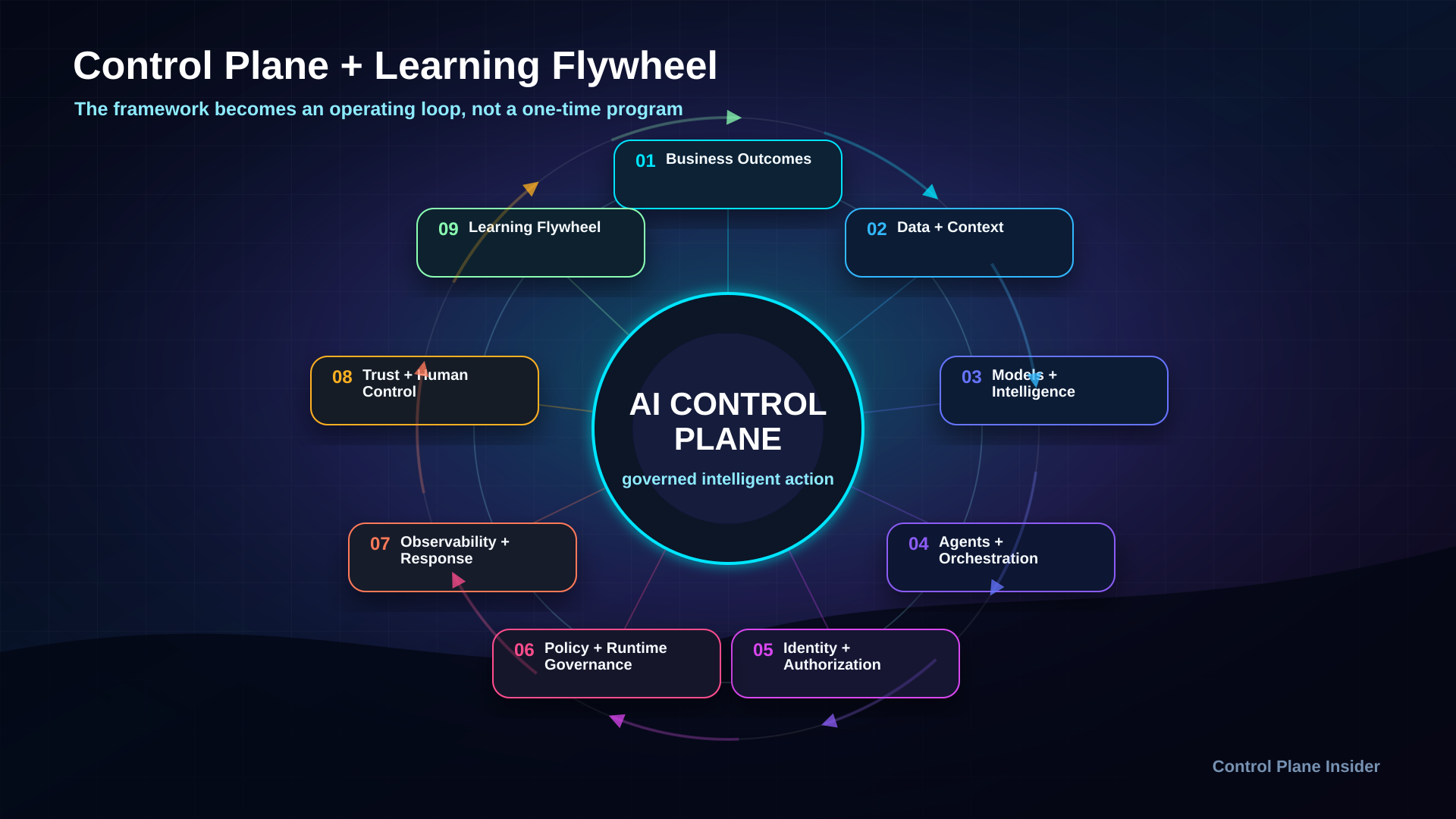
This layer turns AI adoption into an operating flywheel. Usage creates signals. Signals improve systems. Better systems unlock more use cases. More use cases create more learning.
The companies that win will not be the ones that launch the most pilots.
They will be the ones that learn fastest while staying in control.
The Control Plane Connects the Layers
The 9 layers are not independent silos. They need a connecting layer: the AI control plane.
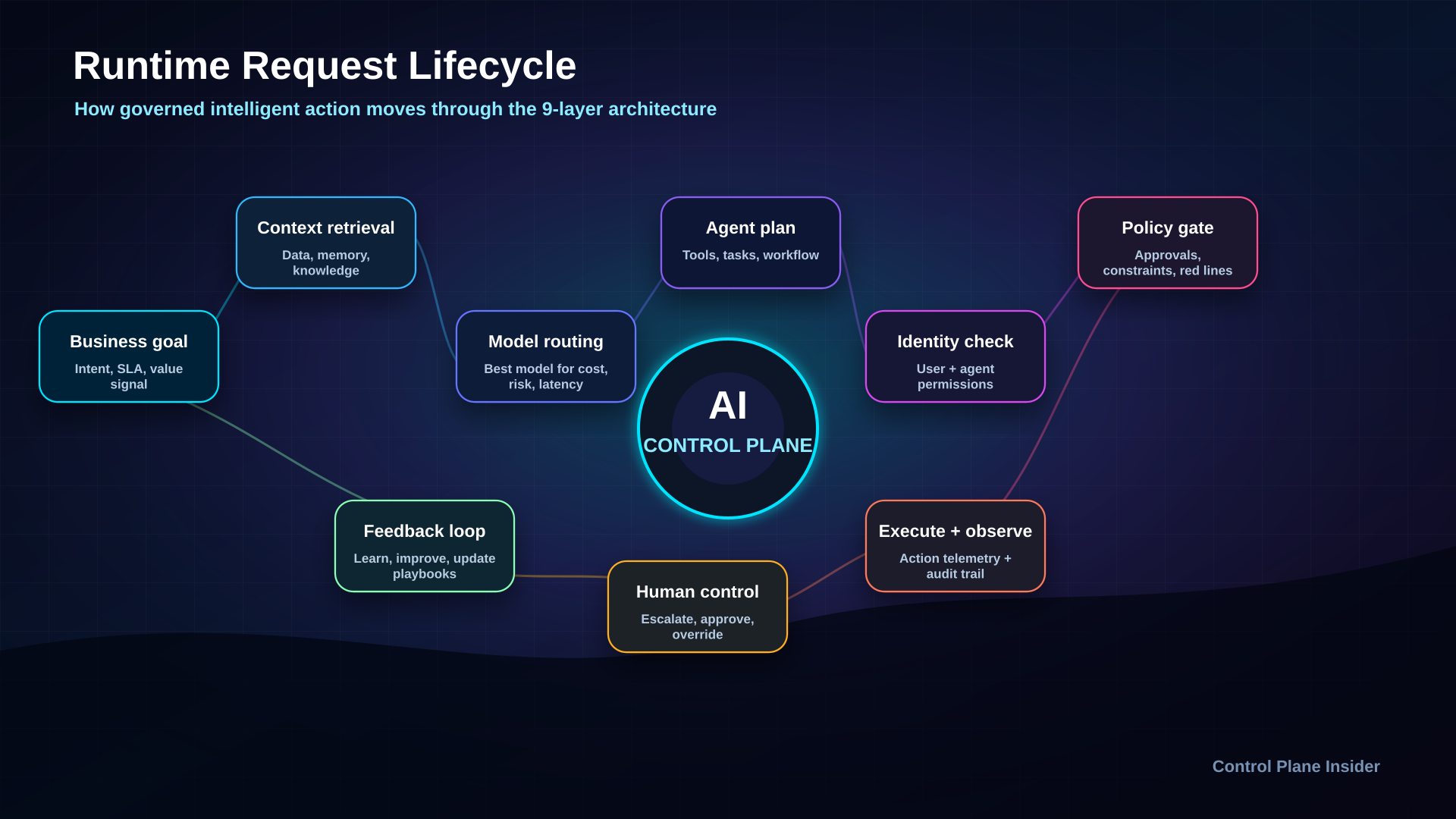
The control plane is the governance and enforcement layer across agents, models, tools, data, policies, identities, and workflows. It gives enterprises a way to answer the critical questions:
- What AI systems exist?
- Who owns them?
- What can they access?
- What actions can they take?
- Which policies apply?
- What did they do?
- What happened as a result?
- How can they be stopped, changed, or rolled back?
Without a control plane, the 9 layers fragment. With a control plane, they become an operating model.
That is the difference between experimenting with AI and becoming AI-native.
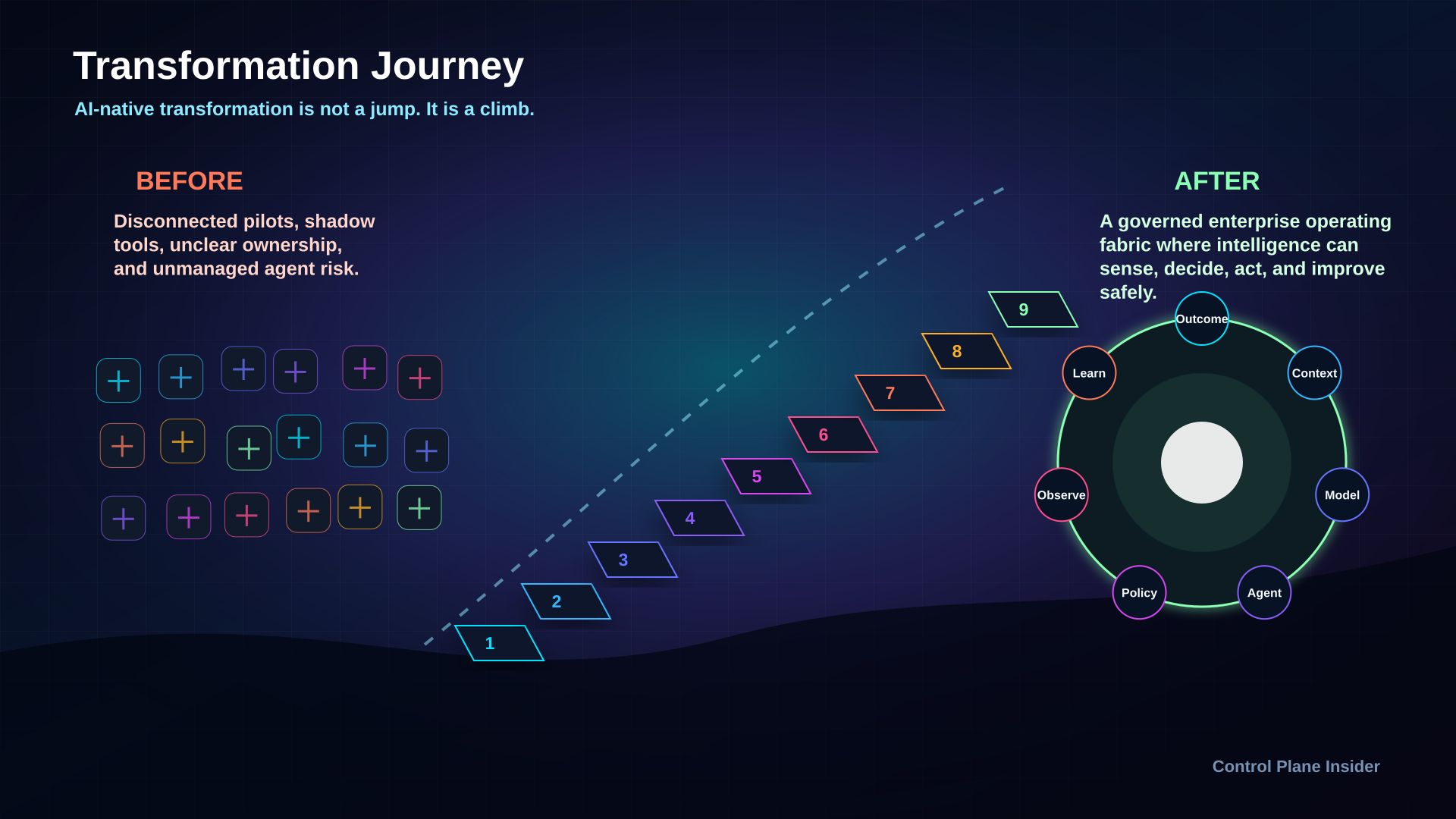
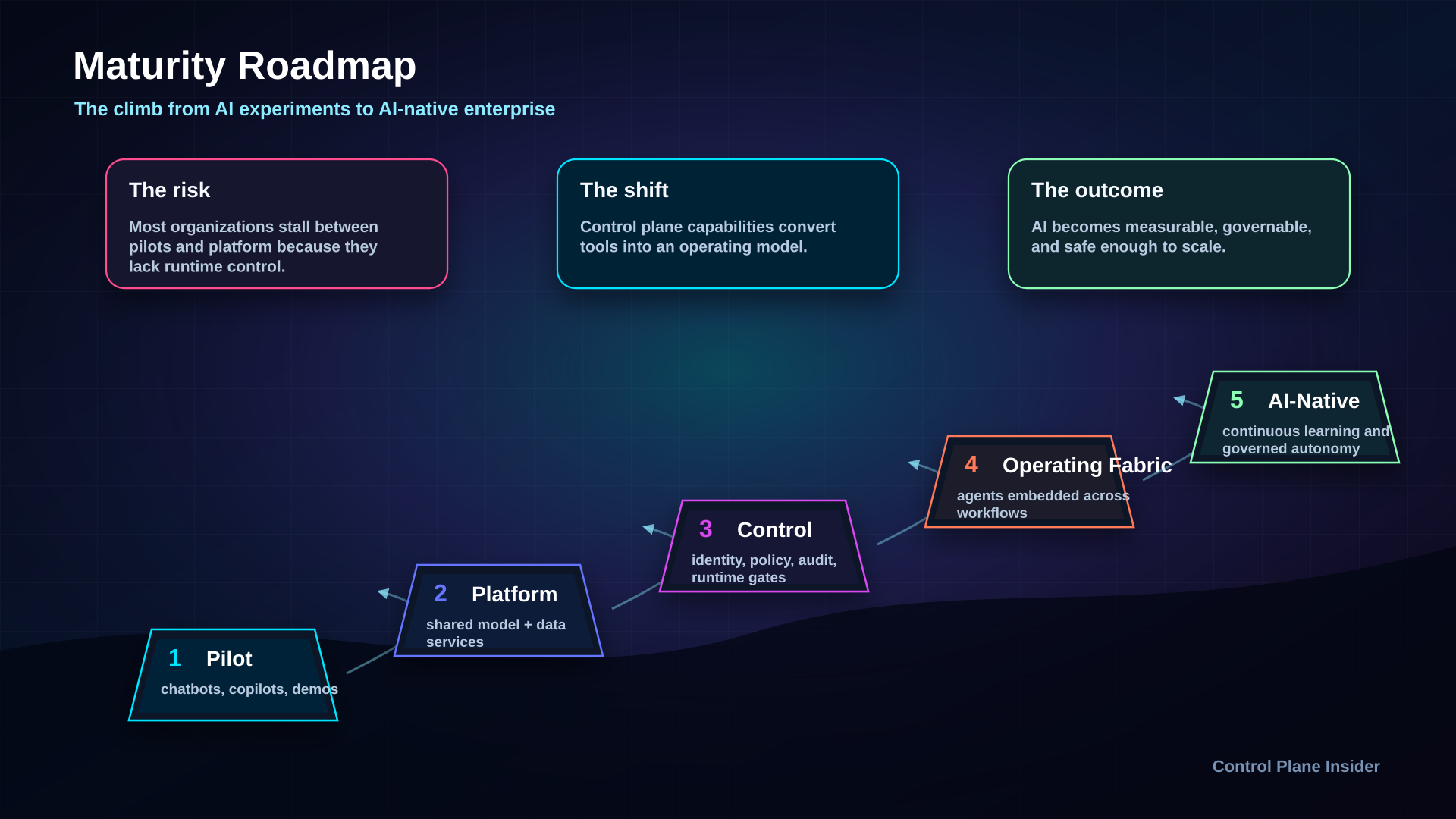
The Maturity Path
Enterprises do not need to perfect all nine layers before creating value. But they do need to know which layers are missing.
A practical maturity path looks like this:
- Identify high-value business outcomes.
- Map the data and context required.
- Select the right model portfolio.
- Orchestrate agents and tools safely.
- Establish identity and permissions.
- Enforce runtime policies.
- Monitor behavior and prepare incident response.
- Define human control points.
- Build the learning flywheel.
The order matters because each layer increases the stakes. A model pilot can be experimental. A tool-using agent needs governance. A production autonomous workflow needs identity, policy, observability, and incident response.
AI-native transformation is not a jump. It is a climb.
The Real Transformation
The real transformation is not that enterprises will use AI.
Everyone will use AI.
The real transformation is that some enterprises will redesign themselves around trusted, governed, intelligent action — while others will accumulate disconnected tools, unmanaged agents, shadow workflows, and invisible risk.
The 9-layer AI-native transformation framework is a way to avoid that trap.
It reminds leaders that AI transformation is not only about models, copilots, or productivity gains. It is about building the operating architecture for a business where intelligence is embedded everywhere.
The future enterprise will need AI that can reason.
But it will also need AI that can be governed, observed, secured, authorized, trusted, and improved.
That is what it means to become AI-native.