The AI-Native Enterprise Blueprint
Using the 9-Layer ANTF Framework to Build an AI-Native Enterprise Blueprint and Transformation Roadmap
Most AI strategies are too vague to execute.
They say the company will “adopt generative AI,” “improve productivity,” “modernize workflows,” or “embed intelligence across the enterprise.” Those statements may be directionally correct, but they do not answer the questions that matter when transformation becomes real:
What changes first?
Which systems need to connect?
Who owns the risk?
Where should agents be allowed to act?
How do we measure progress?
How do we move from experiments to an operating model?
This is where many AI programs stall. They begin with pilots, but they do not become platforms. They generate excitement, but not architecture. They produce demos, but not durable capability.
The enterprise does not need another AI brainstorm.
It needs an AI-native blueprint.
And it needs a transformation roadmap that turns that blueprint into sequenced execution.
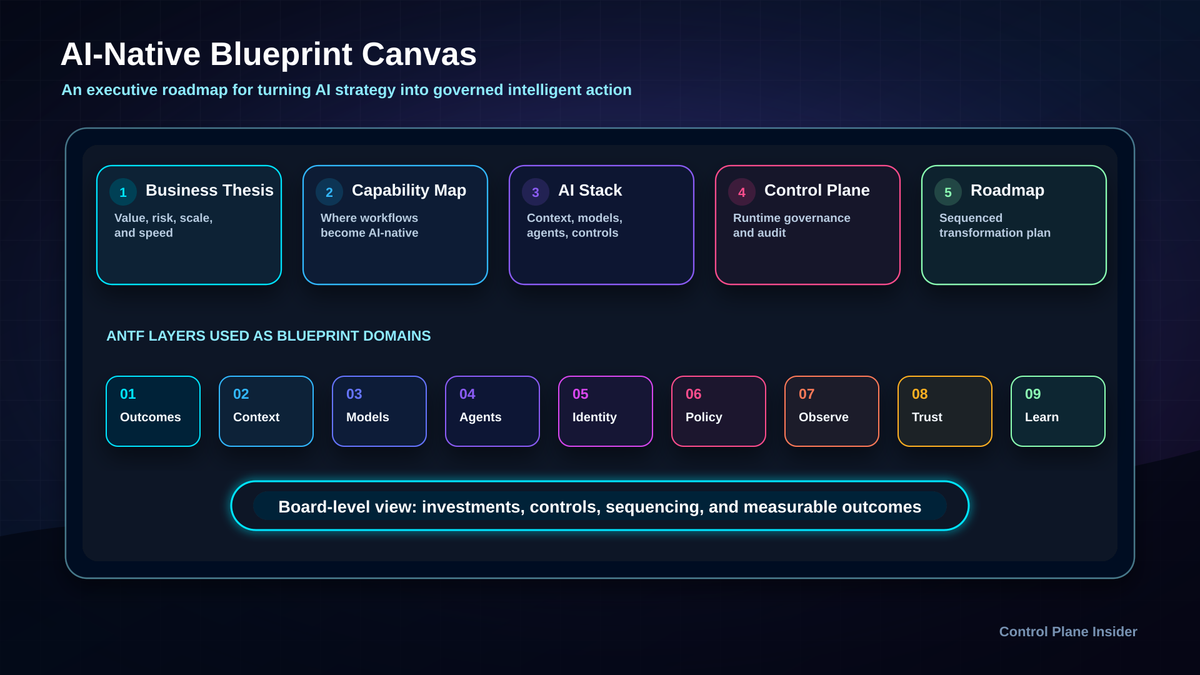
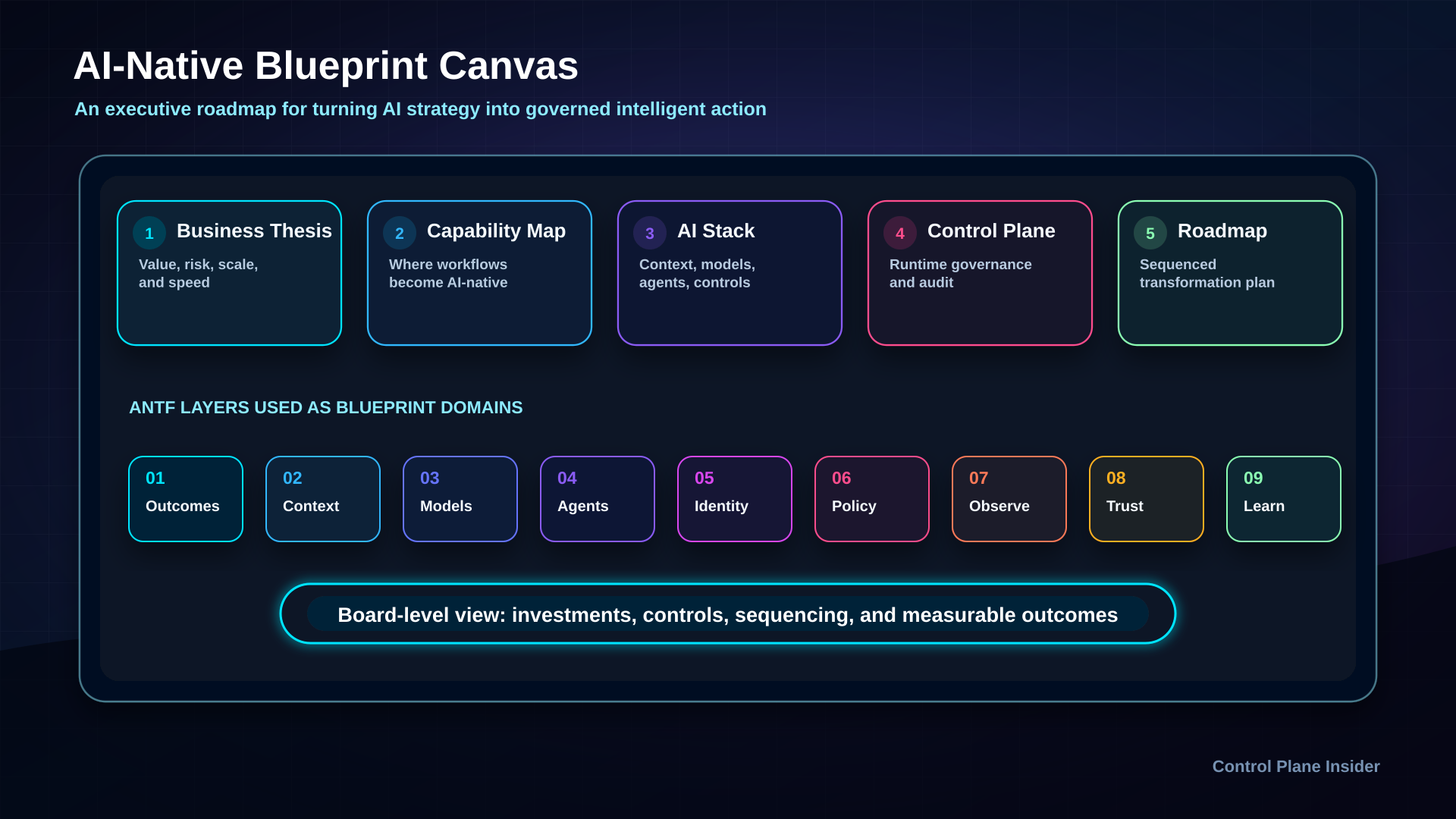
The 9-layer AI-Native Transformation Framework, or ANTF, is designed for exactly that purpose. It gives leaders a structured way to map the enterprise from business outcomes down through data, models, agents, identity, policy, observability, trust, and continuous learning.
Used correctly, the framework becomes more than a conceptual model. It becomes a planning tool, architecture map, governance model, investment thesis, and roadmap for becoming AI-native.
The Difference Between an AI Strategy and an AI-Native Blueprint
An AI strategy describes intent.
An AI-native blueprint describes the operating system required to deliver that intent.
A strategy might say: “We will use AI to improve customer support.”
A blueprint asks:
- Which support outcomes should change?
- What customer, product, ticket, and policy context does the AI need?
- Which models should be used for which tasks?
- Which agents or workflows will take action?
- What identity and access controls apply to human users and non-human agents?
- What policies must be enforced at runtime?
- What telemetry proves the system is working safely?
- When should humans approve, override, or intervene?
- How will the system improve over time?
That is the difference between aspiration and architecture.
The blueprint does not have to define every implementation detail on day one. But it does need to establish the layers of capability the enterprise must build, buy, integrate, govern, and measure.
Without a blueprint, AI transformation becomes a portfolio of disconnected tools.
With a blueprint, AI transformation becomes an enterprise operating model.
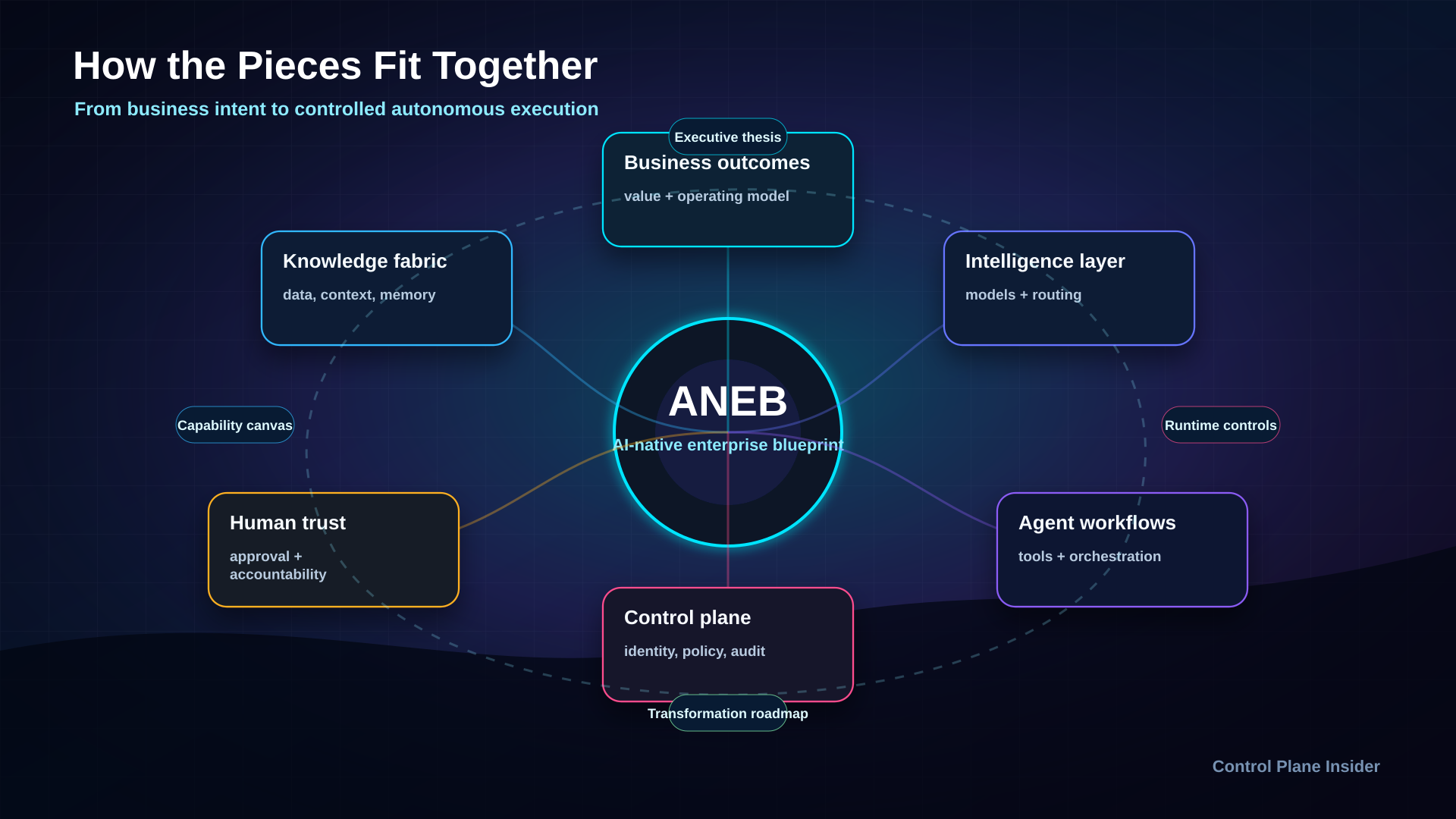
Why the 9-Layer ANTF Works as a Blueprinting Tool
The 9-layer ANTF helps leaders avoid one of the most common AI transformation mistakes: starting in the middle.
Many organizations start with Layer 3: models. They ask which LLM to use, which vendor to select, or which benchmark matters most. Others start with Layer 4: agents and workflow automation. They want autonomous systems before defining the controls around them.
But AI-native transformation is a stack.
Each layer depends on the others.
If you deploy agents without identity, you create unauthorized automation. If you connect models to knowledge without policy, you create leakage risk. If you automate workflows without observability, you lose operational control. If you measure usage but not outcomes, you mistake activity for transformation.
The 9 layers force a more complete view:
- Business Outcomes and Operating Model
- Data, Context, and Knowledge
- Model and Intelligence Layer
- Agents, Tools, and Workflow Orchestration
- Identity, Access, and Authorization
- Policy, Risk, and Runtime Governance
- Observability, Monitoring, and Incident Response
- Trust, Safety, and Human Control
- Continuous Learning and Transformation Flywheel
Together, these layers answer the central question of AI-native transformation:
How does the enterprise safely turn intelligence into action?
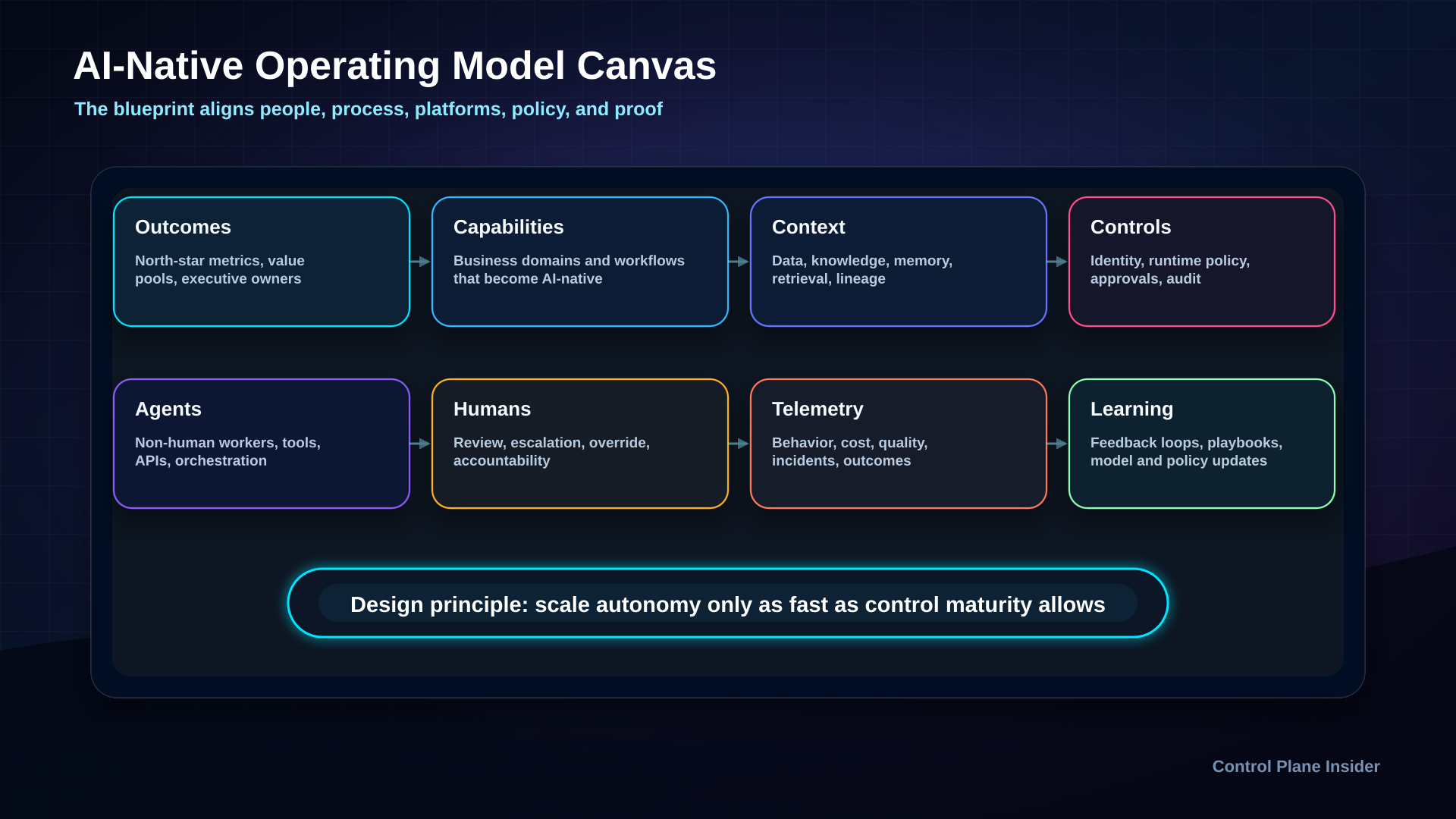
Step 1: Start With the Business Capability Map
The first move is not to list AI use cases.
The first move is to map business capabilities.
A use case is often too narrow. “Summarize support tickets” is a use case. “Transform customer support from reactive ticket handling to proactive resolution” is a capability shift.
The blueprint should identify the major business capabilities where AI can change the operating model. Examples include:
- Customer support
- Sales operations
- Software engineering
- Security operations
- Finance and reconciliation
- HR and workforce services
- Legal and contract review
- Supply chain planning
- Product research
- Compliance and audit
For each capability, leaders should ask five questions:
- What outcome should improve?
- What decisions are currently slow, manual, or inconsistent?
- What actions could be automated or augmented?
- What risks would increase if AI acted incorrectly?
- What proof would show the capability is becoming AI-native?
This becomes the top layer of the blueprint.
It prevents the company from building AI infrastructure for its own sake. It also gives executives a way to prioritize investments based on business impact rather than novelty.
Step 2: Define the Context Architecture
AI systems do not become useful because they are connected to a model.
They become useful when they are connected to the right context.
The second layer of the blueprint maps the knowledge foundation. This includes structured data, unstructured content, tickets, policies, contracts, product documentation, logs, customer records, code repositories, architecture diagrams, runbooks, and historical decisions.
But the goal is not to give AI access to everything.
The goal is to make context available with control.
For each business capability, the blueprint should identify:
- Authoritative systems of record
- High-value knowledge sources
- Sensitive data categories
- Data ownership and stewardship
- Retrieval and ranking patterns
- Freshness requirements
- Lineage and audit needs
- Access boundaries by role, agent, and task
This is where many AI programs discover that their biggest limitation is not model quality. It is knowledge readiness.
If enterprise knowledge is fragmented, stale, unclassified, or poorly governed, AI systems will amplify that disorder.
The blueprint should therefore treat context as infrastructure.
Step 3: Design the Intelligence Layer
Once outcomes and context are defined, the enterprise can design its intelligence layer.
This is where models enter the architecture — but not as a single decision.
AI-native enterprises will not use one model for everything. They will use a portfolio of models and intelligence services: frontier LLMs, small language models, domain-specific models, embeddings, classifiers, multimodal systems, local models, and deterministic rules.
The blueprint should define model routing principles:
- Which tasks require the highest reasoning quality?
- Which tasks require low latency?
- Which tasks involve sensitive data?
- Which tasks can use smaller or cheaper models?
- Which tasks require multimodal understanding?
- Which tasks should stay inside a private environment?
- Which tasks require deterministic validation?
The point is not to chase the best model in the abstract.
The point is to match intelligence to the operating requirement.
A customer-facing agent, a security triage assistant, a contract review workflow, and a robotic process automation system may all need different intelligence patterns.
The blueprint should make those patterns explicit.
Step 4: Map Agents, Tools, and Workflow Orchestration
Models generate intelligence.
Agents turn intelligence into work.
This is one of the most important shifts in AI-native transformation. The enterprise is not just adding assistants to existing software. It is introducing non-human actors that can reason, plan, call tools, update records, trigger workflows, and coordinate across systems.
That changes the architecture.
For each priority capability, the blueprint should identify:
- Which workflows are candidates for agentic execution
- Which tools and APIs agents need
- Which actions are read-only, write-capable, or irreversible
- Which steps require human approval
- Which systems must stay deterministic
- Which handoffs occur between humans and agents
- Which failure modes must be contained
A mature blueprint distinguishes between assistants, copilots, agents, and autonomous workflows.
Not every AI system should act autonomously. Some should advise. Some should draft. Some should route. Some should execute only after approval. Some should operate continuously within narrow constraints.
The roadmap should sequence these autonomy levels deliberately.
Start where risk is bounded and value is visible. Expand only when identity, policy, observability, and human control are mature enough to support the next level of autonomy.
Step 5: Build the Identity and Authorization Fabric
Traditional enterprise identity was designed for humans and applications.
AI-native enterprises must also manage agents.
That means the blueprint must answer a new class of questions:
- What is the identity of an agent?
- Who owns it?
- What systems can it access?
- What actions can it perform?
- What data can it retrieve?
- What tools can it call?
- How are credentials managed?
- How are permissions scoped to task, context, and risk?
- How are agent actions attributed and audited?
This layer is where the enterprise prevents AI transformation from becoming shadow automation.
Every agent should have a clear identity, purpose, owner, permission boundary, and audit trail.
The roadmap should prioritize identity early, especially before agents are allowed to take write actions in enterprise systems.
If the company cannot answer who or what performed an action, it is not ready for autonomous execution at scale.
Step 6: Move Governance Into Runtime
Most governance programs live in documents.
AI-native governance must live in runtime.
Policies, risk rules, approval flows, data restrictions, model selection rules, escalation requirements, and compliance constraints must be enforced while AI systems operate — not reviewed only after the fact.
The blueprint should define runtime governance controls such as:
- Prompt and response policies
- Data access restrictions
- Tool-use permissions
- Action approval thresholds
- Model routing constraints
- Sensitive workflow restrictions
- Regulatory and compliance rules
- Risk scoring
- Exception handling
- Audit evidence generation
This is where the AI control plane becomes essential.
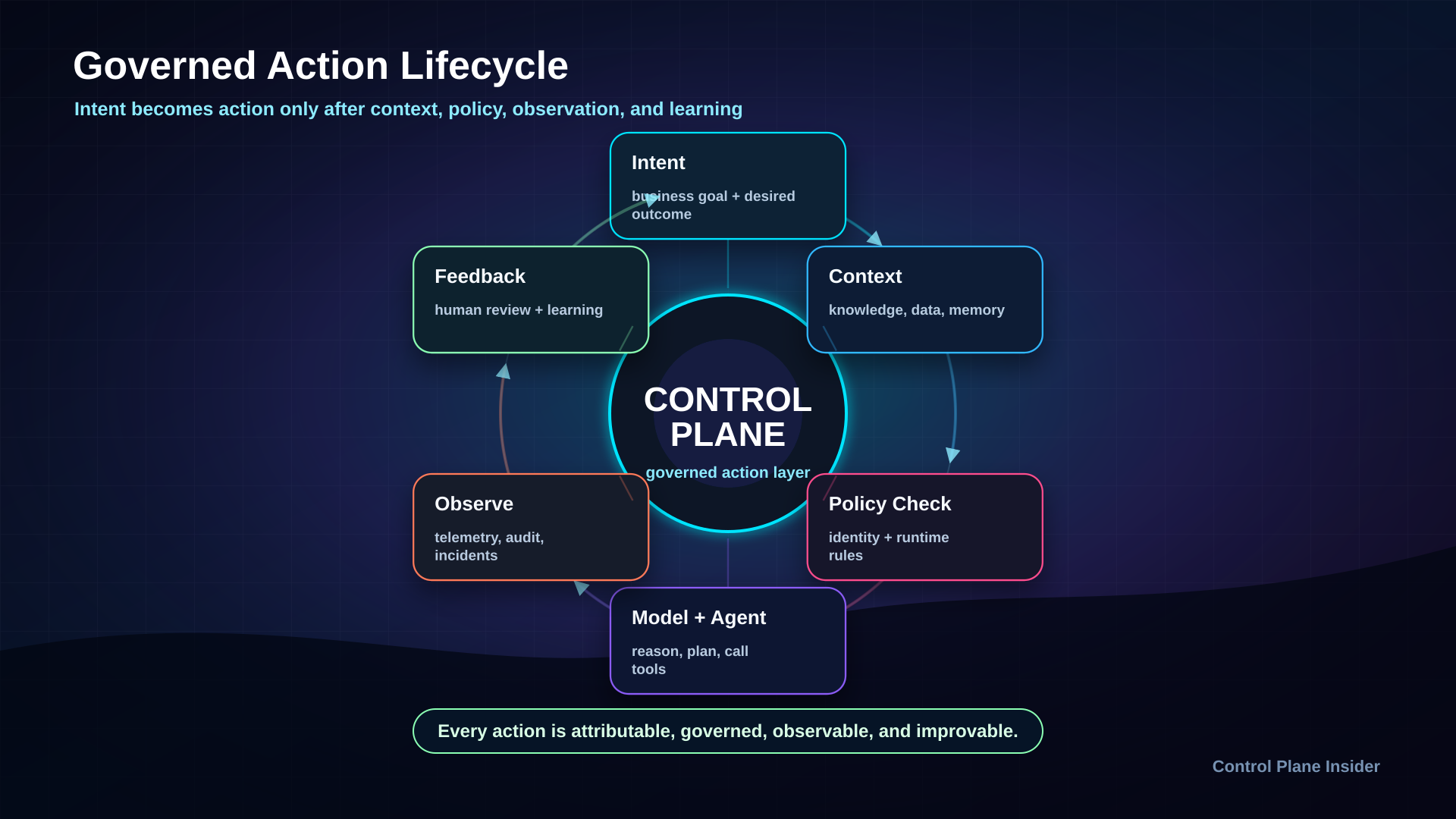
The control plane is the layer that connects intent, identity, policy, telemetry, and action. It allows the enterprise to govern AI systems dynamically rather than relying on static policy documents.
Without runtime governance, the organization is forced to choose between speed and safety.
With runtime governance, it can scale AI with control.
Step 7: Instrument Observability From the Beginning
You cannot govern what you cannot see.
AI observability is not just system uptime or token usage. It must include the behavior of models, agents, tools, users, policies, approvals, failures, escalations, and outcomes.
The blueprint should define telemetry across the AI lifecycle:
- What prompts were submitted?
- What context was retrieved?
- Which model was used?
- What tools were called?
- Which policies fired?
- What actions were taken?
- What was approved or denied?
- What errors occurred?
- What outcomes changed?
- What incidents or near misses occurred?
This observability layer provides the evidence needed for security, compliance, reliability, cost management, and continuous improvement.
It also gives executives a way to separate real transformation from AI theater.
If a capability is becoming AI-native, the data should show it: faster cycle times, fewer manual steps, improved resolution rates, better quality, lower risk, higher customer satisfaction, or reduced operational cost.
Step 8: Define Human Control Points
AI-native does not mean human-absent.
It means human control becomes more intentional.
The blueprint should specify where humans remain in the loop, on the loop, or over the loop.
Some workflows require direct human approval before action. Others require human review after execution. Some require escalation only when confidence is low, policy risk is high, or the action is irreversible.
Human control points should be designed around risk, not habit.
The roadmap should identify:
- Which decisions require human approval
- Which actions require two-person review
- Which workflows can be automated within limits
- Which exceptions trigger escalation
- Which roles can override the system
- Which incidents require immediate intervention
- Which audit trails humans must review
This is how trust becomes operational.
Employees, customers, regulators, and executives will not trust AI because the company says it is safe. They will trust it because the system has visible controls, accountable owners, and clear intervention paths.
Step 9: Turn the Blueprint Into a Learning Flywheel
The final layer is continuous learning.
AI transformation is not a one-time implementation. Models change. Business processes change. Regulations change. Threats change. Customer expectations change. The enterprise itself learns what should and should not be automated.
The blueprint should define how learning flows back into the system:
- User feedback
- Human corrections
- Incident reviews
- Policy updates
- Model evaluations
- Workflow performance data
- Cost and latency metrics
- Security findings
- Customer outcome data
- New business priorities
This creates the transformation flywheel.
The enterprise deploys AI into a governed workflow. It observes performance. It captures feedback. It updates policies, prompts, context, tools, models, and operating procedures. Then it expands to the next workflow with greater maturity.
That is how AI-native capability compounds.
Building the Transformation Roadmap
Once the blueprint is mapped, the organization can create a roadmap.
A useful roadmap should not simply list use cases by quarter. It should sequence capability maturity across the nine layers.
A practical roadmap might follow five stages.
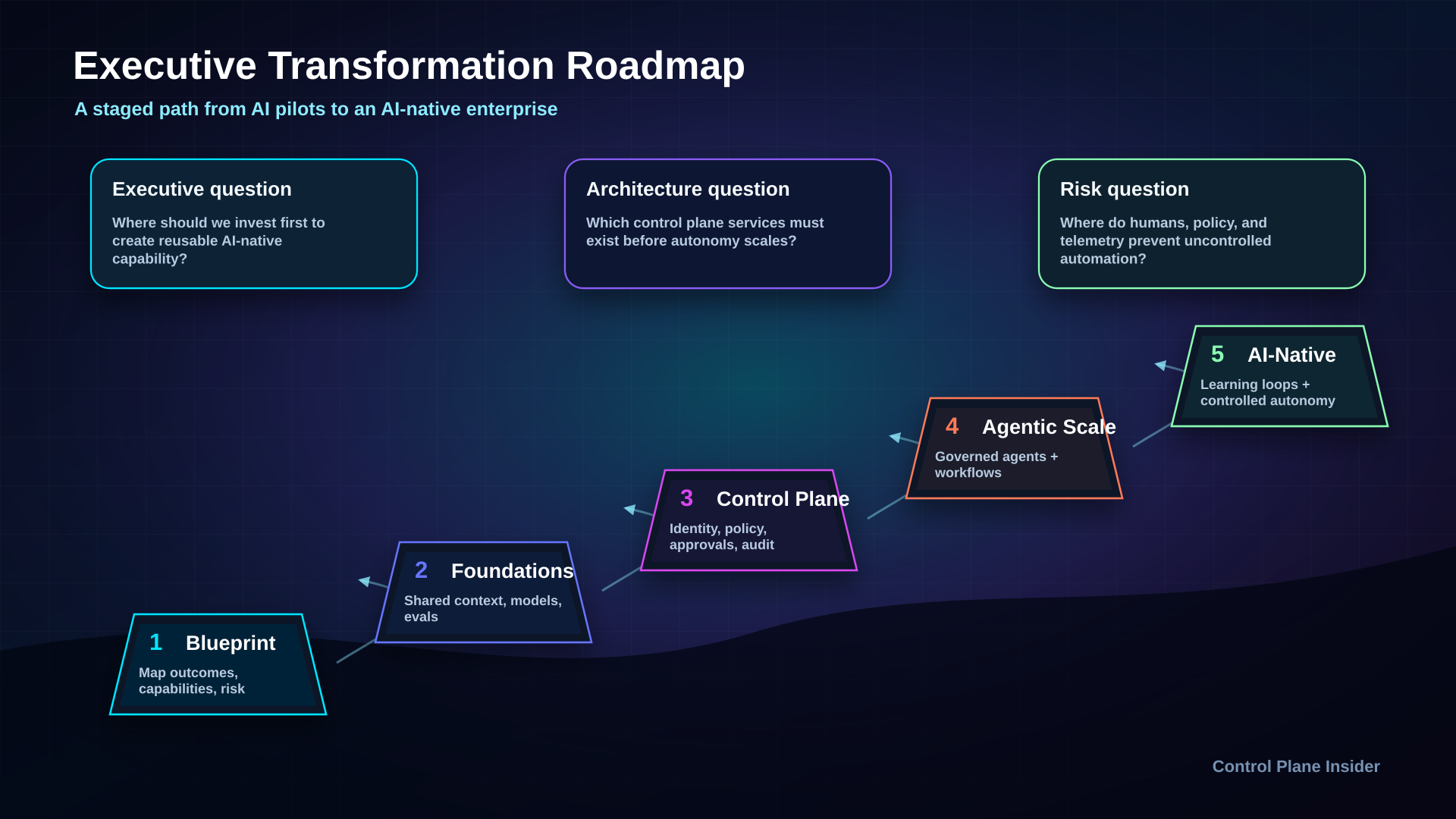
Stage 1: Pilot With Purpose
Select a small number of high-value workflows. Define the business outcome, context sources, model pattern, human review process, and success metric.
The goal is not experimentation for its own sake. The goal is learning what the enterprise must build to scale safely.
Stage 2: Build Shared Foundations
Create reusable services for context retrieval, model access, evaluation, logging, and workflow integration. Establish initial standards for AI usage, data access, and approved tooling.
The goal is to stop every team from reinventing its own AI stack.
Stage 3: Add Control Plane Capabilities
Introduce identity, policy enforcement, approvals, observability, audit trails, and incident response. Begin managing agents as governed actors rather than scripts or hidden automations.
The goal is to make AI controllable at runtime.
Stage 4: Scale Agentic Workflows
Expand from assistants to agents in selected domains. Connect agents to tools and enterprise systems with clear boundaries. Increase autonomy only where controls and evidence support it.
The goal is to convert intelligence into measurable operational leverage.
Stage 5: Operate as an AI-Native Enterprise
Create continuous improvement loops across business capabilities. Use telemetry, feedback, incidents, and outcome data to refine the operating model. AI becomes part of how the enterprise senses, decides, acts, and learns.
The goal is not simply more AI adoption.
The goal is a new enterprise operating fabric.
The Blueprint Deliverables Leaders Should Expect
A strong AI-native enterprise blueprint should produce concrete artifacts, not just slides.
At minimum, leaders should expect:
- A business capability map
- A prioritized use-case and workflow portfolio
- A context and knowledge architecture
- A model routing strategy
- An agent and tool integration map
- An identity and authorization model for agents
- A runtime governance model
- An observability and audit architecture
- Human control and escalation patterns
- A maturity roadmap
- Investment priorities
- Success metrics by phase
These deliverables create alignment between executives, architecture teams, security leaders, data teams, platform teams, compliance teams, and business owners.
They also make the transformation discussable.
Instead of debating whether the company is “doing enough with AI,” leaders can ask where the organization is mature or immature across the nine layers.
That is a much better conversation.
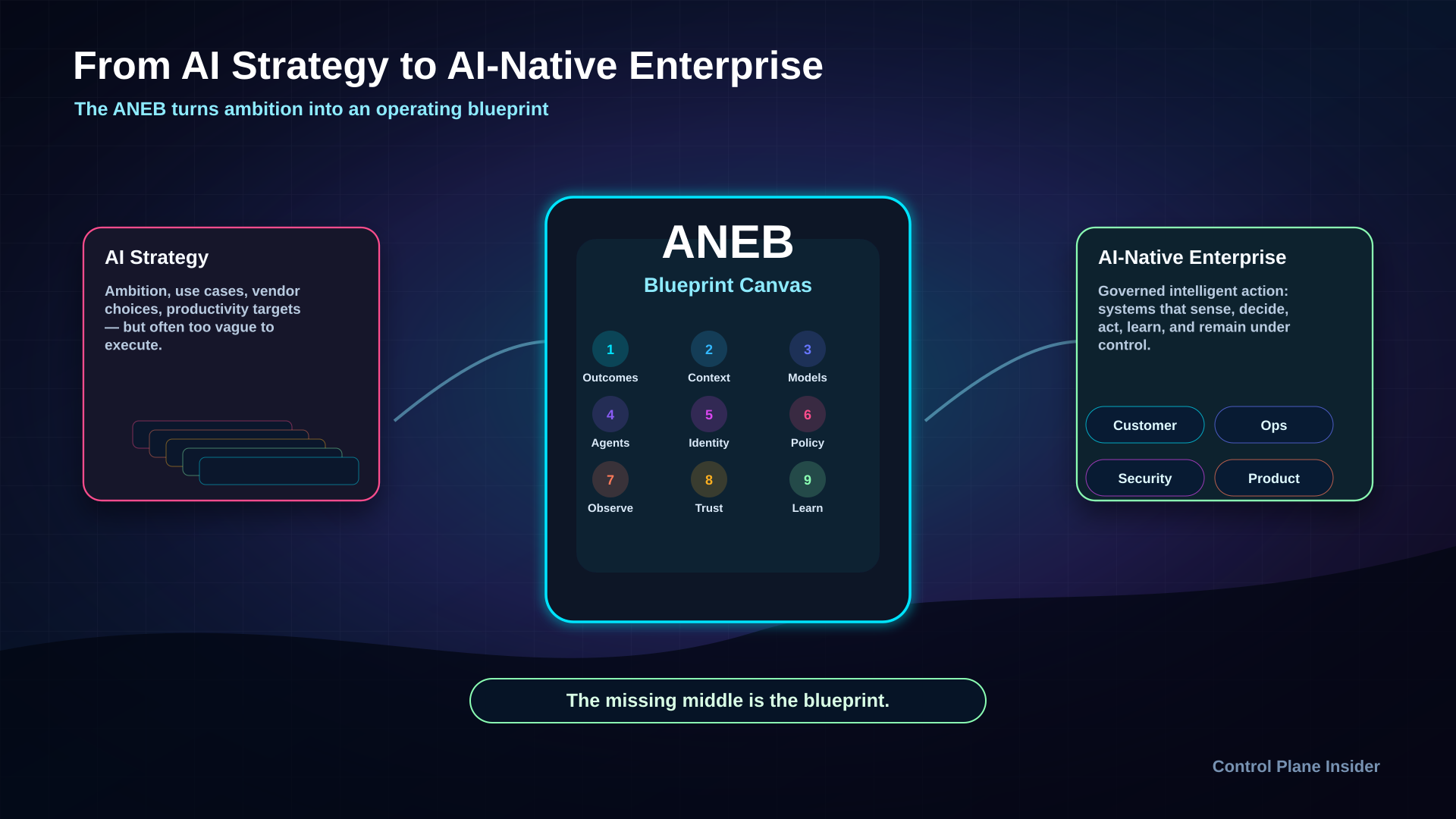
The Real Goal: Governed Intelligent Action
The future enterprise will not be defined by how many AI tools it buys.
It will be defined by how safely and effectively it turns intelligence into action.
That requires more than models. It requires context, agents, identity, policy, observability, trust, and learning. It requires a control plane. It requires an operating model.
The 9-layer ANTF gives leaders a way to see the full transformation surface.
As a framework, it explains what must exist.
As a blueprint, it shows how those pieces connect.
As a roadmap, it sequences how to build them.
The companies that win with AI will not be the ones with the most pilots.
They will be the ones that turn AI into a governed enterprise capability.
That is the difference between using AI and becoming AI-native.